Leave home for three weeks, and look what happens? They drain the canal! JJ was in charge of keeping an eye on it. He has been sacked. Is this the end of the world as we know it, or……?
The Duke of Bridgewater will be turning in his grave.

Leave home for three weeks, and look what happens? They drain the canal! JJ was in charge of keeping an eye on it. He has been sacked. Is this the end of the world as we know it, or……?
The Duke of Bridgewater will be turning in his grave.

 There's a shortcut from the restaurant to the Rote Chumme path. This well graded route led us through columbine meadows under limestone cliffs to a grassy lunch spot where it joins the main Rote Chumme path before its steep final 200 metre ascent to 2600 metres.
 We took the 9.50 am minibus up to Selden, a hamlet at the head of the long Gasterntal valley. The 25 minute ride (we needed to book ahead to get seats) saves a good couple of hours, so is well worthwhile.
We were last away of the disgorged passengers due to my faffing and sun tan creaming, but soon drew ahead of any others as we commenced our 900 metre ascent to the tongue of the Kanderfirn glacier.
The route started gently through meadows where harebells, cranesbills, clovers, campions and crocuses are hanging on until the autumn snows finally dampen their growth hormones. Dwarf pines and juniper abound in the valley, and marmots whistled as we ascended over increasingly rocky terrain to a moraine wall. 'Elevenses' taken here granted us a bird's eye view of an avalanche across the valley down the cliffs of the Doldenhorn.
The cliffs we were heading for seemed very close, and the Gasterntal looked far below, but we still had 500 metres to climb! A well graded path got us there for lunch time, only a little more than two hours after setting out. We were going well in the slightly cooler conditions.
It was a surprise to find a visitors book up at 2400 metres where the red and white path turned blue and white, indicating that glacier skills are advised from this point. We wrote an entry and settled down for lunch in this magnificent spot, perched above the tongue of the huge Kanderfirn glacier.
Sue posed for today's postcard, and we both regretted not having the skills or equipment to safely carry on to the Mutthorn Hut (2901 metres), high up on the edge of the glacier.
Three others appeared from the valley, and three more from the glacier, but we encountered really very few people today.
There's fresh snow above 3000 metres on the nearby mountains. It must have fallen a week ago when it last rained in Kandersteg, and despite the subsequent hot weather this snow has clung on, especially to north facing slopes. First signs of the 2010 winter, I suppose.
The long and fine descent to Kandersteg, some 1200 metres below, took a good four hours, during which time the sky filled with cloud and a cool breeze kept me comfy in the cotton t-shirt that I discovered this morning was the last of my clean clothes. We've been so busy doing the Belgians' laundry that we forgot our own!
We were down in plenty of time to replenish our provisions from the Co-op and enjoy another fine home cooked meal.
All in all, another most pleasurable day out.

The pretty blue flower, 1 to 2 cm in diameter, is abundant hereabouts. We also saw it around Chamonix. Curiously it doesn't feature in my book 'Alpine Flowers of Britain and Europe', published 30 years ago. Perhaps it has flourished since then. It's almost unheard of to find deficiencies in this book, but the correct identification was verified by two separate flower books that we spotted in Aosta a couple of days ago.
There are still some very pretty flowers about, despite the approach of Autumn, heralded by the Autumn Crocuses already referred to in these pages.
Today was another thoroughly summery day. We took the Öeschinensee cablecar then set about reversing the circuit that I found so exhausting last week. I was perfectly ok today, and we managed an extension beyond the sparkly lake by walking up to 2400 metres for lunch some 400 metres above last week's high point but still 400 metres below the Hohtürli Pass.
Two sheep tried to share our lunch, but a nearby flock of yellow beaked choughs (which we would normally expect to intrude) must have had other things on its mind.
The postcard shows Sue at this spot below several glaciers, with Hohtürli and the Blümlisalphütte high above her head, on the horizon. Our lunch was punctuated by the crash of avalanches near the feet of these glaciers. The path follows a lateral morraine, and there are steep drops down to where a huge glacier once flowed. I can recall the moment on my first visit to this spot over 20 years ago - when a rather frightened pair, Dave Scruby and I, turned around in a July snowstorm and returned to Kandersteg. Sue and I turned around today at almost the same spot, but for a different reason - we had never planned to go to the pass, and time was against us.
We found the descent easy, and chuckled as we overtook a mountain biker on a wired section. Then a young calf approached Sue "may I lick your leg?" his little bell jingled. "Of course" replied Sue. Having extracted a mixture of salt, sun tan cream and dead skin from the leg, the calf proceeded to try to untie her shoe laces. Its mother stood nearby, unperturbed. Here the cows roam freely, much like sheep in the UK; dogs wander without need for leads. Strange to contrast this with angry UK cows that trample folk to death.
Finally (for those still awake - and my own level of wakefulness is very low!), thanks Mark A for your comment on yesterday's entry. It's always good to receive your words of encouragement, and despite the paucity of comments at present, I know there are a number of other readers out there.
Enjoy the Great Outdoors, and do take care.
The views are superb on a good day like today, but on a bad day the weather can be grim.
The col is however notorious for the (un)welcome given by the guardian of the Refuge du Col de Balme. We experienced this nine years ago; Pete and Trish were there a few days ago. The guardian had not changed and nor had her welcome. The hut is cold, with damp in the air; there is a menu; one selects one's preferred meal; it's not available; a second choice is made; the guardian becomes aggravated - "why can't you choose something that's available?" Eventually you finish up with soup, the only thing she has got around to cooking today.
Pete and Trish found all this particularly tedious as they were recovering from drinking stream water coming off Mont Blanc. They had done this without realising that the numerous high mountain huts dispose of their effluent by chucking it down the mountain!
Today we returned to Kandersteg by an efficient underground route (aka Autoverlad Lötschberg - car transport through a railway tunnel) to discover the affect of 6 days of 6 Belgians on the apartment we have grown so fond of. Our worries were unfounded, as the Belgians had made a good stab at clearing up after themselves despite the sweltering heat. We have already dealt with all their rubbish, have renewed our friendship with 'ginger', and tomorrow will embark on our new careers as laundry attendants.
What it must be like for Annie and Peter, the owners, we hate to think; even as sort of caretaker visitors we find we have become very protective towards this place...
...as indeed we have towards John and Janet's splendid pad in Chamonix from which we reluctantly departed this morning. Rest assured, everything there is spic and span, with not a crumb in sight.
Anyway, we stopped again at the Col de la Forclaz, this time on the brightest and clearest summer's day imaginable. So we paused for a stroll beside the 'Bisse' - a small canal built in 1895 to channel water from the splendid Glacier du Trient to the col, for use in irrigation on the slopes below. The Bisse (it would be called a levada in Madeira) drops 60 metres on its 3 km journey from its source to the col, but from the Path to Col de Balme it looks as if it rises sharply to the Col de la Forclaz - an optical illusion.
There is no such excitement with the view up to the Col de Balme from the Bisse. As you can see from today's postcard there is no illusion regarding the 900 metre ascent to the unfriendly refuge on the col.
The Alpine flowers are mostly on the wane just now. As you can see from the image, even the Rosebay Willowherb has mostly gone to seed.
But summer reigns supreme - it was 31C when we arrived here on today's perfect summer's day.
Next day

Today's highlight was a visit Les Tines to Mark the Mountain Guide, expert alpiniste and purveyor of children's mountaineering epics.
He is also an outdoors blogger - see:
http://www.markthemountainguide.com/ and http://www.markseaton.com/
We exchanged stories of common acquaintances and all matters mountaineering over tea and cake outside his and Jane's lovely house in Les Tines.
A most pleasurable afternoon, and a delight to meet someone whose exploits we have followed vicariously for some time.
His books are outstanding - essential for the library of any budding junior alpiniste.
We travelled to Les Tines via the Planpraz cablecar, then along the Grand Balcon Sud to La Flégère for lunch, and on down through lovely woodland to Le Paradis (aren't these place names wonderful!) and Les Tines, where the house numbers puzzled us until Mark explained that they represent the distance in metres of each house from the main road.
Before we left, Mark kindly posed with Walter (aka 'Leo') at the request of Andrew, our 7 year old friend, and fan of Mark's books.
The previously clear skies developed a little high cloud today, which made for a wonderfully pink sunset on Mont Blanc, from where paragliders continued to drift relentlessly down.
Today's postcard was taken near La Flégère at lunchtime, and shows Sue chomping under the magnificent backdrop of Les Drus and Aiguille Verte.
Happy Days!
Next day

"It needs an airing" said Janet, as she and John handed over the keys to their flat in Chamonix a few weeks ago.
So here we are, airing it. We've been here for a few days now.
We look out onto the Savoy Fields (nursery ski slopes) and over the rooftops of Chamonix to the pointed snout of the Glacier des Bossons, which draws the eye upwards towards the summit of Mont Blanc.
Today's postcard is this view from our living room window. We are so lucky. Often trainee paragliders can be seen frolicking on the lawn; in winter these are replaced by novice skiers. There's usually a wagtail, crow or pigeon grubbing around in the grass, and lots more to entertain the watcher having a lazy day in the flat.
Yesterday's sojourn in Italy allowed the French skies time to clear sufficiently to justify our catching the Brevent cablecar this morning to its mid station at Planpraz (2000 metres) and enjoying views towards Mont Blanc that we only briefly glimpsed through the cloud on our previous visit.
Even today, these views were hard won, as the cloud slowly cleared from our Grand Balcon Sud trail.
The path to La Flégère is fairly level. We romped along it in an hour and a half. Time for lunch! We've developed a habit of late starts and short days...
The binoculars revealed a procession of 'ants' heading down from Mont Blanc's summit towards the prominent spike of the Aiguille du Midi.
Then it was a gentle 500 metre ascent up to Lac Blanc - apparently one of the most famous walking destinations in the Chamonix valley. The path lived up to that reputation. It was crowded. A lower pond gave excellent views whilst we enjoyed a second lunch, but the vistas from the Lac Blanc area were all a bit much. The sun was too high to allow for any particularly good images, but we tried our best, next to a jovial Englishman with a huge tripod.
Sue's muscle problem forced her to retrace her steps and return via the La Flégère cablecar and a stroll beside the River Arve.
Meanwhile I enjoyed a longer descent via Les Tines - a beautiful route over mixed ground - including some ladders - then lovely woodland, with Mont Blanc all the while looming high across the valley.
During the descent I managed to escape from the multitudes. Over a two and a half hour period I saw just half a dozen people - English mountain bikers. They said they were enjoying it. They were walking their bikes down a gentle slope. For some reason, at that point I was going uphill towards La Flégère!
Sue had managed to acquire some grub, and a salad nicoise was quickly knocked up whilst we oo'd and ah'd at the sight of the sun's shadow slowly slipping up the side of the highest peak in Europe.
Time to turn out the lights.
I have a funny feeling that tomorrow we may bump into somebody we know!
Oh, and Alan, you should be aware that Sue is inclined to accept your kind offer - given its date, presumably to join you on next year's TGO Challenge. She travels light these days, Alan, but sadly does not come without 'baggage'. About 12 kilos, which she assumes you will carry in the manner to which I am becoming accustomed (without protest).
Thanks mate!
Next day
This morning the storm had passed and the sun was shining, so we got back to some 'path bagging'. First, route 2 to the foot of the ski jumps. Their heyday was short, from 1979 to 1991 - a plaque names the winners of an international competition, but since then it seems that Kandersteg has dropped off the international ski jumping circuit. The equipment looks dilapidated but servicable. From above it looked like a 'dry' facility, with a synthetic landing strip and steel runners for skis, but the run off area is just grass, so either a synthetic carpet or a blanket of snow is needed for the jumps to be operational.
Today's image was taken on the way to the ski jumps, a few metres from home actually, with the 2502 metre summit of Bire, to the north east of Kandersteg, looming high above the valley meadows.
We explored the quaint road bridge over which a cross country ski trail passes in winter. There is no summer footpath here, and the bridge timbers are very slippery. Nor is their much evidence of the rest of the ski route. The geography of the village must be altered somewhat when winter activities take over!
Retracing our steps, we enjoyed a variation of the panoramic walk to the west of the village, taking the paths nearest to the cliffs rather than last Saturday's higher route to Höh. Today's route gave better views; all of Kandersteg's landmarks being laid out below us in the sunshine.
We were down in time to enjoy lunch outside the Marmotte Tea Rooms, during which it began to cloud over.
Next, route number 8, a delightful woodland path with a 'vita-parcours' - exercise route - involving various keep fit equipment being placed strategically by the path for fitness freaks.
The sky darkened and before we knew it the rain had started. It lashed down. We sheltered in a very small but conveniently placed brick shelter until the worst had passed, before adjourning to the Co-op and inadvertently purchasing (inter alia) a supply of 'tax paid' rubbish bags that will possibly last Peter and Anne several years!
Then house admin, a lovely meal (cordon bleu chicken - still hanging on from the 1970s), and a dossy evening....
...and that's all for today.
Oh, BTW between the two of us we have now walked 20 of the 60 routes annotated on our 1:25000 map. Target achieved! What next?

The Öeschinensee cablecar whisked us expensively up the first 500 metres (perhaps we should have bought passes, but we didn't expect to be using the cablecars so much), and an easy 20 minute stroll brought us to the lake, where we luxuriated in a restaurant with cold drinks.
It's people watching territory. We observed as family groups and bunches of youths played in the blue boats, jumping in and out of the lake. Clearly my thoughts yesterday that the holiday season was drawing to a close were premature! Sue thought it reminiscent of Nice, but here the bikinis were more like the traditional two piece items, as opposed to the Nice variety with the missing tops.
It was amusing to see the bathing area shared with a somnolent herd of cows - especially as there were lots of dogs wandering about (no traffic = no dog leads). I noticed one bemused animal get a friendly lick from a cow.
Today's picture was taken amidst this scene of domestic tranquillity. I didn't realise at the time, but Sue appears to have been speared by the boatman's canopy!
We'd spent all morning getting this far, and there were paths to bag. So we ambled (and I use the word 'ambled' advisedly) off towards Hohtürli - a high 2778 metre pass that we had no intention of reaching. Our plan was to head up 400 metres to Ober Bergli, then walk back to the cablecar station via a high level belvedere that just HAD to be walked.
Movement in an uphill direction soon became a problem for me. Nausea set in and frequent stops were needed. Heat stroke? (it was 32C even up here), dehydration? - I'd just had a long drink. It was a mystery that Sue attributed to a toboggan ride that I'd enjoyed at the top cablecar station having addled my insides. [It was a good ride, especially for one who has an aversion to braking whilst speeding down such a metal causeway!]
Everyone, yes Everyone, overtook us as we struggled up to our 1980 metre high point, pausing on the way for drink stops, lunch, people coming down wired sections, people overtaking, photos of the view, photos of flowers, and for me to catch my breath and overcome the waves of nausea. I felt as if I'd been wound around a long stick and was being toasted or kebabed under the hot sun.
We made it. Eventually. And our pauses should result in some pleasing images despite the height of the sun and the heat haze. (Here's Sue at our lunch spot above Under Bergli.)
 A fountain (spring coming from a tap) at Ober Bergli was used to refuel our water bottles. Sue's transparent bottle gained a leech; mine is opaquely green; the water was lovely despite any chewy bits.
The path contouring above the lake was a delight, absolutely brilliant - a wonderful path with immaculate views. Blighted initially by aircraft noise, the huge bowl in which the lake sits then reverberated to the melodic sound of an alpenhorn. It became louder as we reached a rocky promontory overlooking the lake. The sounds were emanating from a couple with a huge horn - 10 feet long at least. After listening for a while I was about to record one of their numbers when they packed up the horn (it concertinaed into a package less than a metre long) and wandered on along the path.
By 3.30 we were back near the cablecar. Sue used that for descent whilst I stumbled down path 13, through pleasant woods with cows sheltering from the heat, and steep meadows where locals were busy bundling their harvested grass ready for it to be taken down to the valley by helicopter. (Hire cost less value of grass = subsidy? I wondered.)
Interestingly, from a near cloudless sky at 4 pm, half an hour later the whole sky had clouded over, and by 5 pm the friendly ginger cat had joined us under our canopy to watch the first drops of tonight's storm. We were expecting it.
We need a rest!
Hot summer days in the Alps make initial ascents by cablecar irresistible, so today we used the Allmenalp cablecar again to get us up the first 600 metres, leaving only 900 metres of ascent for the rest of the day (plus a bruising 1500 metres of descents!).
Last week's empty playground was full of children as we passed by at 10 am, a sure sign that the central European holiday season is over. In fact we only encountered two other people doing today's walk - a far cry from yesterday's busy paths.
Even the cablecar 'cheat' and the well graded paths didn't make the stiff ascent up First very easy. It's an extremely steep hillside, so pretty difficult to devise a non-energetic route. The jangle of cow bells slowly diminished as we rose steadily, with Öeschinensee soon coming into view across the Kander valley. A small bird of prey with white plumage floated overhead. (A peregrine, perhaps.) The flowers were wonderful, with huge banks of deep blue monkshood as we neared the summit. It had taken just over two hours.
Time for lunch. It's a narrow ridge, with steep drops, so I strapped my rucksack to my leg! The views were splendid - today's image was taken from here and shows Öeschinensee, with the Blümlisalp massif above it. To the left (top centre) are the Eiger and the Jungfrau, and the white slashes of Kandersteg's dry ski jumps show clearly near the bottom (centre) of the image.
Mont Blanc and the Matterhorn were also in (somewhat distant) view from here.
Poles were stashed for an interesting descent over steep ground, aided in places by wires, and backed by the sound of whistling marmots. With such a fine mountain backdrop it was hard to have to concentrate on 'micro foot placement'!
Difficulties over, we mounted Stand (2320 metres), and admired its gentians before toiling down steep slopes in hot heat to reach Kandersteg around 4.30 pm - in plenty of time to buy beer and salad to enjoy on our patio in the company of a somnolent ginger cat.
We started slowly - I blame the shutters - rising at 9 but then, moving quickly in a relaxed sort of way, we managed to get to the top station of the Sunnbüel cable car, suitable daubed with sun tan cream and ready for a good mountain day, by 10.45.
We ambled off amongst the hordes deposited up at 1900 metres by the crowded cable car. There's a motorable track across the Spittelmatte plateau, but we soon left this to explore the Arvenseeli, a small lake set amongst pines. The narrow path was deserted, with everyone else bashing on along the main arteries. I tried to picture the scene of my last visit to this spot, on skis in March 2006, when we spent some time watching a group being taught about such topics as avalanches, and how to make a snow hole.
Anyway, today there was hardly a patch of snow in sight. We returned to the main drag (hardly a drag in this weather!) and admired the view back over the Spittelmatte towards Kandersteg, hidden in the valley beyond. This is the subject of today's image.
The day rushed on. Coffees outside a busy mountain hut; lunch on a high col - Schwarzgrätli - 2400 metres. Then Sue headed along the airy Höhenweg Ueschenegrat ridge whilst I took a longer route, rising to 2639 metres on a broad unnamed summit overshadowed by a mountain that looks as impossible to climb as it does to pronounce its name - Tschingellochtighorn.
Fabulous views to far corners of the Alps.
Having encountered some slow sections along slippery vertiginous scree, and I reckoned Sue would have been waiting at our rendezvous point for a good hour by the time I got there. I waited there for 30 minutes - no sign of her. 'Must have gone down for a beer' I thought. So I returned to the lower cable car station - a 1300 metre descent altogether. No Sue. Luckily our meeting point was on a narrow toll road, so I hastily drove back up 500 metres to find Sue waiting, unperturbed, enjoying the last of the afternoon sun and pleased not to have to walk down the final 500 metres, much of which duplicated yesterday's pleasant woodland descent.
The shops were shut (we cater on a day to day basis) so we enjoyed a pizza at Pizzeria Antico tonight, before enjoying the stroll home in still warm mountain air, with the fading Alpenglow.
...I think that's where we came in...
PS Pleased to hear you are feeling better, Dot. Robin - I think you'll find things here have moved on a bit since your childhood - you should plan to revisit. (We know of a nice apartment you could rent!) Actually, for a period we were horrified to think that all the scouts may be staying in the International Scout Centre - a huge sort of Alpine Hut/Refuge - but today we were relieved to spot a few tents as well. (Better here than in the Carneddau!)
Imposed on the face of the map are numbers 1 to 60, representing 60 routes varying from short walks in Kandersteg village to multi-day Alpine excursions requiring ropes and ice axes. The back of the map is crammed with information, including descriptions for all 60 of the routes. Tourist Information kindly provide an English translation, so it seems reasonable to start 'bagging' these routes. We are (ie I am) aiming for 20 during our short stay here. And if we return one day to find some of them deleted and new ones in their place, I for one - in true Munroist spirit - will not be at all upset!
We also have Kev Reynolds' excellent walker's guide to the Bernese Alps (Cicerone), but for a holiday based in Kandersteg the above map and translated route guide is all that most people would need.
Yesterday's circuit gained two ticks on the list, and this morning's short stroll to Höh, less than 200 metres above the village, gained another.
The low cloud lifted as we lunched in the sunshine outside the apartment, so this afternoon we took the Allmenalp cablecar (a small DIY affair) up to 1700 metres, to 'bag' two more routes as we rose a further 100 metres, with fine views across the valley to Öeschinensee, before a gentle 700 metre descent back home.
The cablecar trip afforded us a good view of route 56. We won't be doing that on this visit. We had a bird's eye view of both its Tyrolean Traverses (which on closer inspection appear to be optional) - it's a Via Ferrata (Klettersteig) of the harder variety, and we have left our zypers at home.
Allmenalp is a mecca for paragliders - yesterday we could see masses of them from across the valley. But today we were alone in the small cablecar; very few 'fliers' were out due we presume to unfavourable weather conditions, though the ones we did see looked fine.
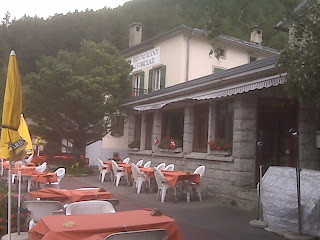
Despite the promise of a sunny afternoon, it never really materialised; the cloud lifted but it remained dull. So today's image is a rather boring snapshot taken in Kandersteg village during our short spell of sunshine.
The journey here did Sue's muscle problem no good at all, but after two days in situ she reports that it is benefiting from some good books (thank you Susan and Hazel), light exercise, mountain air and sunshine.
 Today Sue and I were due to arrive in Saas Grund with a view to continuing our 'Italian Border Route' (IBR) backpack, roughly in the direction of Trieste.
Sadly, Sue's muscle problems mean that at best she can only manage short days carrying no more than a bum bag.
Whilst we do know of someone who backpacks in that style, it's not for us, so our IBR has been abandoned for the time being. Quite upsetting really.
Today Sue and I were due to arrive in Saas Grund with a view to continuing our 'Italian Border Route' (IBR) backpack, roughly in the direction of Trieste.
Sadly, Sue's muscle problems mean that at best she can only manage short days carrying no more than a bum bag.
Whilst we do know of someone who backpacks in that style, it's not for us, so our IBR has been abandoned for the time being. Quite upsetting really.