Sue and Martin in Mallorca 2019

Sue and Martin in Mallorca 2019
On the Archduke's Path in Mallorca

Tuesday, 6 November 2012

A Mandarin at Brooklands

Mandarin Duck (female)

After some lovely weather and lots of photos yesterday (see a later posting) I didn’t bother with a camera for today’s stroll along the canal towpath in the rain.

There’s quite a variety of wildlife in evidence along the canal between Timperley and Sale.  There are always lots of Mallard and Canada Geese, with Black-headed Gulls in the winter.  Swans live here – today just two adults and a juvenile were in evidence.  Moorhens, the occasional Coot, a Cormorant, a Heron and Grey Wagtails are also commonly seen.  The hedgerows sport an active colony of Sparrows, lots of Pigeons and Blackbirds, and passing swarms of Goldfinches as well as mixed flocks of Tits – Long-tailed, Blue and Great in the main.  Dusk brings sightings of our local foxes, so the grey squirrels make themselves scarce then, whilst the water rats and the canal’s stock of large fish are less frequently spotted.

However, today I spotted a duck I’d not seen before on the canal.  It seemed quite happy in the company of a group of Mallards.  I returned home for a camera.  The top picture didn’t match anything in the first two bird books I checked, but my Collins Pocket Guide came to the rescue - the bird is clearly a female Mandarin Duck.

The images below show the Mandarin next to a Mallard, and a typical autumnal view of the Bridgewater Canal in the rain near Marsland Bridge.  The duck was on the Sale side of that bridge if anyone is interested.

The Bridgewater Canal and Marsland Bridge Mandarin Duck and a Mallard

Wednesday 31 October 2012 – The Plodders visit Lud’s Church

Lud's Church - top entrance

Lud’s Church is one of my favourite places, and I enjoy the 11 mile walk that also visits Danebridge, The Roaches and Hanging Stone, so it was a pleasure to be asked to lead this little amble with the LDWA’s East Lancashire Plodders.

The walk starts near the Ship Inn.

There are numerous stories associated with the pub, mainly concerning its name. It is thought that Sir Philip Brocklehurst, a relative of Sir John Brocklehurst who owned nearby Swythamley Hall, sailed with the explorer Shackleton on one of his many expeditions to the Antarctic, as an Assistant Geologist, although history states that he may well have been a paying guest. It was often thought that the sign on the Ship Inn related to the famous Endeavour, from a 1914 expedition, but it depicted the Nimrod in Antarctic Ice. Others say that the Ship is named after another vessel, known as the Swythamley, which was owned by a close friend of the Squire, and that the pub was named in his honour.

The current sign seems to have more to do with Sir Gawain and the Green Knight than with the Endeavour!

The Ship Inn

Despite forecast rain, a good turnout of twelve Plodders - myself, Sue, Reg, Jim, Neil, Nancy, Bernard, Andrew, Paul, Roger, Phil and Allan, assembled at Danebridge for this escape from East Lancashire to the distant land of North Staffordshire.

Plodders setting off from Danebridge

Danebridge

A crossing of the River Dane at Danebridge was first recorded in 1190, where it was known as Scliderford, meaning a slippery ford. In 1357, Sliderford Bridge was constructed.  This was rebuilt in the seventeenth century, using stone. Unfortunately, the new stone bridge was washed away by floods in 1631 and replaced a year later by another, more sturdy, bridge. The present bridge dates from around 1869, and was funded by the two Counties of Cheshire and Staffordshire, with each paying £1,000 for its construction and upkeep.  Materials were supplied by the Brocklehurst family, of Swythamley Hall.

Today’s weather was in fact 'fine', albeit a bit cloudy, and we managed the whole walk without the need for waterproofs.  Meanwhile it rained in Lancashire.  Perhaps we should head south more often!  After a few steps we passed Wincle Brewery - set up in 2008 from a redundant milking parlour - where some of us thought we spotted the shadowy figure of erstwhile Plodder 'R Norman', nursing a pail of beer.  We left him to it and headed up through autumnal woods to gain a view of Hanging Stone, our first objective.
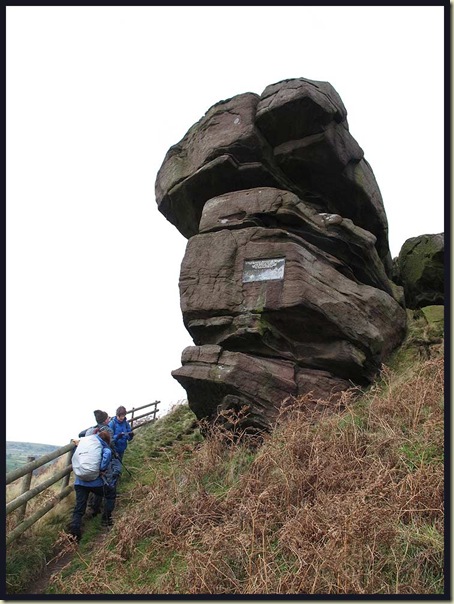
The Hanging Stone

Hanging Stone

The Hanging Stone perches on the hillside like a giant fist, a sentinel overlooking Swythamley, on the Staffordshire side of the River Dane. Swythamley Hall stands in a fine park and was originally a mediaeval hunting lodge belonging to the Abbey of Dieulacres near Leek. The hall was granted to the Traffords by Henry VIII in 1540 and became their home and that of their successors, the Brocklehursts. Unfortunately the original house burned down in 1813, so the modern building is a rebuild dating from then. The Brocklehursts had an adventurous history. As mentioned above, one of them accompanied Shackleton to the Antarctic. The Hanging Stone bears a plaque to Colonel Brocklehurst, who was killed in Burma in 1942. A game warden in the Sudan, he started a private zoo at Swythamley when he returned to Britain, and during the Second World War the animals were released into the countryside because there was no food for them. The wallabies from the zoo survived and bred around the Roaches until recently. In fact there continue to be rare sightings, which have surprised many walkers and climbers over the years.

The plaque reads:
“Lt. Col. Henry Courtney Brocklehurst. 10th Royal Hussars and Pilot in the Royal Flying Corps, 1916 - 1918. Game Warden of the Sudan. Born at Swythamley, May 27th, 1888. Killed Whilst On Active Service, in Burma, on Commando. June 1942.
Horses he loved and laughter, the sun. Wide spaces and the open air.
The trust of all dumb living things he won, and never knew the luck too good to share.
His were the simple heart and open hand, and honest faults he never strove to hide.
Problems of life he could not understand, but as a man would wish to die he died.
Now, though he will not ride with us again, his merry spirit seems our comrade yet.
Freed from the power of loneliness and pain, forbidding us to mourn or to forget.
Erected by his devoted brother – 1949”

There’s a second, earlier stone plaque at the foot of the stone:
“Beneath This Rock
August 1, 1874 was buried
BURKE
A Noble Mastiff
Black and Tan
Faithful as Woman
Braver than Man
A Gun and a Ramble
His Heart’s Desire
With the Friend of his Life
The Swythamley Squire”

Swythamley has been convincingly identified as the castle of the Green Knight of the classic mediaeval poem "Sir Gawain and the Green Knight" and nearby Lud's Church as the knight's 'Green Chapel'. This probably means that the unknown author was connected with Dieulacres in some way.

There is no record of Hanging Stone being used for hanging - the name describes its look rather than its function!  However, it did claim one of our number, as Reg decided a low level stroll would be more to his taste today.  I think he could smell the beer at the Ship Inn, as it later transpired that he had gate-crashed a Rucksack Club party with some luminaries who were known to him, so whilst we were hauling ourselves over The Roaches he was taking a rare break from leading a Plod in order to get sozzled in the pub.

From the top of Hanging Stone, there's a fine view of Shutlingsloe, the 'Matterhorn of the Peak District', and dramatic photos can be gained of those brave enough to stand on the edge of the stone, which overlooks the Cheshire (or should that be Staffordshire?) plain.  We didn't go close to the edge today, for fear of being blown off.  Nor did we spot any wallabies.

Martin, Allan and Roger brave the gale on top of Hanging Stone

Phil led the wind blasted group of Plodders along the ridge that is called Back Forest, high above Roach End Farm, beyond which we employed tarmac for a while to take us below The Roaches to Roaches Gate, where we edged out of Phil's slipstream and headed past a hovering kestrel and a group of climbers, below the BMC's Don Whillans Memorial Hut.

The Don Whillans Memorial Hut, tucked in under The Roaches

We then rose gently up a rocky path to a good spot for lunch with views towards nearby Tittesworth Reservoir, and distant hump of The Wrekin - over 40 miles away.  In the far distance the outline of Snowdonia was also just about visible.

The Roaches

The name Roaches has evolved recently from 'Roches' as the area used to be known only 100 years (or less) ago. 'Roches' is the French word for rocks.

The Roaches Estate, which includes Hen Cloud, was purchased by the Peak District National Park Authority in the 1980s to safeguard the area from adverse development. In clear conditions, it is possible to see much of Cheshire and views stretching as far as Snowdon in Wales and Winter Hill in Lancashire. The Roaches are the most prominent part of a curving ridge which extends for several miles from Hen Cloud in the south to Back Forest and Hanging Stone in the northwest. Nearby are the broad hills of Gun and Morridge.

 Looking out from The Roaches

Hen Cloud rose prettily to our south, but some members of this motley group were more concerned about the presence around us of Rock Climbers.  "Will I mange OK" asked Jim "I have no equipment."  "Oh dear" I replied "the rest of us have ropes and harnesses!"  Perhaps that's why Reg dropped out and went to the pub, but even without his fatherly guidance we did somehow manage to scrabble our way up the vertigo inducing cliffs that led eventually to a lump of white concrete at 472 metres, our highest point of the day.  As leader, I felt obliged to venture as high as I could, but nobody followed - it was windy on top.

The Roaches - 472 metre summit

We then started the long descent to Lud's Church and were soon back in the woods, where a well signed path led us inexorably to the back door of this fine geological artefact.  Only Andrew by-passed the top entrance, shown at the top of this posting, from where we slowly descended into the main auditorium. 

Allan and Roger admire the murals in Lud's Church

Autumn in Lud's Church

Lud’s Church

The natural cleft is over 100 metres in length and over 20 metres high in places. The light of day rarely reaches and damp mosses curl down from the walls. Even on the sunniest of days, it is possible to hear the drip, drip of water from the ferns which cling to the sides of the cleft, which has been identified as The Green Chapel – the very place where Sir Gawain met and battled with the Green Knight one New Year’s Day long ago.

Lud's Church is formed within the thick bed of coarse Carboniferous sandstone known as the Roaches Grit, which here dips northeastwards into the Goyt Syncline. The rocks of this area are traversed by numerous roughly northwest-to-southeast-oriented faults and fracture planes. In addition, weak layers of mudstone exist within the sequence. It is along such lines of weakness that a large mass of the Roaches Grit bounding the northeast side of the rift has slipped slightly downhill into the Dane Valley resulting in the open rift. The age of the movement is unknown but is likely to be post-glacial.

It is believed that the chasm was considered by early Pagans to be a sacred place, most likely due to the phenomenon that occurs on Midsummer Day, where only on this day does the sun's light penetrate deep into the chasm. Lud, known as Nud in Welsh, or Nodens by the ancient Britons, is a major Celtic deity associated with many parts of Britain and with the Arthurian Fisher King and, by way of Sir Gawain and the Green Knight, the Green Man.

The area also has a place in Christian history: the Lollards, who were followers of John Wycliffe, an early church reformer, are supposed to have used this as a secret place of worship during the early 15th century, when they were being persecuted for their religious beliefs. Lud's Church may have been named after Walter de Ludank or Walter de Lud-Auk who was captured here at one of their meetings. A wooden ship's figurehead from the ship Swythamley formerly stood in a high niche above the chasm, placed there by Philip Brocklehurst, then the landowner, around 1862. It was called 'Lady Lud' and was supposed to commemorate the death of the daughter of a Lollard preacher.

A number of climbing routes up the sides of the chasm were pioneered during the 20th century but climbing is now discouraged so as to protect the lower plants that have colonised the damp rock-faces.

In legend, Robin Hood, Friar Tuck and Bonny Prince Charlie are all reputed to have hidden from the authorities within the chasm. Ralph Elliott, local Luddites (known to be active in the area during the Luddite protests), and others have identified Lud's Church as the Green Chapel of 'Sir Gawain and the Green Knight'.

Another legend has it that Lud's Church was named after a horse: supposedly, a huntsman was pursuing a deer and as he followed it on horseback he was led to the chasm. The hunter failed to see the danger but his horse, Lud, did: when the rider went too close, the horse bucked and threw him to his death in the chasm. There are also connected rumours that originate from a similar period in time, suggesting that the hunter that was killed still roams around the woods and the area. It is said that he is covered from head to toe in moss and leaves so the locals called this legendary being the Green Man.

It was a little muddy in places on this visit, but unlike a solo lady walker who appeared to be stalking our party (bizarre, I know, but true) we did find our way past the numerous mossy murals to the front entrance.  Here, tea was taken and the remnants of a cake were shared out (most of it having been eaten at previous halts).
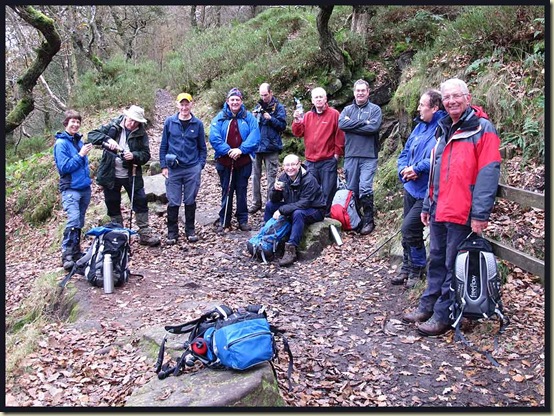
Afternoon tea at the bottom entrance of Lud's Church

From the church, our route casually followed the course of the River Dane, back to Danebridge past a rare breed sheep farm where the farmer’s car registration plates are nearly as interesting as the sheep!

Before reaching the farm, we passed a landslip that in March 2011 looked like this:

River Dane landslip - March 2011

Now it looks like this:

River Dane landslip - October 2012

Interestingly the water was forced by the original landslip to flow on our side of the river, resulting in further erosion and a landslip (unseen in today’s photo) just below the path from which the photo was taken.

Nature at work!

After the sheep farm, we met Reg, stumbling along after his encounter with the alcoholically inclined members of the Rucksack Club.  He seemed pleased to see us, especially when Bernard offered to carry him back to Danebridge.  Then Bernard remembered that he had a bad ankle and changed his mind.  So Reg had to walk.
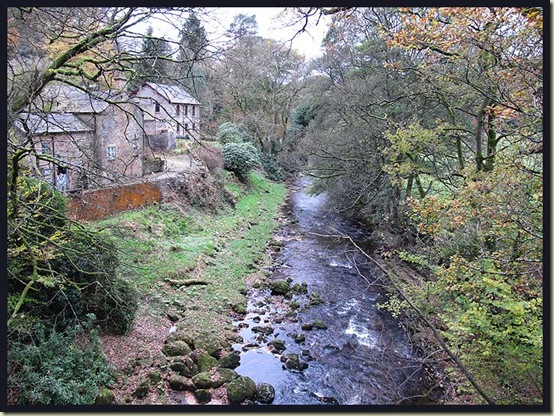
Danebridge

Adjourning to The Knott Inn for refreshments, we had our only real mishap of the day, ten minutes proving to be insufficient time for Roger to get his car into a position whereby it was pointing in the right direction.  Or did he just change his mind and go straight home?  We may never know.

Our route today was about 17 km (11 miles), with 600 metres ascent, and took about 5.5 hours.

Our route - 17km, 600 metres ascent, 5.5 hours

Click here for a 43 image slideshow.

Note: The text in blue has been taken from previous postings and from Wikipedia and other sources.

Sunday, 4 November 2012

Tuesday 30 October 2012 – An Evening Walk

Merchant's Footbridge, Manchester

The plan was to meet at The Old Grapes, off Deansgate, for a walk through the Irwell Valley in Salford as far as Heaton Park – about 10 km (6 miles) in total.

It was a pretty dismal evening.  Meteorologically speaking.

Nobody turned up.  That was no great surprise, but I’d wanted some exercise and enjoyed a beer before leaving what used to be a ‘local’ to my old workplace in Manchester.

The rain eased as I strolled down Deansgate, thereby dissuading me from the temptation to bale out at Deansgate’s Metrolink station!

I was soon in the familiar surroundings of the Merchant’s Footbridge (above) and lock 92.

Ambient light in Manchester means that there is no need to carry a torch on such walks, though the silence of the towpath can be a bit eerie at times.  Today the silence was broken for a while by a noisy funfare next to the canal in Old Trafford.  It was well fenced off, with no canal access, so I heard lots but saw nobody as they were high above me.

I was glad the huge posters attached to the football stadium, glorifying a Scottish pensioner, were distant enough to be merely amusing and not too threatening, though they were by far the scariest encounter of the walk.

It has been a bit wet and windy of late, as reflected by the inner city debris.

The Bridgewater Canal near Old Trafford

As the canal approaches Stretford, there are great night time reflections from the buildings on its banks.  It’s a shame that the standard of my photography at such times is so poor.  This is just a cheap postcard though…

Reflections in Stretford

Heavy drops of rain as I approached Stretford signaled my abandonment of this short excursion, in favour of tram power for the rest of my short journey back to Timperley.

I got my exercise though – a pleasant 7.5 km in an hour and a quarter – much better than slumping in front of our 12 inch TV!*

* Borrowed from Mike as ours went ‘pop’ – with almost perfect timing, the day after we ordered a new one.

Saturday, 3 November 2012

27 to 29 October 2012 – The Annual TGO Challengers Weekend in Fort William

Buachaille Etive Mor from Beinn a' Chrulaiste

Last weekend numerous stalwarts of the TGO Challenge congregated at the Alexandra Hotel in Fort William for an annual reunion bash organised by Les and Issy Silkowski.  And very well organised it was too.

Whilst the majority of attendees were happy to potter about in Fort William*, a few of us chose hills on which to enjoy the autumn weather.  On Saturday Graham Brookes mopped up his last Munro in the area – Beinn Sgulaird, whilst Emma and Stan pottered up Beinn a’ Chrulaiste.  Others may have ventured elsewhere, but I’m not aware of any epics.  On Sunday the rain seemed to dampen enthusiasm, with Emma and Stan perhaps making the best call with their visit to the ice climbing centre at Kinlochleven.  By Monday, everyone either had or was wending their way home, though Emma and Stan were going via The Fara.  Good on them!

All this meant that unlike last year, when Graham B and I walked together, I was on my own for the walking aspect of the trip, which was otherwise highly sociable.  At least that meant I could potter along at my own pace rather than continually battle to keep up with Graham!

Here’s what I got up to:

Saturday 27 October 2012

Parking up at the bridge beyond Spean Bridge before reaching Corriechoille, there was frost and bright autumn colours as I headed along the road before turning up the good track that leads to Rannoch and many other enticing destinations.

Berries nearCorriechoille

The River Spean was low, with a rather monochromatic look in the low sun.  The path to Rannoch is a long one – 26 miles according to the sign.  Much closer, Aonach Mor stood high above the frosty fields and The Grey Corries slowly came into view.

A little way along the path, beyond the turn off to The Grey Corries, I looked up and was surprised to see this gentleman winking at me.

The Wee Minister

After being rather taken back by this unusual encounter, I realised he wasn’t moving.  I’m sure that had he been alive, he would have responded to my greeting, but today his response was by way of a small plaque at his feet:

THE WEE MINISTER
A stone statue of the Wee Minister dating back from the 1900s once stood on a site near here and was said to bring good luck to climbers and walkers.
The statue, believed to be of the Rev. John McIntosh, was destroyed in the 1970s.
However in May 2010 the local tourism group decided to resurrect him and replace him with this replica crafted in cedar wood by Peter Bowsher, champion wood carver.
Good fortune to all who pass this way.

Today’s first hill, Cruach Innse, soon drew close as the excellent track wound its way up The Lairig and onwards to cross Allt Leachdach, beyond which I enjoyed elevenses before forsaking the path and heading up grassy slopes with fine views across to The Grey Corries.

It was quite breezy on the 857 metre summit of Cruach Innse.

Cruach Innse (857m) with The Grey Corries

It’s a short but pleasant ridge walk that cuts down to the south to reach the 593 metre col that divides Cruach Innse from its puny looking neighbour, Sgurr Innse.

However, the Sgurr is quite craggy so more care is needed on this modest hill.  Three ptarmigan kept me company for a while.  They had already dressed for winter, and indeed there was a sprinkling of snow on the summits, but even in winter plumage with no snow these birds are well camouflaged.

Ptarmigan on Sgurr Innse

Sgurr Innse’s 809 metre summit was soon gained.  An eagle soared far above, and whilst the weather was clouding over there were good views across to The Grey Corries, and to the south to the Achallader summits beyond Rannoch Moor.

View south to the hills beyond Rannoch (Achallader area)

Returning down Sgurr Innse’s craggy slopes to the 593 metre col, I then headed directly down to the wide track, and down to the Wee Minister, then past ornate gateposts at Corriechoille, to reach the car minutes before the rain came.

Here’s my route - approx 20 km, 1000m ascent, 5 hours.

My route - 20 km, 1000 metres ascent, 5 hours

Later, some lucky raffle winners are pictured below – thanks go to Ian Cotterill for the image he placed on the TGO Challenge Message Board.  There were some great prizes, thanks to John Manning’s efforts, and those of organisers Les and Issy, whereby TGOC sponsors and friends donated some very generous prizes.  There was even £150 left over after payment of the band (a reason for the raffle) which will find its way into the coffers of Lochaber Mountain Rescue.  Thanks also to John Donohoe for updating those gathered on several TGO Challenge administrative matters, which he conveyed with great humour, as always.

Raffle winners at the Alexandra Hotel

The dance floor (I keep away from such places) later claimed some victims.  The arrival of an ambulance alerted those of us at the bar of a major incident.  Janet was concussed and required an overnight stay in the local hospital, whereas Pauline’s thumb injury failed to hospitalise her.  What the two of them were up to remains a mystery.  I’m sure everyone would wish them a speedy recovery.  When I left the hotel on Monday morning the staff were compiling a claim for compensation for a serious dent in the dance floor!

Sunday 28 October 2012

It was raining, but not too hard, and it wasn’t particularly windy, so I adjusted my plan to one of modest ambition, the ascent of Garbh Bheinn, from Caolasnacon beside Loch Leven.

The path relentlessly ascends 800 metres, over the short distance of 3 kilometres, to gain the 867 metre summit of Garbh Bheinn.

Luckily the cloud base was around 800 metres, so there were views, if not that ‘good’ for most of the way up, especially looking back to the Pap of Glencoe (742 metres) and Loch Leven.

The Pap of Glencoe, from the slopes of Garbh Bheinn

Waterfalls streamed off the back of Aonach Eagach, but there was little to see from the cloud laden summit of Garbh Bheinn.

There was nothing there to give reason to linger, so I turned on my heels and slithered carefully back down to Caolasnacon, and back to Fort William for lunch.  It was still raining.

Here’s my route - 6km, 860 metres ascent, 3 hours.

My route - 6 km, 860 metres ascent, 3 hours

Monday 29 October 2012

A pleasant evening with the small residue of TGOC visitors was followed on Monday morning by some au revoirs as we all headed off after an excellent and highly sociable reunion.  The Alexandra Hotel is an excellent venue.

I parked up near Kings House Hotel, from where the Stob Dearg summit of Buachaille Etive Mor stood proud in the winter sunshine.

Stob Dearg from near King's House

Beinn a' Chrulaiste was my target for this quick excursion on my way home.  Whilst a longer walk than yesterday’s, my 600 metre ascent over 5 km was easy and pleasurable, as I took the good path up Coire Bhalach to reach the minor col that overlooks Blackwater Reservoir, then ambled west then south to reach the broad 857 metre summit.

There were red deer on the summit ridge - noisily rutting today – and the three ptarmigan I saw on Sgurr Innse on Saturday seemed to have recovered my scent up here!

From the ridge there were good views to Blackwater Reservoir and the Mamores; this is a great viewpoint for TGO Challengers as many will be able to trace their routes across the northern horizon.

However, the best views are arguably those across to the summits of Buachaille Etive Mor, pictured at the head of this posting, and below.

Buachaille Etive Mor from Beinn a' Chrulaiste

Panoramic views extending from the Black Mount, across Glencoe, and around to the Mamores, make this summit a brilliant viewpoint.

A vague path leads easily down the hill’s ESE flank and back to Allt Bhalach for the final stroll down to Kings House, of which establishment the path provides a bird’s eye view.

Kings House Hotel

Here’s my route - 8km, 600 metres ascent, taking about 2.5 hours.

My route - 9 km, 600 metres ascent, 2.5 hours

Later.... a Lake District sunset from Tebay Services.

A Lake District sunset from the M6 Services at Tebay

There’s a 49 image slideshow for this trip, click here.

* Some had walked to Fort William.  Colin Tock, for some reason, had arrived from Ardnamurchan, and John and Sue Plume arrived hotfoot from Inverness.  Well done all concerned.

Friday, 26 October 2012

Wednesday 24 October 2012 – Another Curry Walk

JJ and Mick - Runners

We’ve been on Curry Walks before.  A couple of times in my case.  The reports, including route and other details, are hereJJ has been on many more such walks.  He’s a Professional.

Alan arrived first, after receiving invites from both me and JJ.  The carrot had been dangled, and he was selected to test my first attempt at a cake (carrot, of course) for some time.

Coffee and Carrot Cake

It was quite a large cake.

There’s only a sliver left just now.  (Pauses to eat more cake…)

JJ and Viv soon arrived, then Mick turned up on the train from Litchfield.  The walk had been Gayle’s idea, but the fact had escaped her mind, so she was left to work in the Midlands.  She came for tea though!

No sooner had we left the house than we bumped into Rick and Pete.

“Fancy a curry?” asked Rick.

“That’s a fine idea” – JJ led the chorus before setting off at a trot with Mick (see above).

Sue was soon lagging behind, out of breath.

The Bridgewater Canal, by Walton Park

The Sustrans improved towpath of the Bridgewater Canal in Sale is a pleasant place, even on a dull and overcast autumn day like this one.

The Bridgewater Canal in Sale

Striding seemed to be the order of the day – certain members of today’s team may be catching bad habits from their LDWA friends (not the Plodders, of course!).

I suppose it was too early to stop for a pint, though I know how many readers would respond to that comment.

The Bridge Inn

Autumn leaves

After passing through a shrubbery, over the River Mersey, under the M60 motorway, and alongside the Theatre of Dreams, we crossed to the other side of the canal near where a branch of the Metrolink system heads off to Salford and Eccles.

The Metrolink line to Eccles, at Cornbrook

“That’s one of Brindley’s Circular Weirs”  - someone observed - “it’s an overflow weir that takes excess water from the canal and drains it into the River Medlock (in a tunnel).”

This weir and it's companion at Potato Wharf were apparently the first of Brindley’s Circular Weirs, predating those found on the Staffordshire and Worcestershire Canal.  It needed a clean!

Brindley's Circular Weir

We soon reached Castlefield Junction, where the futuristic Merchant’s Footbridge guided us in to our objective, with JJ rather lagging behind at this point.  The pace had got to him?!

Salford Quays

Here the Beetham Tower comes into full view, and the duck house pictured on earlier visits seems to have been moved.

The Beetham Tower Gypsy Ducks

The canal reaches an area that is unrecognisable from a few years ago, with many derelict buildings having been restored.

Lock 92

Eventually, as Oxford Road and Whitworth Street are reached, more modern tall buildings crowd in on the towpath.

Buildings in Manchester

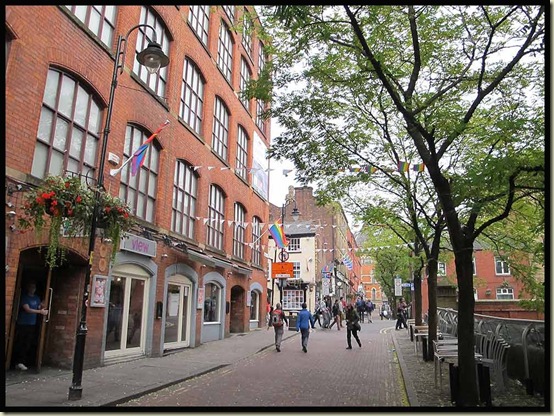
We decided to leave the canal on reaching the Gay Village, as its route to Piccadilly is a little unsavoury at times (see previous postings).  There’s always some party or other going on in the Gay Village – a very jolly place.

The Gay Village

City streets then led inexorably to This & That, in about two and a half hours from Timperley.  The standard fare here is ‘rice and three curries’ – currently £4.40 – and very good it is too.

This & That

Sue had eaten most of hers before I took this photo.

Curry Sue

Alan then stormed off, with the rest off us hot on his heels, to one of his favourite Holt’s establishments, the Ape & Apple, for an alcoholic afternoon whilst he waited for Sheila to finish work.  His beer stained report on the walk is here.  The rest of us joined him for a while before embarking on a variety of tasks (eg Sue and I bought a new television) and reconvening later in Hazel Grove for Mick and Gayle’s excellent slideshow relating their adventures on the Pacific Crest Trail earlier in the year.  There’s no ‘label’ on their reports, but if you start reading here, then move to here and here, and even more recent postings, you could spend an entertaining hour or two…

PS JJ’s report is here – very good it is too.