Sue and Martin in Mallorca 2019

Sue and Martin in Mallorca 2019
On the Archduke's Path in Mallorca
Showing posts with label Gear. Show all posts

Wednesday, 7 July 2021

Gossamer Gear - Lonestar 30 rucksack


Gossamer Gear are supporters of the TGO Challenge, and last year they kindly provided rucksacks for those vetters who wanted one.

The rucksacks have been sitting in Newtonmore, awaiting collection, for a while. Luckily, they were taken to the Park Hotel in Montrose last week, and I was able to collect this nice piece of kit.

The 'Lonestar 30' is a day sack, so I'm not really interested in its weight (a meagre 600 grammes). The nylon material is thinner than the material used for my current Deuter 30 litre day sack, so it's 'floppy' in comparison. Also, the Deuter has more convenient pockets and a raincover.

The Lonestar 30 has the following features:

  • Convenient top lid pocket
  • Drawstring main opening
  • Trekking pole and ice axe loops
  • Hydration sleeve and tube routing
  • Daisy chain and plenty of tie-on points
  • Removable internal stay system
  • Removable belt with pockets
  • Tough and durable Robic fabrics

It doesn't have a raincover or a separate lower compartment for waterproofs. 

I thank Gossamer Gear for their generosity, and will certainly bring this rucksack into use soon, if only to prolong the life of my Deuter Trans Alpine 30 sack that is showing signs of age.


I'll add further comments when I've used the rucksack. The external storage spaces and pockets all look to be a bit bigger than those on the Deuter, so that could be a plus factor in that comparison.

(Meanwhile, in Montrose with Mike Parsons, the old Karrimor rucksacks that Mike designed received many plaudits.)

Friday, 21 May 2021

Waterproof clothing - Mk 1


I suspect it was August 1967 when my dad drove me and Mike, and I think Geoff, who must have taken the photo, to Hollows Farm campsite near Grange (Borrowdale). He dropped us off and collected us a few days later.

It was our first visit to the Lake District, and we set off up Scafell Pikes in the rain. On reaching the summit, we worked out that we were on Lingmell. Oops!

My anorak wasn't waterproof, so my waterproof clothing in this era comprised an ICI fertiliser bag with a hole cut in the bottom to allow breathing. I don't recall Mike P mentioning this form of waterproof clothing in his excellent book 'Keeping Dry and Staying Warm'.

We will be backpacking with Mike P this coming weekend - hence the 'Mobile Posting' test by way of the previous posting. I can reassure him that we have moved on slightly from the ICI bag form of waterproofing, which actually worked very well.

I can't remember whether we got to the top of Scafell Pikes (I think we did), but I can remember watching Mike for some some making futile attempts to catch a trout for supper, as his bag of popcorn was empty.

Thursday, 3 September 2020

The Death of a Fitbit Ionic


On 1 August 2019 I gave a summary of my 'smartwatch'/'tracker' gadgets - here. The latest addition was a Fitbit Ionic, bought in July 2019. That gadget is shown on the left above. On Sunday it 'died'; all the resuscitation procedures that I could find - "press all three buttons", "press … (a selection of buttons for differing lengths of time)", etc produced just an intermittent Fitbit logo, as shown.

A root around in a drawer found its predecessor, a Fitbit Surge, pictured right - the broken strap reminding me as to why it had been superseded. Anyway, I charged it up and it has worked fine in my pocket for the last few days.

Not pictured, is the Garmin 35, on which I reported in that earlier posting. I've used that as my GPS/running watch since the 310XTs both failed, and it currently still looks and behaves as new. My only niggle with it is that it has a very limited pause time of about 5 minutes before automatically ending the activity, so if you pause it you risk having to start a new activity when you get going again. That's fine for an activity like running, but for a walk with a lunch stop in a pub you have to accept that you have to add together two separate activities to get your stats and .gpx files. I've come to accept that, and overall the 35, linked with Garmin Connect,  is a perfectly adequate piece of kit for a reasonable price.

I haven't needed to use the Ionic as a gps gadget, as the Garmin 35 has done that and has better battery life than the Ionic, so it was a bit of a surprise when the Ionic failed after less than 14 months' use. A call on Tuesday morning to Fitbit support (08000698505) resulted in a ten minute wait, then a twenty minute session with an American operative, going through all the resuscitation techniques I had already tried, and more. At the end of that she simply said "I've sent you an email with your options."

The email duly arrived and gave me the (usual - I've been through this before with Fitbit products)option of a new Ionic watch (just the watch, no straps or charger etc), or 50% off a different product. I chose the former, and it arrived this morning, just 48 hours after I'd reported the failure of its predecessor. I can live with that - the new watch is shown in the centre of the above picture, up and running after being charged up and downloading the latest software.

Hard to spot in the picture is the fact that the removable straps ('bands') are on their last legs, so I should have mentioned that when on the phone to Fitbit. Never mind, I've just thrown them a little petty cash for a new strap to go with the new watch. The cheaper non-Fitbit options all seem to get a thumbs down from their reviewers.

Friday, 17 April 2020

Keeping Dry and Staying Warm (Part 1)


Our friends, Mike and Marian, are parties to this tome, that Mike kindly sent me to review.

Here's the authors' take on it:

"A unique must-read resource for outdoor enthusiasts and professionals alike. Gain a better understanding of what you are buying, selling and/or wearing, and blogging or writing about. Despite what advertising may imply, the garment does not do it all for you. Garment performance depends on user understanding of both the materials and usage skills. We develop your understanding of garment selection for activity and weather and the layering skills which are the key to as much as 50% of your garment’s performance.
This probably unrivalled resource is the first ever independent book on outdoor garments. It gives a vital in-depth insight into all the options available to you, using generic words and accepted scientific terminology to ensure we are the most reliable and consistent information source.

Outdoor Gear Coach are a not-for-profit Community Interest Company (CIC), UK based with a USA editor. Our mission is to improve knowledge and understanding of outdoor gear and clothing, including the skills required to achieve best performance."

Here's what I made of it:

"This is a highly sophisticated and detailed treatise on the outdoor clothing, for a wide range of activities, required to enable the wearer to Keep Dry and Stay Warm. The authors and contributors display an encyclopaedic knowledge of everything from coatings and membranes for a range of fabrics, to the complexities of stitching and sizing, the detailed nuances of socks, and rucksack design.

This book should be essential reading for anyone involved in selling clothing for the outdoors, or involved in outdoors training (mountain leadership, for example) or guiding. Outdoors enthusiasts of all creeds will also benefit from the highly detailed knowledge and guidance offered within the pages of the book. That's 119 pages, plus a very long and comprehensive 30 page introduction that could be regarded as a separate chapter in it's own right.

For those wishing to explore subjects in even more depth, there are numerous links to explanatory information and videos."


The book is available from Amazon, here.

Fascinating stuff! Especially for gear enthusiasts.

Thursday, 1 August 2019

Smart watches and GPS trackers

 
Gayle asked why was I using two GPS gadgets recently?
 
GPS gadgets come in several forms. For serious navigation there are numerous hand held gadgets, some of them with maps. I've gone through a few of these - Satmap, Garmin etrex Vista, etc. I've now sold them all on ebay apart from the fairly basic Garmin etrex10 that only gets occasional use. The Anquet and Viewranger maps on my mobile phone (with power pack), with back up paper maps and compass seem to meet my current needs.
 
Whilst I rarely need to know precisely where I am, I do find it useful to know where I've been, so a gadget that records my route that can later be downloaded as a .gpx file to the maps I have on the computer at home, is very useful. It's also good to be able to view 'splits' of times per kilometre when running.
 
The recent such 'watches' I've used are shown above. They were preceded by a wonderful watch called the Suunto Altimax. I used this on our Pyrenees HRP crossing in 2004 and the height information it provided was extremely useful. It's a regular sort of barometric watch with no GPS, and the battery lasts for several years. I wrote about it here. The one I used in 2004 wore out and I bought a new one that I've hardly used. It's due to be ebayed. That's because I have the maps on my phone, and am using one or more of the GPS enabled watches shown above.
 
I bought my first GPS watch, the Garmin 310XT pictured in the middle above, in April 2011, for the above-mentioned purpose - tracking routes so that they could be downloaded later. I've also found the data given on the big screen useful when running. I didn't use the gadget as a watch, simply taking it off after each use and re-charging the battery for next time. The battery lasts for about 12 hours.
 
Meanwhile, Fitbit came on the scene with its sophisticated GPS watches that link to mobile phones using an 'app'. This appealed to me and in 2016 I bought a 'Surge'. The strap broke in 2017 and the whole unit was replaced under warranty. Earlier this year the strap on that one broke - out of warranty. I bought a new 'fit it yourself' strap that lasted a few months, then another one that is pictured on the watch shown above on the far left. Shortly after fitting that, I realised that one of the screw threads in the watch had reached the end of its life - the one on the bottom right shown below, so this repair could only be temporary. 
 
 
So whilst the above watch still functions, the strap problem means that it's a candidate for the recycling bin.
 
So I've replaced the Surge with, second from the left above, the Ionic, which should last longer as it has a replaceable strap. In fact, it comes with two straps! It has more features than the Surge, and seems like a really nice watch. It has a GPS tracking capability, but that drains the battery in a few hours ('up to 10', but I suspect rather less). So I'm happy to use it as a watch - recharging it every few days - leaving the GPS function for occasional use as a back up for the Garmin, which was becoming increasingly unreliable. The Ionic is a really nice watch, and much more - I still have to learn its full capabilities.
 
Back to the Garmin 310XT, another product with strap problems, albeit - at a price - replacement straps are available. However, once the rubber surround gives way, any water ingress gives rise to steaming up and erratic readings. My first 310XT lasted five years - it's the one on the left shown below. It still works, but the strap was transferred to its replacement, an identical model bought in 2016, when the strap on that one broke. As you can see - it's the one on the right below, not only the strap has broken. The rubber surround has given way by the on/off switch, which is now operated with the blunt end of a key. The gadget still works, and I've been using it alongside its replacement, but in future it'll be kept as a back up only, in a dry bag.
 
 
My research into a replacement, the 310XT no longer being available, led me to the £250 Garmin 245. I bought one at a discount and tried to set it up and get to grips with the plethora of settings. After a good two hours, and after trying for ages to turn it off, and failing, I boxed it up and sent it back for a refund. A shame, as it looks a really good piece of kit if you can master its workings.
 
Then I chose the much cheaper (£100) Garmin 35, pictured far right above. With the help of some youtube videos I've been able to (just about) get to grips with this. It provides lots of data that downloads in the background via Bluetooth to the Garmin Connect app where all my trips data is stored. Whilst it could be regarded as unnecessary duplication with the Fitbit Ionic, I'll be using the Garmin 35 only when I'm running/walking/cycling - re-charging it after every use. The battery life in GPS mode is said to be 13 hours. I doubt that's correct, but hopefully it'll be adequate, especially with the Ionic or one of the 310XT watches as back up on a long day out. I will have to get used to having only three bits of data on the screen, compared with the four that I'm used to seeing, and there are other aspects of the Garmin 35 that may take a bit of getting used to. But at least it's easy to turn on and off!
 
Update - 3 September 2020, when the Garmin 35 is still going strong but the Fitbit Ionic has had to be replaced.

Update - March 2022 - Garmin 35 still fine despite the occasional soft reset. Fitbit Ionic recalled due to a propensity to overheat and cause burns. A refund is promised.

Thursday, 13 December 2018

New Trainers

1301asics1

Yesterday I took the opportunity to pop in to Running Bear in Alderley Edge, thanks to their 20% off voucher in the Tatton Yule Yomp goodie bag.

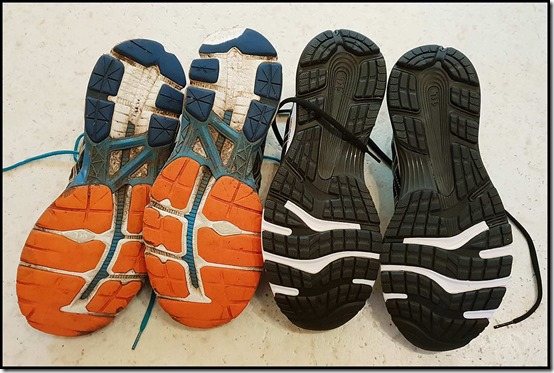
My old Asics trainers have lasted well and haven't come adrift in the usual places such as the heel fabric. The soles are somewhat lacking in tread though. The shoes were duly declared ‘dead’ and have been relegated to a dark corner. My records indicate that they have done around 1100 miles, which I believe is pretty good for this type of shoe. Their predecessors lasted  to about the same mileage. So the obvious choice of replacement was a third pair of Asics shoes, this time their ‘Nimbus 9’ offering. The design does appear to have changed in the 2-3 years since my last ones were bought.

Whilst the uppers and heel and internal fabric of the old shoes are still in excellent condition, the soles have become rather worn, despite being exposed mainly to the grass of Wythenshawe Park.

1302asics2

I hope the new Nimbus 9 shoes match up to their predecessors.

1303asics3

Whilst I was at it I got Sue some Saucony Peregrin shoes that have big lumps (lugs?) on the soles so that she can speed through the slippery grass of the park. I’ll picture them when she uses them – maybe on Saturday.

Saturday, 10 November 2018

Fitbit Dead

This Fitbit gadget was a free replacement for the original Fitbit when the strap on that one broke.

This one still works. In my pocket, so no heart rate monitoring. Not that I pay much attention to that feature.

It's now out of warranty, which is restricted to a two year period under EU rules. It's just one year in the USA, where I wouldn't have got any replacement under warranty, so for that I say thank you to the EU legislators.

Will I get another one? Probably. 

Monday, 15 January 2018

Keen Men’s Targhee II Walking Shoes – Long Term Review

0808keen8

My first acquaintance with this shoe was in April 2011, when I was supplied with a pair for review back in the days when a few retailers felt that reviews from outdoor bloggers, in return for FOC products, might help their sales.

I duly earned my crust by writing a comprehensive review of these shoes, which together with all the relevant technical data, can be found here.

Since then, I have updated the original review and I am now on my third pair of Targhee II shoes. Unusually, Keen seem to have stuck with this product without ‘developing’ it, which must be some sort of tribute, in my mind.

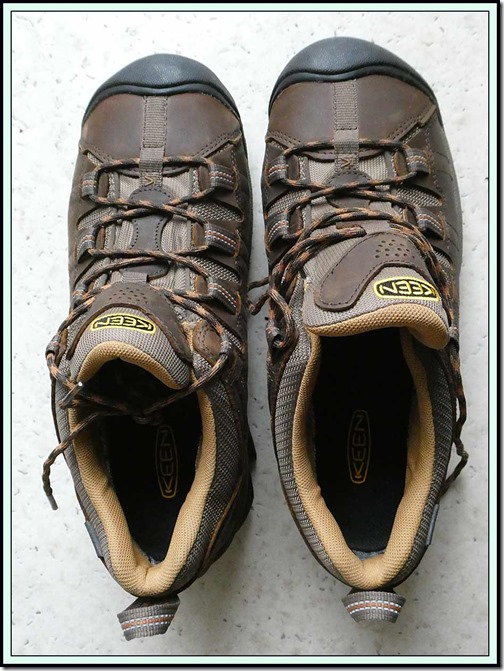
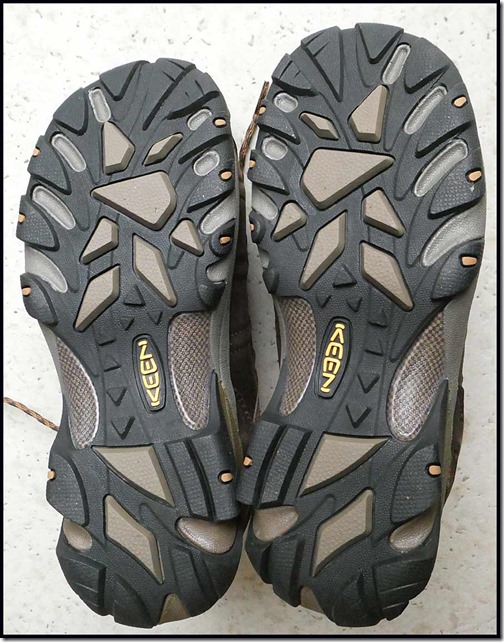
The first three pictures in this posting are of this third pair, bought recently on-line from Mastershoe in Trowbridge for £89.

0809keen90810keen10

Meanwhile, the original pair that was reviewed back in 2011 was ‘replaced’ in 2015 by a new pair bought at MEC in Ottawa (when exchange rates were more favourable than they are today). Those shoes, pictured below, were bought for the purpose of trekking 900 km across the Pyrenees on GR11 (the Spanish route).

0805keen50807keen7

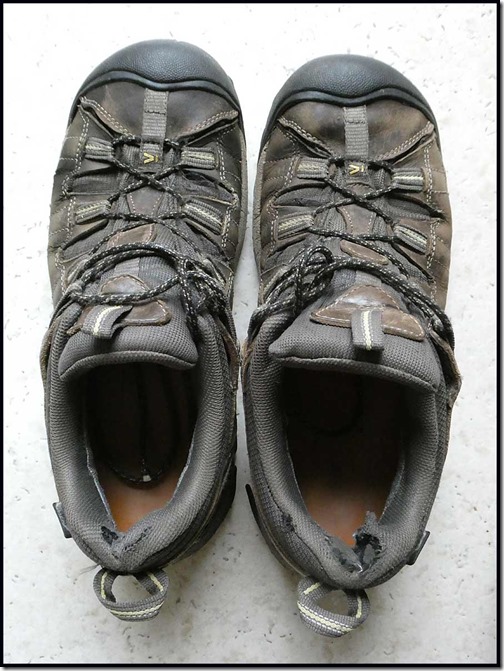
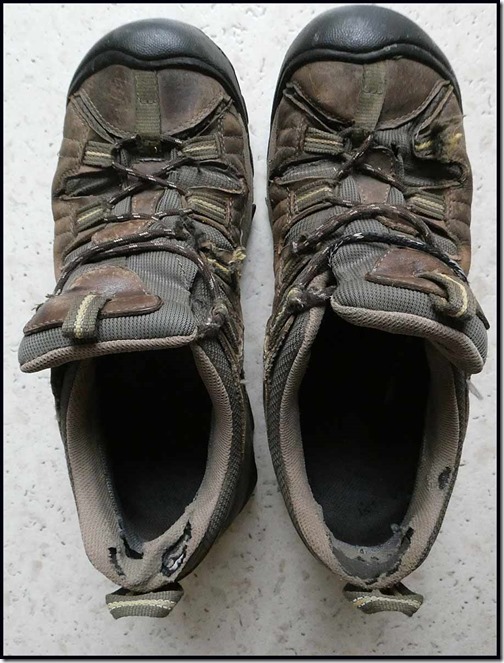
GR11 hardly dented the shoes, which I have continued to wear until the recent purchase from Mastershoe. They have now done 2400 km and are still going strong, but will now be used mainly for mountain biking. The waterproof membrane and the lacing system have remained intact, the main source of wear being on the soles and (shown below) the fabric in the heel area. That won’t have been helped by the frequent removal of the Salford insoles that I use. These are a tight fit and need to be removed to air the shoes properly.

0806keen6

The final four pictures – below – are the last you will see of the original shoes from 2011. These have been worn for mountain biking in recent years, but before that they did clock over 2500 km (1560 miles) of use as trail walking shoes. The main source of wear was the fabric lacing system, and extra holes had to be made to thread the laces. This wasn’t really a problem, nor was the wear on the soles, for use as mountain biking shoes.

0801keen10803keen30804keen40802keen2

As you can see from these pictures, and given that these shoes cost me nothing in the first place, the shoes were pretty worn and owed me nothing, so after these pictures were taken they were recycled, albeit with reluctance.

I’ve noticed a comment on my original review, suggesting that the quality of some Keen products has deteriorated since then. In the case of these shoes, the second (newer) pair seem if anything to be more durable than the original pair. Remarkable, in fact, as the GR11 route was demanding on the shoes, and my track record for both Asolo and Scarpa three season walking boots is that they last for about 2000 to 2500 km, if anything less than these trail shoes.

Conclusion

This is my last review of these shoes, and I’m unlikely to review any other trail shoes as I can’t really imagine that I’ll find a better product. So as long as you can get them to fit properly using a suitable insole, heel cup, etc, I wholeheartedly commend this product.

Friday, 28 July 2017

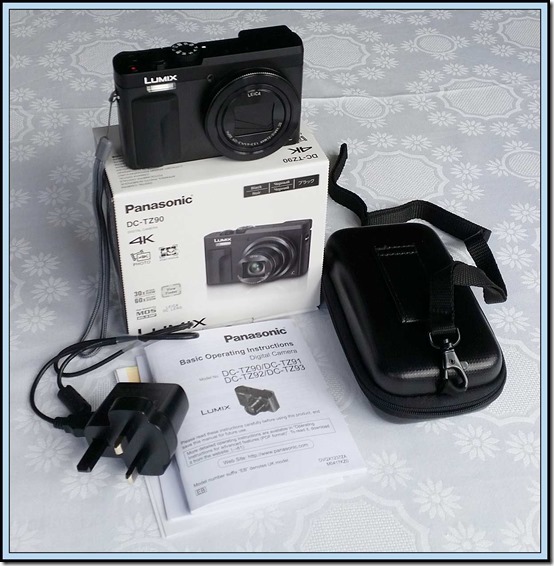
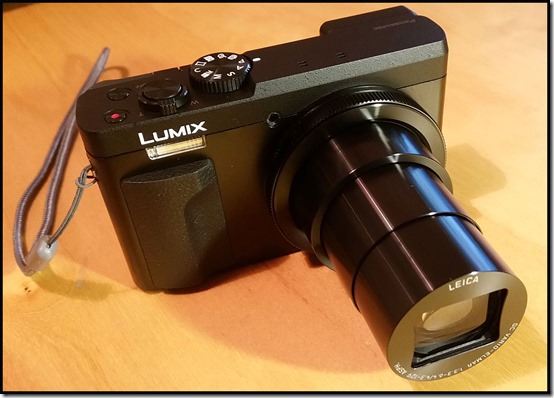
A New Camera - Panasonic Lumix TZ90

2801Lumix

Unfortunately my Canon G16 was injured when I tripped in Austria, giving me the familiar words of death that I’ve experienced on my previous ‘G’ range of cameras:

1128camera21129camera3

It was nearly four years old. I could never get it to talk to our computers, nor would the wifi work, but the camera performed ok. (I don’t regard myself as a photographer.)

I clearly needed a replacement for a forthcoming trip, and an estimated repair cost for insurance purposes. Mike Parsons recommended a company called Wilkinson Cameras, who have a shop in Warrington. So I popped down there on Tuesday, got good service, and bought this new camera, which is pretty much a direct replacement for the Canon, but with a longer lens.

An engineer’s report would be needed for the repair cost of the old camera, but the shop reckoned that could be about £150. For a four year old camera – probably not worth it, but the insurers wanted that information, and my policy gives them the opportunity to apply wear and tear and depreciation costs to any claim. Anyway, I sent all the stuff off to Ageas, who deal with Snowcard Insurance’s claims. We have a £50 excess. The Canon cost £300 four years ago. So I was happy to agree to Ageas’s offer to settle the claim for £250, and the money was sent to my bank on Wednesday. It’s the fourth time I’ve claimed under our annual Snowcard policy, and all the claims have been dealt with in this speedy and effective manner.

You’ll see that I bought a hard case for the new camera. It was a surprise that my old Camera Care soft case didn’t provide sufficient protection for the G16.

Thanks go to Mike for his assistance. There are lots of products out there to choose from, and others will have different requirements from me. I just hope the TZ90 proves as easy to use as the FT4 waterproof camera that I have from Lumix – the images from that aren’t particularly high quality, but it enables me to take pictures on wet days and has accompanied me on a good many TGO Challenge walks.

2802Lumix22803Lumix3

Thursday, 15 June 2017

A Quartet of Ice Axes, including the Camp Corsa Nanotech

A quartet of ice axes
I wonder how many households sport this sort of array of ice axes? Despite not having used mine very much in recent years, I bought a new axe last week.

That triggered this post.

Here’s what you see above:

Number    Date    Name                                      Length (cm)          Weight (gm)
1               1944   Cornelius Whitehouse                     82                       1050

2             ~1970   Stubai                                              80                         950
3             ~1990   Grivel Mont Blanc                           63                         650
4               2017   Camp Corsa Nanotech                    50                         230

1  Probably not so many households contain the first axe, which was kindly given to me by Rodney Cottrell a few years ago in return for a small favour. It may be connected with Frank and Doris Sale, whose photograph album of a 1949 holiday in Zermatt was also given to me (albeit Rodney’s notes say that Frank died in 1948).

There’s a similar axe in the Scottish Mountain Heritage Collection, but I think the one I have is a more authentic example, possibly never having been used in anger.

Cornelius Whitehouse & Sons - makers of this ice axe - were one of Britain's best known manufacturers of wooden handled tools in the early 1900's.

It's no surprise therefore that the War Department asked them to produce a batch of ice axes in 1944, presumably for issue to mountain troops. Loads of gear became surplus to requirement when the war ended in 1945, and it was sold off to an eager outdoor market. Whether or not the original owner of this axe bought it ex WD or was issued with it I have no idea.

 
2  The Stubai axe, made in Austria, was my first axe, used in anger for about 20 years from around 1970. It’s very similar to the War Department axe. I can’t remember exactly when I first used it, but I do recall Jackie Ross, heavy foundry charge hand at Blackett Hutton steelworks in Guisborough, giving me some freshly fettled crampons in the 1960s. I never managed to fit those with straps, but I did soon afterwards buy some crampons (I feel another posting coming on) that are still in use.

Jackie may have inspired some Lake District use of axe and crampons, or I may have first used them in Scotland in the 1970s, when we enjoyed frequent visits to snow clad Munro summits.

 
3 By around 1990, ice axe technology had moved on, and despite the use of much linseed oil I was nervous about the strength of the shaft of the aging Stubai axe. In those days step cutting was a regular feature of winter ‘walking’. (I was never a climber.)

This Grivel Mont Blanc axe has been a brilliant axe and has accompanied me on many Scottish and Alpine trips over a period of almost 30 years.


4  With an Austrian hut to hut trip coming up, during which no significant snowfields are expected to be encountered, I’m a little nervous about the possibility of of encounters with snow filled gullies.

Whilst any such short impasses may be negotiable using walking poles, I prefer the security of an ice axe, used in conjunction with microspike crampons.

The Camp Corsa Nanotech seems to offer just what is needed, for the very modest addition of 230 grammes for this short (50 cm) version. There’s also a saving of 50 grammes, as Sue has pointed out that the trowel I carry everywhere is rendered obsolete by the hole digging qualities of the axe.
So, hopefully a brilliant piece of kit – despite the flimsy pick protection!


With a group of four, just two of these axes between us should be sufficient for the trip, especially if everyone carries microspike crampons.

Tuesday, 10 May 2016

Deuter Act Lite 65+10 Rucksack

0301DeuterActLite1

When I started this blog in 2007 I was using a Karrimor Jaguar 65 litre rucksack for backpacking. Looking through some recently posted old pictures from 1991, the Karrimor sack looks quite new then. I’ve recently used it in South America and on a Lake District backpack. It works fine but it’s showing signs of wear and at 1900 gm it’s a little heavy, especially after rain; these days it seems the old Cordura fabric is quite capable of absorbing moisture. Not bad for over a quarter of a century of use though.

In October 2007 I bought a Golite Quest. It worked well until the hip belt failed after three and a half years. My reviews are here.

After reverting to the Jaguar for a while, in March 2012 I acquired a Lowe Alpine Nanon 50:60. It was fine until a key shoulder strap broke last summer as I was struggling across the Spanish Pyrenees. A botched repair got me home, but the rucksack was then binned. My review is here.

Since then I’ve been happily deploying the old Karrimor Jaguar, and I’ve stopped using Neo-Air sleeping mats, having reverted to the comfort and warmth of an old closed cell Karrimat. The Karrimat wouldn’t fit comfortably inside either the Quest or the Nanon, but it’s fine in the Jaguar.

So I wanted a sack that would take a Karrimat, inside which a dry bag with the rest of my gear can sit. So it needed a bit more volume. After not a lot of research, I shortlisted the Deuter Act Lite range, and the Osprey Atmos 65. Luckily, my local retailer, Alpenstock, stocks both of these sacks. The Osprey has more ‘bells and whistles’ but is heavier than the Deuter equivalent, and it is less stable.

I found the Deuter 65+10 accommodated my gear with space to spare. It may be a bit on the big side if I don’t use the Karrimat, but I do still have an ancient but very serviceable Karrimor Alpiniste 50 litre sack to fall back on, and that has additional large removable side pockets.

So it was something of a no-brainer. The new sack is a bit heavier than its Golite and Lowe Alpine predecessors, but it seems to be of a more robust construction. Time will tell as to its durability. It’s made of ‘Ripstop 210/Duratex Lite’ and it weighs 1900 gm, the same as the Jaguar.

There’s a highly adjustable back system.

0303DeuterActLite3

The hip belt pockets are quite roomy.

0305DeuterActLite5

Here’s a close-up of the Vari Quick back system.

0306DeuterActLite6

There’s actually a second shoulder strap fixing point, so if one of them breaks…. my Lowe Alpine experience won’t be repeated.

0307DeuterActLite7

The hip belt looks very secure. Hopefully my Golite experience won’t be repeated.

0308DeuterActLite8

Here’s what Deuter currently have to say about this product:actlite65

deuter act lite 40 10 back system

Selling Price
£140.00
Size
H x W x D: 86 x 36 x 32 cm
Volume
65 + 10 litre
Weight
1900g
Colour
Granite-Fire
Description & Details

Our freshly revised, sleek packs remain true to their lightweight credentials with their minimal weight and purist, technical design, the ACT Lite models are the perfect companions on any trekking and mountaineering tours. The new, very technical shoulder strap construction features a bilaminate foam and an exact anatomical shape.

  • Stretch front pocket
  • Compact bilaminate construction with Pull-Forward function makes the hip belt easy to fasten even with heavy loads
  • Vari Quick back length adjustment with two-layer foam construction and optimised shape
  • Anatomically shaped shoulder straps with soft edges
  • Lightweight multi-chamber aluminium X-frame
  • Separate bottom compartment
  • Height adjustable lid
  • Lid pocket
  • Internal valuables pocket
  • Zipped pocket on hip belt for valuables
  • Gear attachment loops on lid
  • Ice axe and hiking pole loops - also for foldable poles
  • Spacious stretch side pockets
  • Compression and load adjustment straps
  • Double layered base
  • SOS label
  • Hydration system compatible
  • Loops for helmet holder (accessory)
  • Wet laundry compartment
Back System
Aircontact System

Features

  1. Stabiliser straps allow optimal positioning of the backpack. These are easily repositioned on the shoulder straps using a “Triglide“ buckle. Aircontact models above 50+10 SL sizes also have two different fixing points, depending on the back length setting, in order to optimize the load adjustor strap angle.
  2. Breathable padding with special ventilating hollow chamber foam: With every movement, a pump effect circulates air through the breathable Aircontact cushions of this direct body contact system. Extra air channel ventilation between the back cushions is very effective. (on ACT Lite)
  3. The anatomically shaped hip fins are made from multiple layers. The inner side has a layer of soft foam with 3D AirMesh lining for heightened comfort. The firm foam on the outside is modelled to the anatomic shape and transfers the load to the hips. Side compression straps on the fins regulate the load and increase stability. On the compact ACT Lite fins this bilaminate construction is perfectly balanced between weight reduction and load transfer ratio. Aircontact models designed to carry heavier loads, maximise stability and load transfer thanks to the additional synthetic reinforcement in between foam layers.
  4. Head molding provides freedom of head movement. Effective on models Aircontact 50+10SL and up.
  5. Contoured shoulder straps with 3D Air mesh lining.
  6. Vari-Quick system for easy adjustment to any back length.
  7. The anatomic profiled X-frame offers a balance of torsional rigidity and flexibility to follow your body movements, and transfers weight through it's perfect back fit.
  8. All Aircontact models are fitted with Deuter’s Vari Flex System, leaving the generous hip fins fully mobile. The Vari Flex hip fins follow even the most complex movements allowing tricky sections to be negotiated without losing your balance – especially important when carrying a hefty load.

Lots of more detailed reviews are available, not necessarily showing this rucksack as a ‘best buy’. But having compared it with others, I think it’s suitable for my requirements. I hope so, and it’s going to be thoroughly tested over the course of the next two weeks.

I’ll add to this posting during the course of this rucksack’s life…

Friday, 24 April 2015

Tilley Endurables Limited

1902tilley2

I wrote about ‘A Tale of Three Tilleys’ on 1 March 2010. That posting contained images of my old Tilley hat, and a bright shiny new one provided by Cotswold. The new one looked identical to the hat shown above on the left. To its right, and below, is that same hat (the one pictured as new in 2010), now looking like the five year old hat pictured back then.

Last week I trotted back to Cotswold with the worn out hat. Unfortunately they were unable to give me a new one. This time they referred me to Tilley’s website. How times have changed! But not that much. It was easy to locate and print the requisite returns note and put the hat in an envelope to Tilley Endurables Limited together with a cheque for £6 for postage and packing.

The hat on the left arrived by return of post.

If I survive another five years, I have little doubt that the hat on the left will look like the one on the right, as each of my previous three hats seems to have lasted just about five years before disintegration has set in. Had I needed to buy the replacement it would have cost me £65 (up from £51 five years ago).

A big thanks to Tilley, therefore, for honouring their lifetime guarantee for the third time. This really should be some comfort to those shelling out £65 for their first hat. You can do it in the knowledge that the one-off payment will secure ‘a hat for life’, even if it may occasionally need replacing free of charge if it wears out.

The hat, by the way, is an excellent product – an item I wouldn’t be without for summer walking. The best you can get.

1903tilley3

Wednesday, 12 March 2014

Scarpa Mustang GTX Boots

1201boot

It’s a while since I bought my Scarpa Infinity GTX boots, one pair of which is still going after over 2,400 kilometres. Since buying those I’ve gone through a pair of Hi-Tec’s top of the range offering.

With the TGO Challenge coming up, and my usual plan to keep my feet dry during that 220 mile walk across Scotland, a new pair of boots was in order. Scarpa have moved on from the Infinity, but Jose and Hugh at Alpenstock in Stockport assured me that the Mustang was their current successor. That was a few months ago, so the Scarpa product range may well have moved on again since then! But at the time of writing this link provides some technical data.

The boots stayed in their box until our recent weekend in Wales, during which they enjoyed 33 km under my new MEC gaiters. I can now put the boots away until that big walk in May (or a Lakes backpack over Easter) as they already fit like slippers, and the old Infinities remain fine for day walks.

I do hope these Mustangs will be as durable as the Infinities. I’ll be using Sidas insoles with them and will report back in due course.

1202boots21203boots3

The boots weigh in at 1480 gm including insoles, marginally lighter than the Infinities. Retail price is about £160, on which at least a 10% discount should be achievable.