Sue and Martin in Mallorca 2019

Sue and Martin in Mallorca 2019
On the Archduke's Path in Mallorca

Friday, 7 July 2017

Sunday 2 July 2017 – The Clwydian Hills with SWOG

0201famau01

Sue and I have been involved with Stockport Walking and Outdoors Group (SWOG) for the best part of ten years, but this was our first Sunday walk with them.

After rejecting the Berwyn route that I reccied with him (on the grounds that a finish after 8 pm would stretch his credibility as a walk leader), Cary chose the Clwydian Hills for today’s excursion. We met him at Loggerheads after coffee in the Visitor Centre café, leaving our car there to give drivers a lift back to their cars at the Moel Famau car park later.

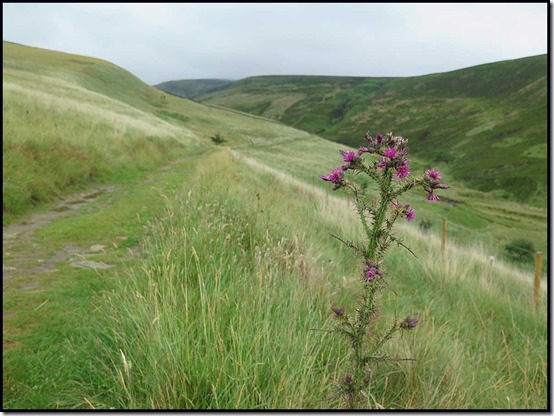
Setting off at 11.00 am, our select group of thirteen was soon enjoying views down to Ruthin and far beyond, from the slopes of Moel Famau (pictured above).

There were lots of folk heading up Moel Famau. Here’s a view looking back from near the summit.

0204famau04

By the time he had reached the tower that crowns the hill’s summit, Mark was suffering from third degree exhaustion.

0207famaumark

Moel Famau's Jubilee Tower dates back to 1810, having been erected for the golden jubilee of King George III – aka Mad King George. A crowd of 3000 people apparently assembled for the laying of the foundation stone. The column fell down after about 50 years, but the rest of the tower has survived, and has been stabilised following some recent repairs.

At 554 metres, it's the highest point in the Clwydian Hills, and it lies on the route of the Offa’s Dyke trail, along which our walk progressed all the way to Moel Arthur.

0212famau12

There are good views to Merseyside and beyond. From Moel Famau, our path continued, minus grockles and drones, towards Moel Arthur on a good surface with remnants of ancient hilltop forts in constant view.

0214famaudepart

Steve, training for the Yorkshire Three Peaks walk, led the way, and the scenery was enlivened by the ubiquitous bright purple Bell Heather, mixed with yellow flashes of tormentil and splashes of the small white flowers of crosswort, as well as ubiquitous foxgloves.

0217bellheather

The summits of Snowdonia could be picked out on the horizon. (If ‘not quite’ in this picture! See the slideshow.)

0218view1

Lunch was taken in view of Moel Arthur, no doubt once the site of an ancient fort. You can see the circular ‘path’ around the scalp of the hill, which may indicate the walls of a fort. The direct line of approach to the summit that Mark and I took later is obvious; the others all took a longer but gentler route that you can just see to the right of Sue’s head in the picture below.

0223lunch1

However, the principal source of interest during lunch was an array of birds of prey. Nearby, a kestrel was minding its own business, hovering; buzzards were on a family outing, their mewing perhaps showing irritation in that smaller birds were dive bombing them; a lone red kite was touring the area, speeding away from any minor irritation. That was all after a conspiracy of ravens had abandoned the area as we approached.

0224lunch2

There was also a snake in the grass!

0226snake

A peculiar looking aircraft flew over. Apparently it takes wing parts to the aerospace factory in Toulouse.

We descended sharply to a minor road.

0228descent

Mark and I ascended even more sharply to Moel Arthur. Time for another snooze for Mark. Chester soon turned up to guard him.

0234mark2

There was a good view back to Moel Famau from Moel Arthur.

Whilst others took an illegal route across a field, I took a long way round and was quite a long way behind by the time I passed the small summit of Moel Plas-yw, from near which point the following picture was taken. It was a lovely day to be out.

0236pathview

I caught up with the others as they tackled a short section of jungle. Most people seemed to be coming the other way, but Mark and I persevered and managed to get through after about 100 metres of intricately threading ourselves through the fallen trees. After waiting for a while, we assumed the others must have chosen another route, and we continued on easy paths for three kilometres or so into the hamlet of Cilcain. The White Horse Inn saw to our needs, and we enjoyed a quiet forty minutes with jugs of cold lager before the rest of the party emerged from the undergrowth.

Tales were concocted and exchanged, and glasses were eventually drained.

0238pub2

There was no chair for our esteemed leader, Cary, who was very thirsty.

0239cary

After an idyllic hour outside the pub, we dragged ourselves off and were soon heading away from Cilcain towards Pont-newydd.

0240pub3

The final section of the walk was along a leete to Loggerheads, past this mine entrance - note the people on the path below us.

0241mine

The 'leete' was a lovely contouring path in pretty woodland that presumably used to be accompanied by running water. Today the only sounds apart from our own emanated from numerous small birds of many different breeds.

0243leete2

There were giant caverns leading to mine workings. I ventured into one of them and only noticed the ‘danger of death’ signs as I returned to daylight…

It was nearly 6.30 by the time we reached the café where Sue and I had earlier enjoyed a coffee and left our car.

Loggerheads: from where the car drivers were returned to their vehicles whilst others chilled out for 15 minutes.

0247loggerheads

Most people then went home, I assume, but Sue and I opted to pop in to a pub restaurant across the road.

Here’s my route (click on it for a larger version) – others went slightly different ways. It was about 21 km, with 750 metres ascent, and took about 7.5 hours including 2 hours of stops.

0299route

Note that the jungle section was through the woodland at the very top of the route map. Cary led most of the group around a track to the west that may not be on my map, to regain the public footpath route that Mark and I took.

Here’s a slideshow with more images.

Wednesday, 5 July 2017

Saturday 1 July 2017 – Wythenshawe parkrun number 295

0101ron

Jan and I were fed up with witnessing Ron Carter’s impressive sprints to the line. His PB is 26.02, so we ganged up and tried to pace him to a new personal best, and maybe slow down his final sprint.

The first kilometre went well, but sadly left Ron a little out of breath. We continued to encourage him, and were hopeful that his final sprint would do the trick.
After nearly 4 km, on the second lap around the football pitches, I looked back and saw Sue about 50 metres behind us. She shouldn’t have been there; her PB is a minute and a half slower than Ron’s.

Anyway, I dropped back to encourage her to move up to Ron. I expected a load of abuse, and was a bit gobsmacked when she complied with my instruction!

Returning to help Jan goad Ron to as good a time as was possible on the day, Sue was left to her own devices. We shouted encouragement to Ron along the lines “Speed up, Sue’s just behind you!” Ron didn’t believe us. Sue overtook him. He sped up, overtaking Sue in the finishing straight with his customary (but a bit slower than usual) sprint.

Sadly he missed his PB by 33 seconds. But on her 71st run at Wythenshawe, Sue’s time of 26.37 obliterated her previous best by 43 seconds.

Keep taking the tablets, Sue!

0102sue

Many of us then enjoyed the customary gathering in the Courtyard Tea Room.

0105pan

Full results are here.

Tuesday, 4 July 2017

Summer Fruit Millefeuille

3003cake3

The last day of June provided an appropriate occasion to test this recipe from Delia Smith’s Summer Collection.

It was excellent, a view hopefully confirmed by our guests, R + J + M.

The recipe is here. We used a purchased roll of puff pastry to make life easy.

Also, advertisement free, see the annotated version below:

Ingredients

5 oz (150 g) raspberries, hulled
5 oz (150 g) strawberries, hulled
2 oz (50 g) redcurrants, stalks removed [We used blueberries as Sue doesn’t like redcurrants.]

For the caramelised flaky pastry: [we used one roll of bought puff pastry]

4 oz (110 g) flour with a pinch of salt added
2½ oz (60 g) butter, weighed carefully (too much makes too soft a pastry), wrapped in foil and left in the freezer for 1 hour
1 tablespoon lemon juice
1 egg, beaten
2 level tablespoons icing sugar

For the pastry cream filling:

1 large egg, plus 1 egg yolk
1 oz (25 g) caster sugar
7 fl oz (200 ml) whole milk
¾ oz (20 g) plain flour
¾ teaspoon pure vanilla extract

To finish:

5 fl oz (150 ml) double cream
1 rounded tablespoon caster sugar
icing sugar for dusting

Equipment

You will also need a baking sheet, greased.

Method

To make the pastry, first sift the flour and salt into a bowl, then take the butter from the freezer and, holding it with foil, dip it into the flour and grate it on the coarsest blade of a grater – dipping it into the flour once or twice more until it is all in the bowl.

Now take a palette knife and flick the flour over the grated butter, cutting and tossing until the flour and butter look evenly blended.

Next, sprinkle in the lemon juice, then, using your hands, gently bring the dough together, adding a few drops of water to make a firm dough that leaves the bowl clean. Wrap it in a polythene bag and chill it in the fridge for 30 minutes.

Meanwhile, pre-heat the oven to gas mark 7, 425°F (220°C).

Next, take a rolling pin and a tape measure, and roll the pastry out to a square measuring 12 x 12 inches (30 x 30 cm). [More like 26 x 36 if using bought puff pastry.] Using the rolling pin to roll the pastry round, carefully transfer it to the baking sheet.

Prick the surface of the pastry with a fork thoroughly and brush it all over with beaten egg, then place the baking sheet on a high shelf in the oven and bake for 10-12 minutes – but do watch it carefully (no answering the phone etc) because ovens do vary.

What you need is a very brown, crisp finish. Then, to get it extra crisp, pre-heat the grill to its highest setting, sprinkle the pastry with 1 level tablespoon of the icing sugar and then literally flash it under the hot grill – don't take your eyes off it till the sugar caramelises, which it will do in just a few seconds.

Remove the pastry square from the grill and, using a sharp knife, cut it into three equal strips.

Turn them over, sprinkle the rest of the icing sugar over, and flash them under the grill once again. Once the pastry has cooled on a wire rack, it is ready to use and can be stored in a polythene box with each layer separated with a strip of silicone paper (parchment).

The pastry is very delicate, so handle it carefully, but if any strips do happen to break, don't panic – you can use them as bottom or middle layers of the millefeuille. [Using the bought pastry, the strips didn’t break, but a bit more ‘pricking’ was needed half way through the baking process.]

To make the pastry cream, break the egg into a medium-sized mixing bowl, then add the egg yolk and sugar. Next, put the milk on to warm over a gentle heat while you whisk the eggs and sugar together until the mixture becomes thickened and creamy – about 1 minute with an electric hand whisk on the first speed. Then sift in the flour and whisk that in.

Now turn the heat up to bring the milk to boiling point and then whisk the milk into the egg mixture. After that return the whole lot to the pan and continue to whisk, this time with a balloon whisk, over a medium heat until the mixture becomes very thick – keep the whisk going all the time because the mixture can catch very easily if you don't.

As soon as a bubble on the surface bursts, remove the sauce from the heat and quickly pour it into a bowl, then stir in the vanilla extract.

Cover the pastry cream with cling film to prevent a skin forming, and leave it to get completely cold.

When you come to assemble the millefeuille (which shouldn't be before about an hour before you want to serve it), whip the double cream and caster sugar together till fairly stiff, then fold the pastry cream into it. To assemble, place the bottom layer of pastry on a suitably sized plate or board and spread it with a quarter of the cream.

Top this with half the fruit and a further quarter of the cream.

Now place the next layer of pastry on top, pressing it gently down to fix it in place, and cover this with another layer of cream followed by the rest of the fruit and the rest of the cream.

Finally, arrange the last layer of pastry on top, dust with icing sugar and serve cut into thin slices using your sharpest knife. [Serrated bread knife was ideal.]

Delicious!

Monday, 3 July 2017

Thursday 29 June 2017 – A Visit to the Museum of Science + Industry

2904crossley1

During our ‘curry walks’ into Manchester, JJ, Rick, Alan and I hatched a plan to walk around the museum, as opposed to walking into town. A date was finally arranged but sadly JJ had to withdraw at the last minute, leaving the three of us to enjoy this educational outing.

Starting with the cafeteria, we moved smoothly into the Air and Space Hall, where the vehicle pictured above, a 1929 Crossley Shelsley, caught my eye. The vehicle was named after the Shelsley Walsh hill climb, that Crossley vehicles first entered in 1910, and won in 1912. The car cost £495, the price at that time of a large semi-detached house.

The hill climb is still thriving, as recently evidenced.

The star exhibit in this hall is the English Electric PIA experimental jet plane. I’ve described this on a previous visit.

2901museum1

The triplane pictured below is a mock up constructed by apprentices, of an extinct model.

2903triplane

Crossley is a local company. Although they didn’t produce many cars, and readers may only be familiar with the name in connection with the commercial vehicles on which they concentrated after 1938, Crossley did make this 1935 Crossley Regis 6. It looks a bit like a Riley to me. It cost £365. The cheaper Ford cars were then retailing for around £100. The Vulcan like aircraft behind it is a one third size version that was used for testing purposes.

2906crossley2

YAK tried to emulate Land Rover. Without success. The ‘Electric Blue’ milk float was specially commissioned by Benny Hill* after his horse died. It reached speeds of around 60 mph!

2908yak

Lots of locomotives were used on private colliery lines. Agecroft features here.

2911train

Local companies like Mather + Platt and Ferranti feature in the museum, as expected, as well as national organisations.

2910mandplatt2913BRlogo

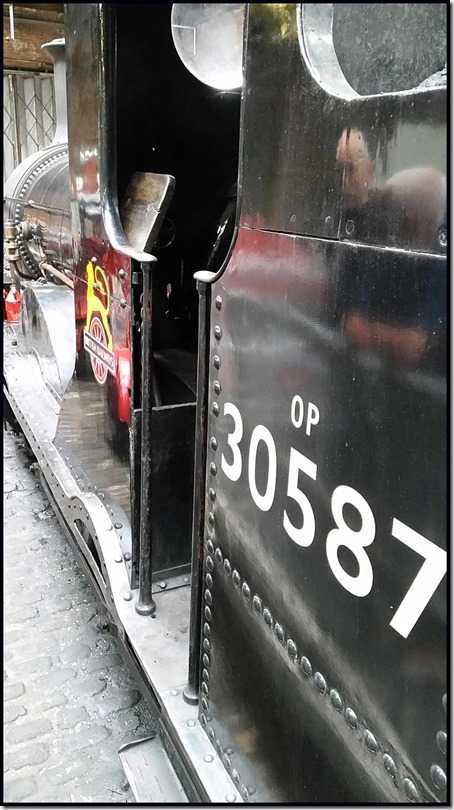
The Beattie Well Tank engine, built in Manchester, was in service on the London and South Western railway between 1874 and 1962. It has returned to the museum for three weeks before continuing its tour. It remains in full working order.

2914train

Next to the real thing is this replica of Stevenson’s Planet engine.

2915planet

This loco is definitely not in working order, but is available for hordes of schoolchildren to inspect its cut away innards.

2918train4

We went to the old station building. Apparently the ticket office was across the road from the station, whence travellers would cross to this greetings hall, where porters would assist with luggage, and any queries would be resolved and information provided.

2921greetings

Before I came to Manchester the old London Road station was replaced with this magnificent edifice.

2923piccadilly

My first memories of Manchester are by way of my arrival here, at Exchange Station, in 1966 or 1967, from where I made my way to stay at the YMCA in Peter Street, before being ‘interviewed’ at UMIST.

2926exchange

So that’s just a selected overview of our visit, which could have generated hundreds of images had we been so inclined. We spent a fair amount of time in the Great Western Warehouse looking at the textile and other exhibits, and eventually we braved the drizzle and enjoyed lunch at Don Marco’s, where the previous posting was by way of a demonstration to AlanR as to how easy it is to make a ‘mobile’ posting simply by sending a quickly composed email to ‘Blogger’.

We shouldn’t leave it so long until our next visit – there’s far too much for old timers like us to take in at one go!

* Playing this track seems to have greatly excited the family of swifts who live just near the speakers. I hope they enjoyed it!

Thursday, 29 June 2017

Wednesday, 28 June 2017

Sunday 25 June 2017 – Bleaklow Head

2501Glossop

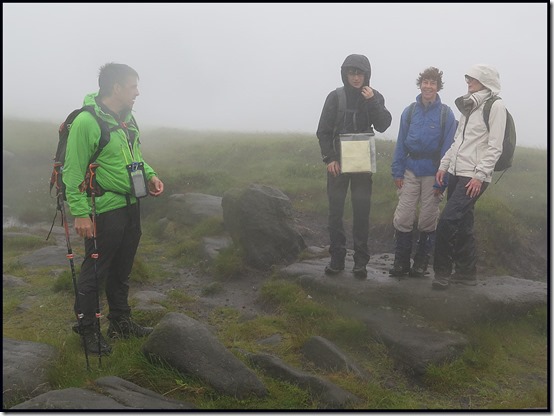
It’s a while since we had a proper walk with the Roberts family, so it was good to join them on a little jaunt designed to provide Andrew with a bit of navigation training for his D of E Award. Sadly Kate couldn’t join us this time due to a beach commitment.

We were all in a cheery mood as we set off behind a runner beside Shelf Brook from Old Glossop. (Note there is parking at the end of Shepley Street as an alternative to the car park by the Bull’s Head.)

2503walkers

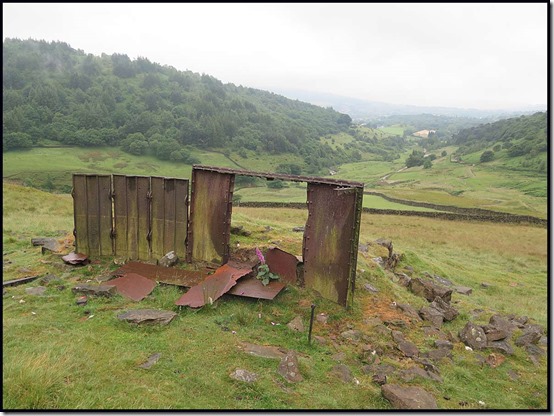
There was however a rather low cloud base. I paused by the remains of a metal structure on a man-made mound, looking back towards Glossop. I have no idea as to the purpose of this structure.

2504structure

The church bells of Old Glossop cheered us as we rose gently past large clumps of Crosswort, with its tiny white flowers. We had turned left towards Lightside and soon reached a stile leading to open country and, after Sue had adjusted her headgear, a misty challenge for Andrew to keep us on track to Bleaklow Head.

2506stile

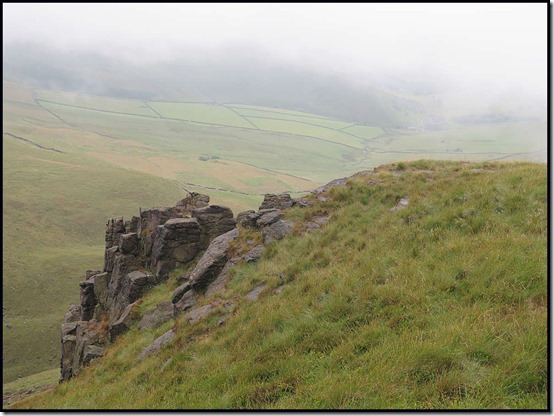
After Alastair had dispensed his wine gums, we continued on into the cloud past an assortment of rocky outcrops.

2507view

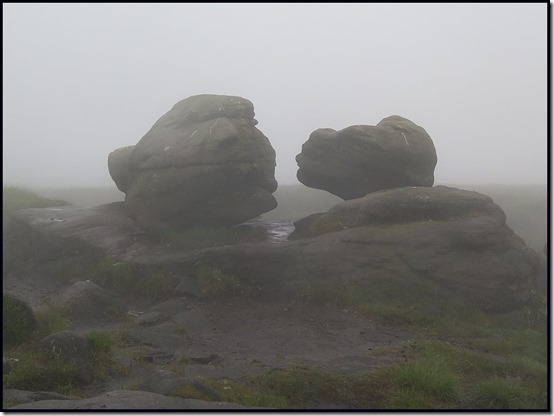
After an expanse of bogginess, and more than a little use of his compass, Andrew was careful to suppress his euphoria when we reached Bleaklow Head, and some rocks, the Wain Stones, that reputedly show two people kissing.

2508bleaklow

Alastair proceeded to address the novice navigator and his two assistants:

“Always wear fluorescent clothing to enable mountain rescue to spot you when you get lost!”

“But we’re not lost” mumbled Andrew, glancing anxiously at the 1980’s map provided by his father.

2509bleaklow2

The maps have improved since the 1980s, as has the nature of the landscape around here. Whilst there are a few areas of peaty mess, the ground is much greener than it was before the Pennine Way path was surfaced.

Unfortunately it took us a while to find that path. There was a bit of toiling in the mist.

2510bleaklow32512navigators2

On reaching the path, we passed a fine specimen of Common Spotted Orchid.

2516orchid2

As the Snake Pass road is approached, the surface of the Pennine Way path gets better and better. We encountered a family group with distressed children, and a few National Park wardens who would no doubt come to any necessary rescue.

2517path

Eventually a signpost to Glossop is reached at a junction. This is the Doctor’s Gate bridleway, down which we turned. Navigation was no longer an issue as the path leads inexorably back to Glossop.

2520doctorsgate3

There are new plantations.

2521doctorsgate4

The bridleway is well used. It’s a challenging technical descent for mountain bikers. None of them were braving it today.

There’s mud.

2522doctorsgate5

Shelf Brook is crossed where the path levels out. There’s a huge new bridge built in memory of a local celebrity. Or has Sue shrunk?

2523doctorsgate6

It’ll be interesting to see how the newly planted saplings change this landscape in years to come.

2524doctorsgate7

After a last look up the Doctor’s Gate path, we ambled back to Glossop in dry weather, having got a bit damp earlier in the 100% humidity of the cloud.

2525doctorsgate8

It was a 16 km circuit, with about 500 metres ascent, taking a leisurely 5 hours. If you look carefully at the blue line (click on the image to enlarge it) you might spot that we didn’t quite reach the cairned summit of Bleaklow, and the path on which we left the Wain Stones was a little to the west of the ‘correct’ Pennine Way path. More micro navigation practice needed, Andrew, or was this intended?

2599route

Most of Glossop’s tea houses were shut, so we made do with afternoon tea/coffee at a branded venue. Their carrot cake was excellent.

Despite the low cloud, a most enjoyable outing.

Tuesday, 27 June 2017

Saturday 24 June 2017 – Wythenshawe parkrun number 294

2404parkrun4

Rain was forecast so the gazebo was deployed about half an hour before the start, when the above picture of keen early arrivals and a rather smart bike was taken.

It didn’t rain. We even enjoyed the post run coffees outside in the courtyard of the tea room.

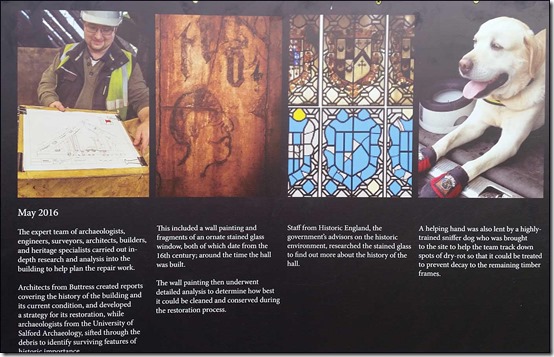
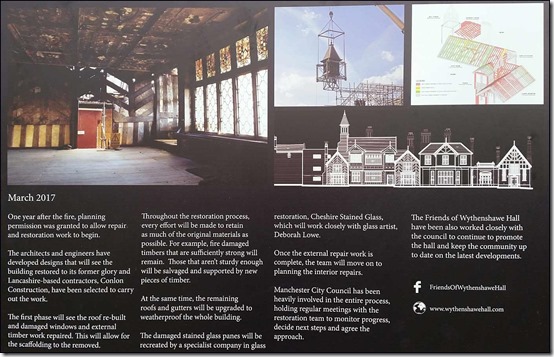
Since my last visit, some posters about the ongoing repair work to Wythenshawe Hall have been attached to the fence. If you click on the images you may get a slightly more readable version.

2402parkrun22401parkrun12403parkrun3

The run was fairly routine. In the absence of ‘HM’ Jackie Cordingley, the ‘Rt Hon’ Mark Hunter took the ‘age-related’ trophy with over 81%. He had finished and left before I got to the tape. Soon afterwards I noted Ron sprinting past an astonished (eclipsed, even) Margaret at a pace that demonstrated that he should really be running much faster, rather than ambling round the course and showing off at the finish.

2405parkrun5

A bit later, Sue replicated Ron’s performance. If she hadn’t spent so much time chatting with Cary, she may have got a PB…

2406parkrun6

As always, a great way to start the weekend. Full results are here.

Monday, 26 June 2017

Friday 23 June 2017 – An Evening Walk Around Alderley Edge

2301Alderley1

For the second of Andrew’s ‘Deepest Cheshire’ walks this summer, he ventured into the familiar territory of Alderley Edge, with an unfamiliar ascent of 150 metres not normally encountered in Deepest Cheshire.

Anyway, it was the Famous Five who assembled before 7.30 pm at the De Trafford Arms in Alderley Edge, where it was warm enough to enjoy an al fresco beer before setting off.

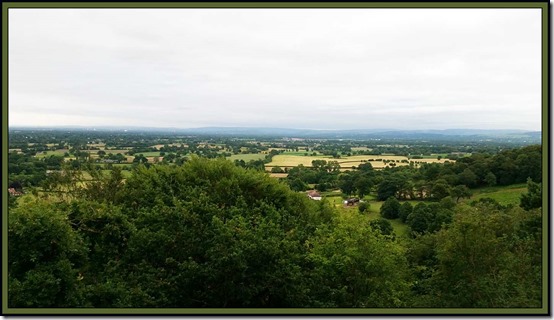
Then a short uphill slog through pleasant woodland brought us to the wide view across the Cheshire countryside to Greater Manchester, with the city’s skyscrapers, complete with combustible cladding, clearly visible, the masts of Winter Hill looming behind them.

2304Alderley4

There’s an Armada Beacon near here, built on top of a Bronze Age ‘bowl barrow’ or burial mound.

2305armadasign

After passing the site of the Hagg Cottages, mineworkers’ houses demolished in the 1950s, we left the escarpment and descended past well securitised properties owned by millionaires to the fields of the Cheshire flatlands. The light levels were low.

2307fields

This used to be a mining area, like Wednesday evening’s venue, but now it’s a sanctuary for the rich.

After a while we passed the 14th century St Mary’s church in Nether Alderley. I’ve described this before. The awful Hamilton family lived next door.

2308church

In fact I’ve described walks and places in this area a few times, so there’s no real need to add much here. If you are interested, click on the Alderley Edge label. The field paths led us pleasantly back to Alderley Edge village.

Here’s today’s route – an amiable 8 km in a couple of hours, followed by a welcome beer in the De Trafford Arms.

2320route

Next outing:
Thursday 6 July - 7.30pm from the Wood House Garden (SJ 808 702). Postcode for Satnav SK11 9DX. Parking at rear of house. Refreshments before an amble around paths and lanes in lush dairy farming country. All welcome.