
Sue and Martin in Mallorca 2019

On the Archduke's Path in Mallorca
Thursday, 29 June 2017


Wednesday, 28 June 2017
Sunday 25 June 2017 – Bleaklow Head

It’s a while since we had a proper walk with the Roberts family, so it was good to join them on a little jaunt designed to provide Andrew with a bit of navigation training for his D of E Award. Sadly Kate couldn’t join us this time due to a beach commitment.
We were all in a cheery mood as we set off behind a runner beside Shelf Brook from Old Glossop. (Note there is parking at the end of Shepley Street as an alternative to the car park by the Bull’s Head.)

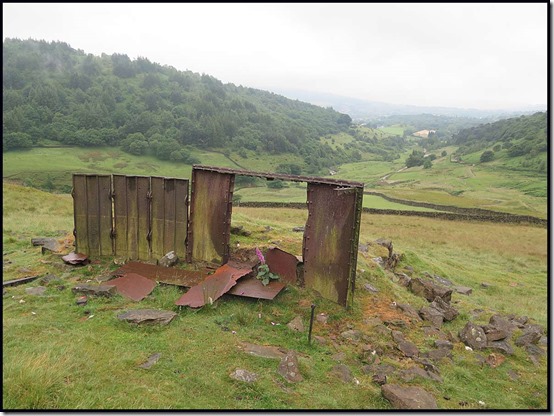
There was however a rather low cloud base. I paused by the remains of a metal structure on a man-made mound, looking back towards Glossop. I have no idea as to the purpose of this structure.
The church bells of Old Glossop cheered us as we rose gently past large clumps of Crosswort, with its tiny white flowers. We had turned left towards Lightside and soon reached a stile leading to open country and, after Sue had adjusted her headgear, a misty challenge for Andrew to keep us on track to Bleaklow Head.

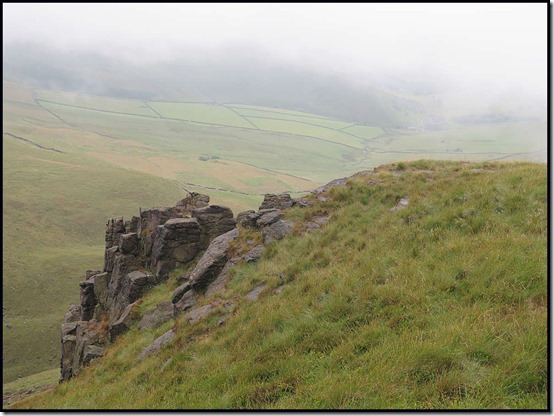
After Alastair had dispensed his wine gums, we continued on into the cloud past an assortment of rocky outcrops.
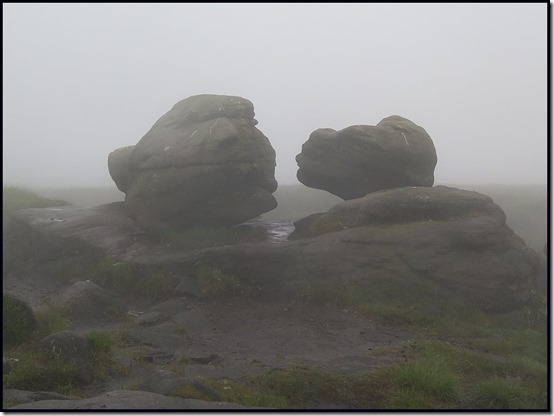
After an expanse of bogginess, and more than a little use of his compass, Andrew was careful to suppress his euphoria when we reached Bleaklow Head, and some rocks, the Wain Stones, that reputedly show two people kissing.
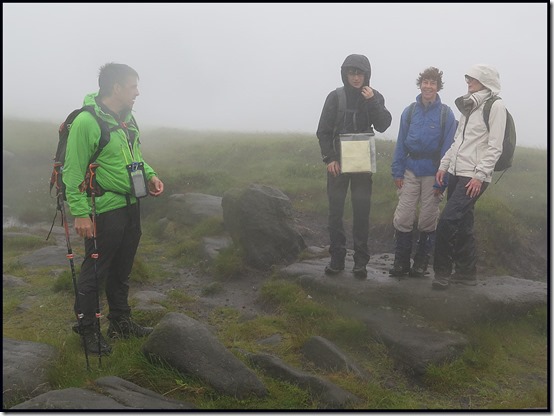
Alastair proceeded to address the novice navigator and his two assistants:
“Always wear fluorescent clothing to enable mountain rescue to spot you when you get lost!”
“But we’re not lost” mumbled Andrew, glancing anxiously at the 1980’s map provided by his father.
The maps have improved since the 1980s, as has the nature of the landscape around here. Whilst there are a few areas of peaty mess, the ground is much greener than it was before the Pennine Way path was surfaced.
Unfortunately it took us a while to find that path. There was a bit of toiling in the mist.


On reaching the path, we passed a fine specimen of Common Spotted Orchid.

As the Snake Pass road is approached, the surface of the Pennine Way path gets better and better. We encountered a family group with distressed children, and a few National Park wardens who would no doubt come to any necessary rescue.

Eventually a signpost to Glossop is reached at a junction. This is the Doctor’s Gate bridleway, down which we turned. Navigation was no longer an issue as the path leads inexorably back to Glossop.

There are new plantations.

The bridleway is well used. It’s a challenging technical descent for mountain bikers. None of them were braving it today.
There’s mud.

Shelf Brook is crossed where the path levels out. There’s a huge new bridge built in memory of a local celebrity. Or has Sue shrunk?

It’ll be interesting to see how the newly planted saplings change this landscape in years to come.

After a last look up the Doctor’s Gate path, we ambled back to Glossop in dry weather, having got a bit damp earlier in the 100% humidity of the cloud.
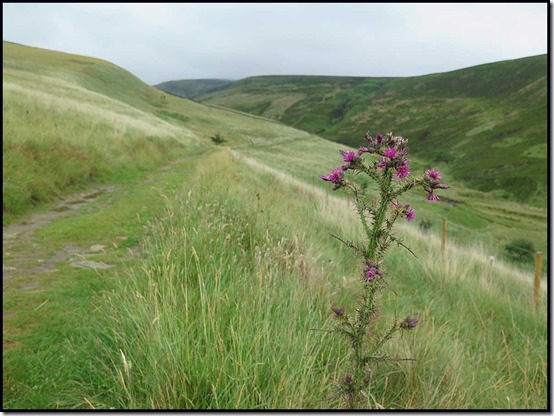
It was a 16 km circuit, with about 500 metres ascent, taking a leisurely 5 hours. If you look carefully at the blue line (click on the image to enlarge it) you might spot that we didn’t quite reach the cairned summit of Bleaklow, and the path on which we left the Wain Stones was a little to the west of the ‘correct’ Pennine Way path. More micro navigation practice needed, Andrew, or was this intended?

Most of Glossop’s tea houses were shut, so we made do with afternoon tea/coffee at a branded venue. Their carrot cake was excellent.
Despite the low cloud, a most enjoyable outing.
Tuesday, 27 June 2017
Saturday 24 June 2017 – Wythenshawe parkrun number 294

Rain was forecast so the gazebo was deployed about half an hour before the start, when the above picture of keen early arrivals and a rather smart bike was taken.
It didn’t rain. We even enjoyed the post run coffees outside in the courtyard of the tea room.
Since my last visit, some posters about the ongoing repair work to Wythenshawe Hall have been attached to the fence. If you click on the images you may get a slightly more readable version.

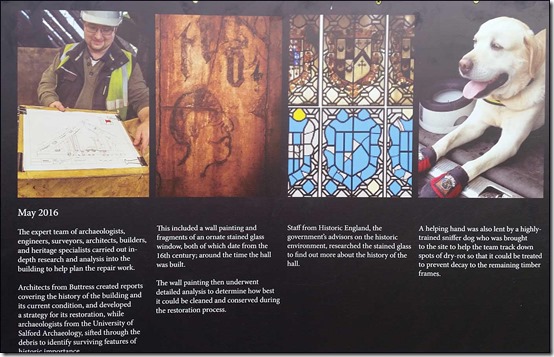
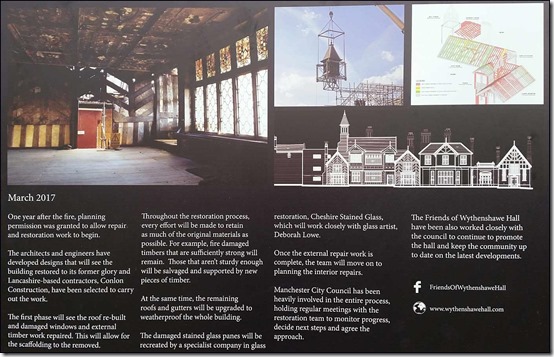
The run was fairly routine. In the absence of ‘HM’ Jackie Cordingley, the ‘Rt Hon’ Mark Hunter took the ‘age-related’ trophy with over 81%. He had finished and left before I got to the tape. Soon afterwards I noted Ron sprinting past an astonished (eclipsed, even) Margaret at a pace that demonstrated that he should really be running much faster, rather than ambling round the course and showing off at the finish.

A bit later, Sue replicated Ron’s performance. If she hadn’t spent so much time chatting with Cary, she may have got a PB…

As always, a great way to start the weekend. Full results are here.
Monday, 26 June 2017
Friday 23 June 2017 – An Evening Walk Around Alderley Edge
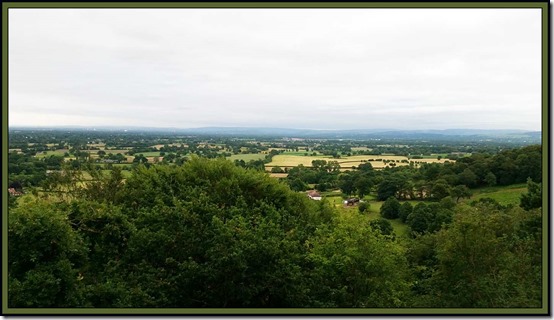
For the second of Andrew’s ‘Deepest Cheshire’ walks this summer, he ventured into the familiar territory of Alderley Edge, with an unfamiliar ascent of 150 metres not normally encountered in Deepest Cheshire.
Anyway, it was the Famous Five who assembled before 7.30 pm at the De Trafford Arms in Alderley Edge, where it was warm enough to enjoy an al fresco beer before setting off.
Then a short uphill slog through pleasant woodland brought us to the wide view across the Cheshire countryside to Greater Manchester, with the city’s skyscrapers, complete with combustible cladding, clearly visible, the masts of Winter Hill looming behind them.

There’s an Armada Beacon near here, built on top of a Bronze Age ‘bowl barrow’ or burial mound.

After passing the site of the Hagg Cottages, mineworkers’ houses demolished in the 1950s, we left the escarpment and descended past well securitised properties owned by millionaires to the fields of the Cheshire flatlands. The light levels were low.

This used to be a mining area, like Wednesday evening’s venue, but now it’s a sanctuary for the rich.
After a while we passed the 14th century St Mary’s church in Nether Alderley. I’ve described this before. The awful Hamilton family lived next door.

In fact I’ve described walks and places in this area a few times, so there’s no real need to add much here. If you are interested, click on the Alderley Edge label. The field paths led us pleasantly back to Alderley Edge village.
Here’s today’s route – an amiable 8 km in a couple of hours, followed by a welcome beer in the De Trafford Arms.

Next outing:
Thursday 6 July - 7.30pm from the Wood House Garden (SJ 808 702). Postcode for Satnav SK11 9DX. Parking at rear of house. Refreshments before an amble around paths and lanes in lush dairy farming country. All welcome.
Saturday, 24 June 2017
Wednesday 21 June 2017 – An Evening Stroll from Nelson Pit with SWOG
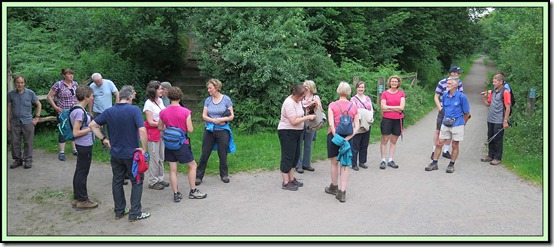
On another warm evening, Sue and I dashed out following a quick bite to eat after Sue’s return home from work, to join a group of 27 SWOG members on their weekly evening stroll.
We started from Nelson Pit, in Poynton, by ‘The Original Coffee Tavern and tea garden – 1876’.

A nearby lay-by soon filled up when it was discovered that the hitherto free car park had introduced charges since the weekend.
There’s a sculpture/plaque at the car park entrance that lists 74 coal mine shafts in the Poynton area. Nelson is number 25. There’s more information here*. The days of this area being full of coal mines are long gone, but keen eyes will spot many signs of the archaeological history of the place.

What with the parking charges surprise, closed roads, and obscure location, there was much milling around waiting for latecomers before Pete finally led us off along the old railway line towards Middlewood. Looking back, this former station on the outskirts of Poynton has now become an immaculate picnic area. But can you spot the grumpy lady?

There wasn’t much grumpiness amongst tonight’s Swoggers though, despite Graham being attacked by horse flies.


Paul’s dog did provide a little discomfort for these two horses, but a horse-whisperer soon placated them. They were a bit too hot to be bothered, really.

Sunset came early.

Or did it? The picture above is a silhouette rather than a sunset, and there was no chance of us needing torches tonight.

After pleasant field paths – they would not be so pleasant after rain as they were overgrown in places, we re-joined the Middlewood Way at Poynton Coppice. Pete did try to reduce numbers by marching on ahead, but everyone seemed to catch up from time to time, and a head count at the end revealed more finishers than starters. Had somebody cheated?

Eventually we passed the grumpy lady, at which point Pete lurched into a sprint.

The Boar’s Head ran out of Black Sheep. An alternative was sought, and the picnic benches were soon fully occupied as it was far too hot at 9.30 pm to be indoors.

Here’s our route - 5.6 km, with 40 metres ascent, taking about 1.5 hours. An excellent and very sociable little outing.

* [From Wikipedia] The name of Poynton is of Old English derivation. Having been omitted by the Domesday Book of 1086, the first mention of the manor of Poynton is in 1289 when it was part of the barony of Stockport. Past spellings include Ponynton and Poynington The Warren family held the manor from before 1386 when Edward de Warren married Cicely de Eton of Poynton and Stockport until 1801 when Sir George Warren, the last surviving male, died. He was succeeded by his daughter, Lady Warren Bulkeley. She died childless in 1826 when she left the estate to Frances Maria Warren, Lady Vernon. The Lords Vernon held the estate until the final sale in 1920.
Coal is found outcropping to the east of Towers Road, which corresponds to the line of the Red Rock Fault at the surface. The earliest record to be found is a lease dated 28 February 1589, which talks of the "Coal pit at Wourthe lately occupied by George Finche". This could be worked on the surface then by shallow shafts, and later by deeper shafts with waterwheels or steam engines operating pumps and winding gear. In the late 18th century, the Warrens of Poynton co-operated with the Leghs of Lyme to work the Cannel and Sheepwash seams at Norbury Hollow. Initially, the mines were pumped using waterwheels driven by the Norbury Brook; atmospheric steam engines were then used and then condensing engines thus allowing deeper pits to be sunk. Output in 1789 was over 23,586 tonnes (26,000 tons) rising to a production of 221,056 tonnes (243,673 tons) in 1859, an amount believed unlikely to have been surpassed. The Poynton Collieries were substantial, and the coal rights were held by the Warren family who leased them the Wrights and the Claytons. The canal and new roads and railway lines were used to remove the coal. In 1826, the estate passed to George John Venables Vernon, 4th Lord Vernon who decided in 1832 to manage the mines himself. In 1856 it was estimated that there was a reserve of 15,163,027 tons which would supply 245,000 tons for 61 years. This was to be supplied by the Park Round Pit, and the Park Oval Pit both working the Four Foot and Five Foot Seam and the Anson Pit and the Nelson Pit which were working the Accommodation Seam. The pits had good transport links to their principal markets, cotton mills around Manchester. With the Lancashire Cotton Famine, in 1861 and the subsequent recession, the price of coal collapsed, the output dropped 112,840 tons, leading to worker redundancies. A new shaft, the Lawrance Pit, was sunk at Park, in 1885 raising the output to 216,362 tons and paying for itself within a year. However the costs were rising and the closure of the Norbury Pits resulted in a constant ingress of water. In 1926 production was down to 80,146 tons. The 1926 General strike lasted for 17 weeks in Poynton and the men went back to work as the collieries would have closed due to the cost of pumping. The collieries closed on 30 August 1935; 250 men were made redundant. 80 were offered jobs in the Kent coalfield and some secured employment with Avro at Woodford. The Anson Colliery is now the site of the Anson Engine Museum, all other shafts have been capped and Park Pit has been levelled.
The Macclesfield Canal was originally proposed in 1765 but construction did not start until 1826 due to opposition from outside parties. The canal was designed by Thomas Telford and completed in 1831. Sir George Warren was a promoter of the extension of the turnpike road from Manchester by way of Hazel Grove to Sandon, Staffordshire where it joined what is now the A51 road. The Manchester and Birmingham Railway opened a line through Poynton in 1845 which today forms part of the London–Manchester main line. The Macclesfield, Bollington and Marple Railway, opened in 1869 with stations at Higher Poynton and Middlewood, closed in 1970. The line is now a footpath called the Middlewood Way.
In the late 18th century, the Pickford family developed their family business of waggoners on the London-to-Manchester route with The Birches Farm at Poynton as its headquarters. The business thrived and they relocated to London in 1823. Pickfords is today one of the best-known removal firms in the United Kingdom.
From the 1870s, private house-building gathered pace and gradually Poynton became a commuter town for workers in the Manchester conurbation. Since the Second World War several housing estates have been built by both the local authorities and private developers.
Friday, 23 June 2017
Monday 19 June 2017 – The Harlem Hot Stompers at Eagley Jazz Club

This posting is really just by way of a reminder. Every couple of weeks a leading jazz band plays on a Monday night at Eagley Jazz Club in Bolton.
This week it was the turn of the Harlem Hot Stompers band.
A regular at these gigs is Reg Kingston, who we got to know through the Long Distance Walkers Association. Sadly he missed Monday night as he had a cataract operation on that day. We hope it went well and that he will be back in position (counting the money) at the next gig on 3 July. All best wishes for a speedy recovery, Reg.
Sorry about the poor pictures, but they are only intended to be illustrative.

The tuba is magnificent. Dave Parr is reported to spend much of his leisure time polishing it.

It’s a bargain - £7 for guests, £5 for members, excellent entertainment, we hope to see you there…
Thursday, 22 June 2017
Sunday 18 June 2017 – Shelsley Walsh Hill Climb

We visited Shelsley Walsh back in 2013, and returned this year on a more than perfect day, albeit a little on the warm side. (Here’s the 2013 report, not much has changed.)
Sadly Robin is no longer with us, so it was Diana who accompanied Richard, Sue and me this time. Richard and Diana have a season’s pass and come quite regularly. Simon and Jacob would enjoy this day out.
Walking up the hill, I seemed to be constantly surrounded by bugs that weren’t bothering anyone else.
“It’s the hat!” Sue eventually diagnosed the problem.

There’s a paddock at the top of the hill where the cars congregate before returning in convoy to the bottom of the hill after each ‘batch’ of racers. The morning comprises practice runs, with the competition in the afternoon.
Everyone gets four or five runs at the hill, which is steep. Speeds in excess of 100mph are reached. Most racers finish in between 30 and 45 seconds, but the fastest few go under 30 seconds.
The spectators’ path comes to an end before you can see into the paddock, so at the top of the hill all you get to see is the helmets of the participants as they freewheel back down to the start, where onlookers can admire the machinery to their hearts’ content without the need to flounce up the hill.
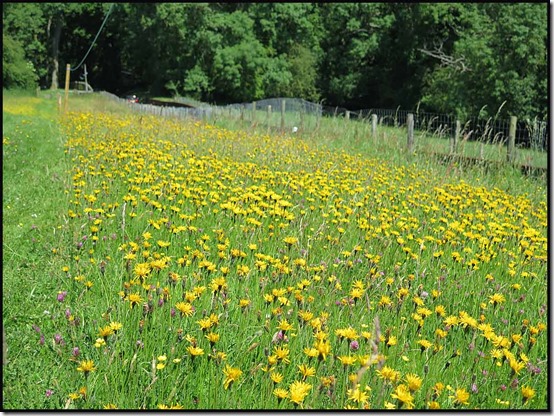
We moved about quite a bit. Snaps were taken. A full slide show is here – 36 images. Refreshments are readily available.


This serious piece of machinery was possibly the quickest of the day.
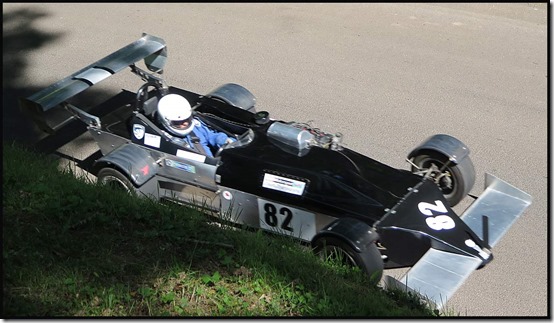
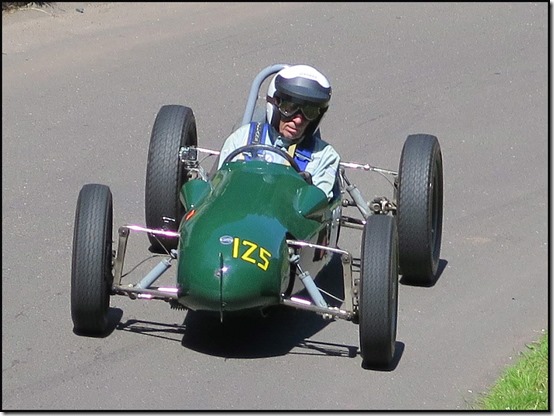
The car below is not so fast, but obviously great fun, and with Stirling Moss’s signature on the steering wheel, what more could you want?
Near the end of an incident free (apart from a breakdown) day, one of the Lotus drivers failed to negotiate the first corner and took a trip into the meadow, leaving various parts of his car, and bits of barrier, strewn all over the road. He was perfectly ok, if a little red-faced, but the mess took a little while to clear up…
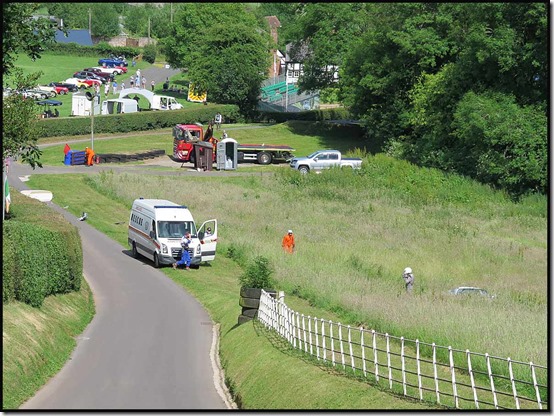
This was a lovely day out in perfect weather. Commended.
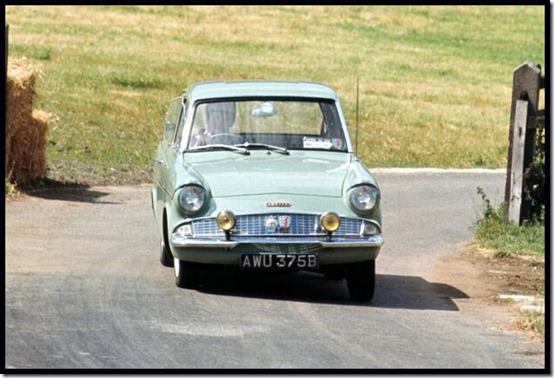
PS I wondered how much interest this posting would be to some of my usual readers. Motor sport attracts a wide audience, so someone may be interested, I thought. Correct. Conrad even came up with a picture of his antics in a Ford Anglia at Harewood Hill Climb in 1965!
Subscribe to:
Posts (Atom)