Sue and Martin in Mallorca 2019

Sue and Martin in Mallorca 2019
On the Archduke's Path in Mallorca

Saturday, 1 November 2008

A Desert Adventure

We have spent the last two days on 'Cairo to Cairo', our hosts' improvised version of 'Paris - Daccar' (the ultimate in rallies). Ours might only have been a round trip from Cairo, but driving over 100 km in the desert, off-road, up and down sandy escarpments with a height difference of 200 metres, was quite challenging.

There were 11 of us, in 5 cars, and we saw just one other group of people all weekend. The smog and 20 million people of Cairo were soon left behind. The camp site we chose in the middle of the desert was idyllic, with a magnificent sunset (pictured above), followed by fine dining and a '60s classics night of music and revelry.

Brad was very proud of the twigs he had brought for the camp fire

Tricky, this desert driving, especially for women drivers!

To be fair, most of us got stuck from time to time, but the magnificent fleet, aided by tow ropes, shovels and aluminium boards,always managed to escape from the quicksand!

'Bunny hopping' down some of the dunes was great fun, if a little scary


But we all made it to this idyllic camp site in the middle of nowhere.


Today, Bill's scrambled eggs and John's sausages set us up for a second 6 hour drive in the desert. The sand was deep at times and all 4 Pajeros had their difficulties, with the Land Cruiser performing impeccably. Periods of driving flat out at 30 mph just to (not always) avoid being stuck were interspersed with speedier sections through a desert full of hidden dips, ridges, rocks and dunes. The absence of a safety net for the luggage in our Pajero did make life interesting for the rear passenger when the car took off - but for the driver it was great fun!

There was a 'girlies' car for Alison, Sue and Ruth

Bill, David and I hammered a rented Pajero in between stopping to collect a few sharks' teeth and rummage through whale bones and coral from the ancient sea bed from which the is desert formed.

Sharks teeth (above)

The hunt for whale bones (below), with Tina admiring her cache


Thanks go to Bill and Alison and their ex-pat friends for organising this trip, inviting us along, and giving us loads of driving opportunity.

It was brilliant.

Friday, 31 October 2008

Religion and Boats

Sue lounges outside the library in Alexandria

Coptic Cairo was clean, uncrowded and peaceful! The museum was a delight and the nearby streets featured Coptic churches of St George (Girgis), a synagogue and the oldest mosque in Cairo.


The afternoon saw us (except Martin, who was confined to bed with 'Cairo Belly') escape to the wide Nile under the sail of a feluka, sipping chilled bubbly as the sun sunk lower in the blue sky.

Then followed an evening of packing for our next adventure!


So you may not hear from us for a couple of days.

Wednesday, 29 October 2008

The Egyptian Antiquities Museum


This museum was today's highlight, in particular the Tutankhamen Galleries which feature all things 'Boy King', including the 11kg funerary mask - a gold headdress inlaid with lapis lazuli, quartz and obsidian. The Rough Guide to Egypt devotes an intense 11 pages to the museum; thankfully (dear reader) I have no intention of competing with it!

Photography is banned inside the museum, so the picture was taken outside.
The lilies were in full bloom - very pretty.


A walk through busy streets was quite satisfying. Two legs in Cairo are definitely quicker than 4 wheels!


To our right the River Nile stretched through the city, a vast waterway and amenity, with frequent bridges linking the divide.


Back in Maadi, Alison, Ruth (Bill's sister) and David had now joined the party, and the evening was spent enjoying an excellent Chinese meal á la Alison, and a further slide show in the villa's large, cool, comfy lounge.

It's snowing at home, so we are told.

Tuesday, 28 October 2008

Egyptian Taxis

For the last few days we have been savouring the delights of Egyptian taxis. They are black and white in Cairo, black and yellow in Alexandria. Mainly old Fiats and Ladas, with a few Peugeots thrown in to the mix - the latter are possibly the safest as they have the loudest horns.

In my youth I enjoyed dodgem cars. We bashed into each other a lot but never suffered from 'whiplash'. I understand that Health & Safety paranoia now rules that dodgems must live up to their name and actually dodge each other in the confined spaces of their rings.

Egyptian taxis are like these modern dodgems - testosterone fuelled macho dodgem cars with hi-fi, lots of flashing lights, nodding dogs, fancy steering wheels and gear sticks, a huge array of mirrors, and much more besides. It really is amazing how they manage, most of the time, to dodge!

Today's postcard shows them in a quiet boulevard outside the railway station in Alex, from where we adjourned after the excitement of Selwa and Amro's wedding celebrations, for our journey back 'home' to Cairo.

Monday, 27 October 2008

An Egyptian Wedding

Here are Selwa and Amro with their bridesmaids, at their wedding in Alexandria on 27 October 2008.

Sue and I can take the occasional reasonable landscape photo. We are not much good at indoor or 'people' photography. But we (mainly Sue) did our best, whilst many others did likewise, and a professional trailed around with a ladder, and an assistant to carry the heavy electrical cables for his powerful equipment. So Selwa and Amro will have a video of the entire proceedings.

Our own video is a little shorter, and comprises mainly of 'stills'. It concludes with the lengthy Cake Ceremony, which may stretch some of your attention spans...

Here it is:


It was raining as we strolled over to the ballroom venue! We found our table and conversed with amiable strangers from Manchester. After a while the band struck up and we returned to the vast atrium to see Selwa and her father come down the stairs, to be greeted by Amro and his father, ascending. Swathes of white cloth adorned the balustrades. Everyone swapped around and Selwa and Amro continued to the bottom of the stairs together. We all stood in the atrium, whilst the band played noisily, before adjourning to our tables in the ballroom.

Selwa and Amro sat on a bench on a stage, again backed by swathes of white material. Then they danced, surrounded by billows of dry ice, then joined by lots of the guests. Music was contrived from a mixture of Arabic and Western influences.

Sometime after midnight we ate, from a buffet of salads and hot food - a fine selection. It had been a long time since lunch! Selwa and Amro were brought food at a table set for two, in front of the stage. Photos were taken (that took some time) and the cake cutting ceremony was then undertaken. The 5-tier cake was erected on what looked like a pile of cardboard boxes in one corner of the room. This involved the pair climbing the precarious construction, slicing each layer of (sponge) cake, and feeding it to each other. All very serious and amusing at the same time.

Next came a live band with a macho singer who insisted on solos from Amro, then Selwa. Then more dancing before proceedings wound up at around 2.30 am, actually rather earlier than we had expected!

It was good to meet the guests and see everyone having such a good time. We enjoyed it a lot.

A long lie in was most welcome before we checked out next day at 11.45 before enjoying an indulgent breakfast of brownies and coffee in the Plaza.

Then it was back to the station,where we had plenty of time to wander amongst ornate lamps in the gardens opposite, and to admire the stained glass windows of Masr station's canopy.


Monday 27 October - Pompey's Pillar and The Catacombs of Kom es-Shoqafa

Whilst waiting in Alexandria for the purpose of our visit - which commenced at 10.30 this evening - we enjoyed the day in the huge city of Alex.

Pompey's Pillar (pictured above), dating from before 200BC, may tower 25 metres above a limestone ridge, but the lofty heights failed to attract Orange's Egyptian partner. So yesterday's message finally went late today when a freak burst of reception was encountered. Who knows when this one will hit the airwaves.

The pillar dominates a well groomed area of antiquity. There isn't much left of the nearby temple of Serapis, but there are the remains of a library and some underground galleries where the sacred Apis bulls were interred. The library was destroyed by Christian mobs in AD391. There are also three sphinxes and a Nilometer to attract the hordes of tourists who arrive by coach rather than by our form of transport - a battered yellow and black cab. The cabs here are truly manic, they make the taxi men of Cairo seem like Sunday afternoon drivers.
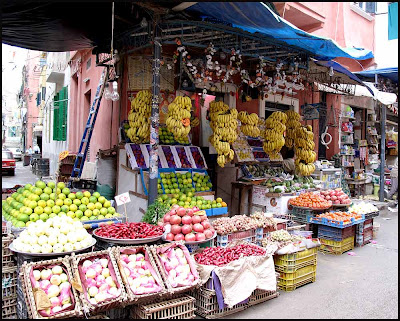
It was a good place to spend an hour before wandering through interesting streets to the Catacombs of Kom es-Shoqafa. On the way we passed stalls laden with luscious fruit and veg - the Nile delta is after all the bread basket of Africa.

Looking down a side street, we expected to see thirsty tourists enjoying the ambience of a street café.

The extensive Catacombs (no photography allowed, sorry) were discovered by an unfortunate donkey in 1900. It's a complex on three levels, reached by a spiral staircase past the 35 metre deep shaft (right down to the water table) through solid rock down which bodies were lowered. These catacombs were in fact an extensive burial chamber dating from before 200BC. They are truly magnificent and amazing to wander around. Different chambers house the dead, depending on their social class, with places for relatives to toast the dead from stone couches.

We were still some way from our next target, the waterfront, so we braved another taxi before enjoying a late, enormous and delicious lunch at the 'Fish Market' restaurant, with fine views over the harbour.

Scallops, Grouper and Sea Bream accompanied a salad with a massive array of dips. Easily enough to last until our next meal, which was scheduled for midnight.

Our perambulations concluded with a walk along the waterfront to Fort Qaitbey, a Toytown citadel buffeted by spray. It was built in the 1480s, which may sound like a long time ago, but it was constructed on the site of the Pharos lighthouse, one of the Seven Wonders of the ancient world, which itself was completed in 283BC. The ravages of earthquakes and treasure seekers put paid to the Pharos, but since 1990 divers have found over 2500 stone objects, including the head of Ptolemy and some huge 50-70 ton monoliths that can only have come from the ancient lighthouse.

Then it was back to the hotel for a rest and a read before 'The Main Event', which started at 10.30 pm!

Sunday 26 October - Bibliotheca Alexandrina

This is a view towards the Mediterranean from outside the new library in Alexandria. More images will follow when we return home (see below). The library cost $355 million and was inaugurated in 2002, some 15 years after being approved by UNESCO.

It's a magnificent place, with a museum and exhibitions. There is still angst surrounding the taking of two 'Cleopatra's Needles' from the city by the Americans and the English in the late 19th century.

We had taken the train to Alexandria, where this Roman Theatre is a short walk from the station.


The theatre is thought to be connected with Alexandria's ancient university, with an annual enrolment of 5000 students. Within the complex is a villa with mosaic floors depicting nine species of birds. Here's a detail:

Next we trundled along to the Corniche - a busy, unforgiving road, almost impossible to cross, to reach the modern library, outside which this white sculpture was redolent against the deep blue sky.

Inside the library a wall of intricate metalwork incorporates some nice touches.

Whilst from the outside the building does look rather futuristic. This image was taken on a horizantal plane from the front of the library, so the building looks a bit like a huge spaceship from Star Wars.

We adjourned to our new home, Alexandria's Hilton Green Plaza Hotel, and a meal at the Splash Restaurant where a very jolly waiter displayed a lovely sense of humour.

Saturday, 25 October 2008

Wadi Digla

Refreshed after a good night's sleep (we need as much as we can get for reasons that may become clear) we sidled off in the well camouflaged Land Cruiser to the end of Wadi Digla. The wadi (river bed) was muddy as there had been a storm yesterday - we had spied it from a distance - but it was sunny for us as usual and we enjoyed a good walk. The steep sides and rough tracks of the wadi provide a fine exercise ground for the many ex-pats living in Maadi.

Here are Martin and Bill enjoying the views from its rim.

We spotted a desert lizard:

And drove back to Maadi through the outskirts of Cairo.

To enjoy refreshments on the roof of Bill and Alison's spacious apartment.

Roast chicken was followed by more slide shows, first our Italian Border Route presentation, then Bill's shutter happy production - from his final Munro walk in 2004 to his recent (and most scenic) trip to Lake Como.

Friday, 24 October 2008

The Step Pyramid of North Saqqara

Oh bliss. A lie in until 9 am. Alison was in the UK, so a recent arrival to Egypt, Sarah - an American engineer - was enrolled to join us for the day's activities. She arrived at 10.30 with a huge box of doughnuts. Yum. Then we set off in Bill's comfortable Land Cruiser (affording secure protection from the wild taxi drivers of Cairo) to visit the Saqqara, or Step Pyramid.


Sue meets a 'local' outside the Step Pyramid

This pyramid heralded the start of the Pyramid Age. Built in C27BC, before being stripped of its casing stones and rounded off by the elements, it stood 62 metres high, and measured 140 by 118 metres along its base. At that time it was the largest stone structure in the world.

It is surrounded by tombs, in which stone tablets like the one shown below abound.

We thoroughly enjoyed our day here, which included a visit to the Imhotep Museum, and some interesting roads to the Dahshur Pyramids - the Red Pyramid and the Bent Pyramid (pictured below).

Bill was the ideal host, and Sarah an excellent companion for Sue and me.

Beers by the Nile as the sun set rounded off an excellent day out.

Our genial host is now about to whisk us off to a party, so that's all for now...

[PS We enjoyed a late lunch today, at a restaurant next to the Step Pyramid, outside beneath some date palms. Mint tea and mezze (tzatziki, falafel, tahini, bread, etc) went down well. We left just as the wind got up and blew clouds of dust through the trees. Dark storm clouds had dropped rain on the other side of the delta, evidenced by puddles we saw later. Should we have brought waterproofs?
In a nearby carpet school children were making carpets in silk and wool. Upstairs was a wide range of carpets, including silk ones whose colours changed with the direction one viewed the fibres.
The drive to the Bent Pyramid, along back roads, revealed the squalour in which many Egyptians live. The narrow irrigation channels lined with towers of rubbish being scavenged by dogs and egrets put the small amount of litter we encounter on our own Bridgewater Canal into sharp perspective.
The evening was spent in another luxurious villa, that of David and Pat, with fine food, a few other friends, and a slide show of Tim, Peter and David's recent walk along the Cumbria Way. All very jolly!]

Thursday, 23 October 2008

Heathrow Terminal 5 - Gateway to the World!

In the company of a man with his beard tucked around his ears, we shuttled off from Manchester's T3 to reach this brand new emporium - T5 at Heathrow.

The flight to Cairo was my first in a 747 (Jumbo) - it was delayed for an hour whilst two cats were removed from the hold because the heating had broken.

The wide luminous ribbon of the M25 belied the fact of a grey day in the UK. We were pleased not to have even thought about packing waterproofs for this 10 day trip - undertaken on the pretence of attending Selwa and Amro's wedding in Alexandria.

It was clear over the Alps, but after a spattering of lights as we passed over the Inn Valley, there wasn't much sign of life in the mountains.

The sparsely lit Adriatic coast was followed by a series of spindly roads leading to Athens, and then we were over Cairo, at midnight. Thursday night is their equivalent of Friday, and the huge city looked very busy below us.

BP's welcoming system efficiently 'immigrated' us, and with our 'hand luggage only' policy for this trip we soon sped through to a waiting car and the journey to Maadi, an affluent suburb to the south of Cairo, where Bill and Alison rent a spacious villa. It was 1.30 am, but Bill was up to greet us and show us around before we finally flaked out in the luxurious surroundings.

Wednesday, 22 October 2008

Monsal Head - Ruskin's view

2201WyefromViaduct View of the Wye Valley from Monsal Viaduct

Mark (Beating the Bounds) comments:

"Ruskin allegedly said that the view of the Lune valley from the churchyard in Kirkby Lonsdale was the finest in the world, but had he been to Monsal Head?"

I'm afraid he had been to Monsal Head, Mark. And he thought very highly of it. Until the railway came. This is what he said:

"You think it a great triumph to make the sun draw brown landscapes for you. That was also a discovery, and some day may be needful. But the sun had drawn landscapes before for you, not in brown but in green and blue and all imaginable colours, here in England. Not one of you ever looked at them, not one of you cares for the loss of them when you have shut the sun out with smoke so that he can draw nothing more, except brown blots through a hole in a box. There was a rocky valley between Buxton and Bakewell, once upon a time as divine as the Vale of Tempe; you might have seen the Gods there morning and evening - Apollo and all the sweet muses of the light - walking in fair procession on the lawns of it, and to and fro among the pinnacles of its crags. You cared neither for Gods nor cash (which you did not know the way to get) you thought you could get it by what the Times calls 'Railway Enterprise'. You enterprised a railroad through the valley - you blasted its rocks away, heaped thousands of tons of shale into its lovely stream. The valley is gone and the Gods with it, and now every fool in Buxton can be at Bakewell in half an hour and every fool in Bakewell at Buxton; which you think a lucrative process of exchange - you fools everywhere."

I'm glad I photographed that information board! I enjoyed transcribing it. There's food for thought, perhaps, with some present day analogies. It has to be said that time has largely healed the scars of the railroad, apart from the impressive viaduct.

Our next series of postings will be a mixture of 'Blackberries' and remote computer transmissions when we have access to them, so there won't be many images for ten days or so. But there will be a new 'label', and perhaps, temporarily, a few different readers / viewers. So we welcome any newcomers and hope we will be able to transmit on the 'big day' (Monday).

Before we go, we would wish Phil at Doodlecat our very best wishes and hope his imminent traumatic experience will cure his ailment, and we wish all those in the TGO Challenge hat at the weekend every success in being pulled out of that hat. We are also conscious of a number of other people who are currently hampered by health and other issues, and we wish you well. Finally, we trust Gayle and Mick will make it safely to Fort William - well done in anticipation.

Tuesday 21 October 2008 - Monsal Head, and another chance encounter

2103UpperdalefromMonsalHead Having got my new boots, a short stroll from Monsal Head to break them in was in order.  The view above greeted me.
Turning left down the Monsal Dale path, I soon reached the weir - a roaring torrent - no paddling across here today.  Then over the narrow bridge and into the autumn sun, where leaves, like these Norway Maple (?) in Little Longstone, were nicely illuminated.
2104mapleleaves
Back up in Little Longstone, this 'phone box and the village pump next to it had also caught my eye.2105TelephoneBox
The path follows the right (north) bank of the River Wye and rises to the Monsal Viaduct, from where the disused railway line disappears into a tunnel.  A short climb leads back to Monsal Head, and the Hotel, which I took the opportunity to book for a Christmas Walk lunch on 14 December, to which everyone is hereby invited.2106MonsalHeadHotel2
A slideshow of today's images (only 18) is here.  No prizes for spotting the 'odd one out'!

And the chance encounter - as I set off towards the Dale I noticed a (proper) photographer setting up his tripod and huge large format camera.  He was packing up when I returned half an hour later, and we chatted briefly before seeking refuge from a shower in our respective cars with our lunch boxes.  This was Andrew, who is trying to make an income out of being a photographer.  Have a look at his website.  I wish you every success, Andrew; it was good to talk, and I think your picture galleries are great.

Asolo Fugitive GTX Boots

Those of you who follow these ramblings may recall two previous entries about these boots.  On 3/10/07 and on 19/6/08, when I purchased a new pair to take to the Alps.  Those who read the missives from the IBR (Italian Border Route) will know that the new Fugitive foots leaked from the outset.  Luckily we only had 4 hours of rain (on the trail, that is) in two months of walking, so it didn't really matter.

[See below for digression.] 

Anyway, on return the rather battered boots went back to Outside and they sent them to Asolo's UK people in Preston.

And yesterday I went back to Outside to collect my refund, replacements, or alternative boots.  Yes, the Asolo people had done the honourable thing and admitted that there was a manufacturing fault with the boots I bought in June.

So I tried on some Aku boots (very light, but perhaps not as robust as the Fugitives, and rather too much arch support for me) and some Scarpas (nice and solid but a bit too roomy around the toes).

The Asolos, as usual, fitted perfectly, so I now have my third pair of Fugitive GTX boots.  It was raining, so Mike at Outside gave them a quick spray and I wore the boots for the rest of the day.  I felt like a stroll so went up to Monsal Head (see next posting).  I needed to get home fairly early as Mrs B needed her car, but I did manage to break in the boots.  They rubbed one of my ankles for the first kilometre, but were fine after that, and will be from now on.  When I arrived home after an hour's drive I stooped to take off my trainers and found this view:2102Boots
Will they last?  I don't know.
Will they be comfy?  Yes.
And I can always use Sealskinz to keep my feet dry.  I'm not worried about the goretex liner, either - my feet obviously don't sweat as much as those of some of our esteemed gear reviewers.

A digression:  Despite what Jim Perrin would have you believe:
'....This miserable summer, its sodden presence imposed over most of Europe....' he writes in the newly vamped TGO magazine, we really did spend over 400 hours exposed to the elements during our walk from Menton to Saas Fee, out of which it rained for 4 hours - that's half a day's rain in two months.  Alright, we did observe rain from our tent and other shelters, but it was actually a magnificent summer where we were in the high Alps.  I know Jim is unwell, and I have every sympathy for him in that respect, but why did he have to be untruthfully negative just to provide the headline that enabled him to write about 'rainy day pleasures'?  Surely he could have approached the topic from a more positive stance?

And the new TGO magazine?  We'll see how it goes, the first issue after a revamp is always going to be a 'flagship' effort.  But I particularly enjoyed new writer Jamie Whittle's piece on Wilderness.

Tuesday, 21 October 2008

A Chance Encounter

2101Anzac
The other day my exercise on the bike was interrupted by Marian.

Marian lives in the old signalman's cottage at the Altrincham end of the disused railway that now forms part of the Trans-Pennine Trail for cyclists. The section by her cottage is currently closed for resurfacing. Marian joined me as I pondered the 'Path Closed' sign, and she volunteered an impromptu life story. It's nice to have time for things like this. She has lived in the 1-up, 1-down cottage (now extended a bit) for 54 years, during most of which time the railway operated. The line closed in 1985, some 4 years after the death of her husband, who I assume was the signalman. I suspect it was used for goods traffic only in its latter years - I don't recall using it to go from Manchester to Warrington in my early days of work before I had a car.

We bemoaned the fact that following closure the ballast had been removed; it's now needed for the cycle track.

Things have changed a bit during Marian's tenure at this place, but the same issues recur - hedge cutting, warnings of the dangerous bend in the road, potholes, the positioning of her driveway, her children (adults now with their own families, but still 'children' to Marian), worries about folk using the closed path, etc, etc.

A pleasant few minutes with a nice old lady - I tried hard to put a positive skew onto some of her worries.

The photo was taken with a box camera in 1960 at Stafford station. My old photo album has it captioned as 'Lord Kitchener' but this is actually 'Anzac', a Britannia Pacific class 4-6-2 engine built in the 1950's - one of the last steam engines to be built in Britain - at Crewe, I think.

There are some more fascinating facts here.

I remember taking the photo, but not in my wildest dreams did I imagine that one day I would be able to show it to the world at the click of a button!

Sunday, 19 October 2008

September 2008 - Bunaken National Park, Sulawesi, Indonesia

Pink anemonefish

Twelve members of Orca Divers, based in Chorlton, Manchester, enjoyed a week's scuba diving in North Sulawesi using the Thalassa Dive Centre, based at the Santika Hotel near Manado.

We dived in Bunaken National Marine Park which includes the five islands of Bunaken, Manado Tua, Mantehage, Nain and Siladen. Manado Tua rises to 820m above sea level but its walls plunge to over 1000m into the Celebes Sea. Each of the islands is surrounded by a dense coral reef and provides excellent wall diving, drift dives and stunning coral slopes. The visibility is generally around 25 to 30 metres and the water temperature is a very comfortable 29 to 30 degrees C! Bunaken has a great diversity of marine life, from tiny pygmy seahorses and nudibranchs to sharks, huge turtles and a manta ray (which I missed!).

Bunaken has one wreck, that of a steel-hulled German merchant ship which sank on 22nd February 1942, just 5 minutes from Molas beach. It was found in 1980.

Around two hours drive away is the Lembeh Strait, famous for the variety of rare macro life on the volcanic sand. Lembeh Island creates a calm, narrow channel and the waters are rich due to currents bringing a rich supply of plankton, accounting for the poorer visibility (around 10 to 15 metres). Buoyancy control is vital so as not to disturb the sand. My first introduction to 'muck diving,' this area is one of the best sites in the world for rare and unusual marine animals.
An hour's journey by boat takes you to Bangka Island, off Sulawesi's northernmost tip,for more superb dive sites.

The photos are my first attempt at underwater photography. I used a Canon G9 with a waterproof case and Photoshop CS2 'tidied' the original shots. A web album on Picasa saved converting the images for the web. If you have time to look at that album I would be most grateful if you would vote (giving the picture numbers by way of a comment on this posting or a separate email via the 'Contact us' button on our website) for your two favourite underwater images - that's how many I'm allowed to enter in the Orca photography competition.

Thanks to Nick and Caroline of Orca for organising such a superb trip, and for their photography tips.

Frogfish