Readers may recall previous visits to
this trail on
23 February and
23 March.
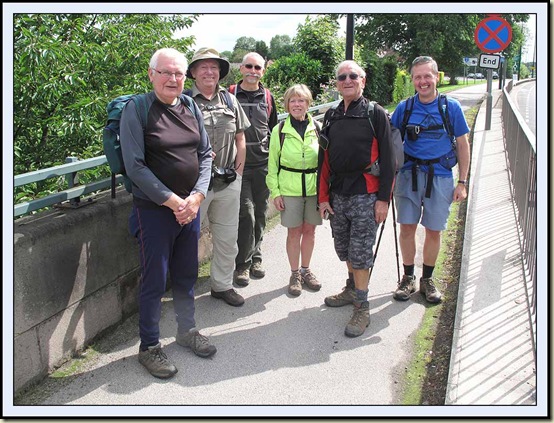
Having missed Part 4 of the trail, I joined various LDWA stalwarts on the recently published Part 5. Seven of us set off from a lay-by in Hollins Green. We were soon joined by the creator of the trail, Roy Bullock, who pointed out the ‘hundred’ marking on the other side of the bridge, denoting the border between Salford and West Derby, two of the six
Hundreds of Lancashire.
The
hundred of
Salford was an ancient division of the
historic county of
Lancashire, in
northern England. It was sometimes known as
Salfordshire, the name alluding to its judicial centre being the township of
Salford (the suffix
-shire meaning the territory was appropriated to the prefixed settlement). It is also known as the
Royal Manor of Salford and the
Salford wapentake.
The
Manor or Hundred of Salford had
Anglo-Saxon origins. The
Domesday Book recorded that the area was held in 1066 by
Edward the Confessor.
Salford was recorded as part of the territory of
Inter Ripam et Mersam or "Between Ribble and Mersey", and it was included with the information about
Cheshire, though it cannot be said clearly to have been part of Cheshire.
The area became a subdivision of the County Palatine of Lancaster (or Lancashire) on its creation in 1182.
So, the history of these parts goes back quite a long way. There’s more information
here (from which the above information has been extracted).
I can’t believe that I failed to photograph ‘
Marge and Steel’, the sculpture designed as a gateway into Salford from Warrington. It is symbolic of the Margarine Factory and Irlam Steel Works, one of the biggest in the country, and the contribution made by the local people to the local economy. It is also the first public art on a roundabout in Salford. The design is based upon an idea developed with the community. Children wanted a modern superhero theme and adults talked about the Steel and Margarine works that used to be here. Retired workers remembered the tea dances they enjoyed. An idea was developed to portray the dance of these two industries which forged people’s lives together in Irlam and Cadishead.
We strolled along between the road and the
Manchester Ship Canal. That was the theme of today’s route. A high level bridge linking Carrington with Glazebrook was soon reached. Apparently this used to be a low level bridge across the
River Irwell, before the creation of the
Ship Canal. Shortly after the bridge there’s an old shunting engine, fairly recently painted and renovated. Its working life was in the CWS. soap works at Irlam. It had no fire to stoke and its steam reservoir was charged with steam from a boiler in the factory. This avoided the soot and fumes common to other engines. After the closure of the works it fell into disrepair and was due to be scrapped. Then the local Rotary Club "adopted" the engine and the road building firm building Phase II of the Irlam and Cadishead by-pass (Birse) offered to restore and relocate the engine to a display site by the new road.

The road soon regains the side of the canal, and before passing under another high level bridge, housing the very much alive Manchester to Warrington main line, we observed the entry of the
River Mersey into the
Ship Canal, at the end of its short journey from Stockport.

Despite being in the industrial heartland of the north west, we were subjected to a short interlude of ‘rain forest?’!

There were lots of flowers to be seen, mostly common to scrubland and meadow, including the Himalayan Balsam shown above, and swathes of Rosebay Willowherb.
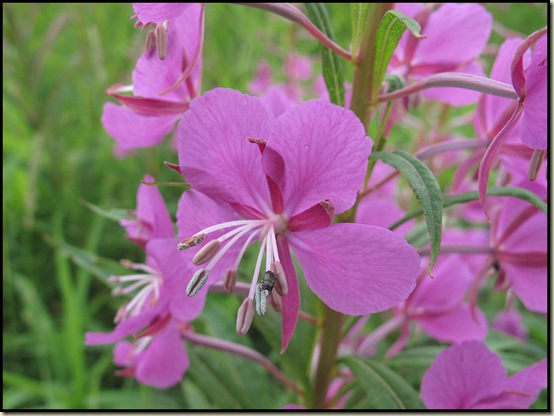
Other flowers included vetches, thistles, St John’s wort, ragworts, buddleia, and more.
Emerging from the forest, we headed beside a section of the old bed of the River Irwell that is still full of running water and home to resident swans and ducks. The river has been incorporated into the
Ship Canal, but the
Boat House still stands, and, since we were not on a ‘hard core’ LDWA outing, Reg permitted a brief halt for refreshments. It was a hot day, after all. Several known addicts would have been unable to walk past the pub anyway.
A little further on, not far from the route of Part 3 of the trail, hordes of workers were busy constructing the City of Salford Stadium, which I understand will shortly be home to ‘Salford City Reds’, a rugby team.

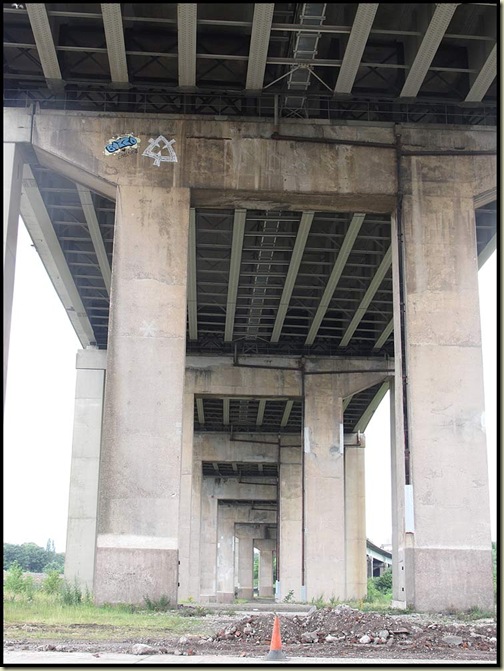
Then we passed under the giant arches of the M60 motorway bridge over the
Ship Canal. It’s rather uglier than the viaducts of the Victorian age, and the graffiti writers must have either very long ladders or a Spiderman kit.
At Barton upon Irwell, where there’s now little evidence of the Irwell, we passed a fish and chip shop reputedly used by Laurel and Hardy when they were in town. It has changed hands since then.

Across the road, beyond a rather grotty area with a bench where we enjoyed a second lunch and a second instalment of
fudge brownies, a swing bridge carries the
Bridgewater Canal over the Ship Canal, and indeed over our route, which from here on was on tarmac.

As we strolled on through Eccles, the sky above the
International Worship Centre, where we resisted the temptation to call in for refreshments at its café, caught my eye.

We tramped on through Eccles and into the large area of Salford Quays and its splendid regeneration projects. It all looks rather smart these days – a far cry from a few years ago. This isn’t far from the docks I visited to see my cousin Philip when he worked as a merchant seaman in the late ‘60s.

The
Imperial War Museum North is well worth a visit if you have time.
 MediaCityUK
 looks as if it will be a great place to work, with its own Metrolink station, for all those people from the BBC who are complaining about having to be based there!

We halted for a while outside the
Lowry Centre, full today of graduating students in their finery with their doting parents. Roy went home, but the rest of us enjoyed a coffee, rather incongruous in our walking gear amongst all the smart suits, before moving on to conclude the walk where it started several months ago, outside Salford Quays Metrolink station.
Here’s the route – 16km with minimal ascent. It took us all day, but less plodding walkers should take 3 to 4 hours over the interesting route.

This entry mentions just a few of the many points of interest on this predominantly urban walk. Whilst country walks have great merit, outings such as this one can be most educational in an entirely different way.
Roy has written about the Salford Trail in great detail
here, and Reg has written up today’s outing
here.
There’s a bit more information annotated to this
slide show.
Roll on the next ‘Plod’.


