Sue and Martin in Mallorca 2019

Sue and Martin in Mallorca 2019
On the Archduke's Path in Mallorca

Friday, 25 March 2011

Wednesday 16 March – Kent to Cape Wrath

Mick, with his and Gayle's 'Kent to Cape Wrath' slide show

Mick and Gayle are in the habit of undertaking long walks in the UK.  They drew a record audience for a slideshow to over thirty folk at last week’s regular Wednesday evening session that Stockport Walking and Outdoors Group holds at Hazel Grove Civic Centre, which is conveniently across the road from The Grapes.

Thanks Mick, and Gayle, for an excellent presentation.

Shortly afterwards they set off on another walk, from the furthest east of the UK to its most westerly point.  Lowestoft to Ardnamurchan.

Gayle is ‘mobile blogging’ – I enjoy following someone’s progress on a long walk in real time as opposed to reading their post trip write-ups, so M&G Go For a Walk will be receiving a daily visit from me (and no doubt many others) for the next few weeks.

[Their previous wanderings, available from the same link above, make a good read as well – recommended.]

They are currently up to ‘Day 5 - Swanton Morley to Pentney’.

Good luck you two.

Saturday 12 March 2011 – The TGO Challenge ‘Snake Reunion’

The ever optimistic Tony Bennett prepares for blinding sunshine

Alan Hardy (that’s not him above!) again kindly organised this reunion.

Whilst some attended the whole weekend, Sue and I joined a hard corps of about 30 folk – nobody was counting – for a 17 km walk; followed by an evening with 40 or so diners at the Snake Inn.

The route chosen for the walk was excellent – from The Snake we dropped through woodland to the River Ashop, for Essential Training – a river crossing.

Crossing the River Ashop in Lady Clough

But the crossing was hardly a practice for Scottish burns in May. Nobody got their feet wet.

Then a large portion of the day’s height gain was achieved on the ascent to Seal Stones. Peter struggled. He may need to adjust his red wine/exercise quotient to get fit for the Challenge.

Barbara and Sue greet Peter as he ambles up to Seal Stones

But we were in no hurry. We pottered slowly along Seal Edge, then across Kinder Scout to the Downfall. There wasn’t much falling down; it has been dry.

Posing on Seal Edge
Peat Hags on Kinder Scout
Kinder Downfall

The well surfaced track of the Pennine Way saw us over Sandy Heys to William Clough, where lunch was taken and one of the less robust members of the party, who shall remain nameless, decided to take a short cut down the Snake Path and Ashop Clough.

The rest of us continued along the Pennine Way to Mill Hill, then along the long paved path across Featherbed Moss to the top of the A57 Snake Pass road.

The paved Pennine Way snakes its way to the Snake Pass

After a long wait for JJ, who had been testing a vital item of Challenge Kit, the motley group carried on to ‘Old Woman’ before leaving the ‘Motorway’ that is the Pennine Way.

A light shower didn’t deter us from enjoying the final few kilometres down Lady Clough and back to the Snake Inn.

Here’s our route – 17 km, 620 metres ascent, taking a leisurely 6.5 hours.

Our 17 km route, with 620 metres ascent, taking 6.5 hours

Then, after a few beers etc, a jolly evening was had by all those who didn’t leave early, and by even more who arrived late.

Waiting for dinner

Great to see you, folks.

There’s a slide show here – not very good images I’m afraid, but they do feature one Challenger who seems to be preparing his own head for target practice!

Wednesday 23 March 2011 - The Salford Trail (Part 3)

Blackthorn blossom

Avid readers (are there any?) may recall that a small team of Timperley Trotters and Tipplers joined an elite squad of mud splodgers from East Lancashire LDWA (Long Distance Walkers Association) on 23 February for ‘Part 2’ of the Salford Trail.
Today we reconvened outside the Marriot Hotel at Worsley Old Hall, where walk leader Reg gave a short speech in the blinding sunshine to his 22 or so victims.
“Worsley Old Hall is part of a large Conservation area which includes the Marriott Hotel and Golf Course. The Hotel was formerly the Farm attached to the Hall. The Old Hall was the residence of James Brindley(1717-1771),employed by the Duke of Bridgewater to design and build the Bridgewater Canal and the Barton Aqueduct.”
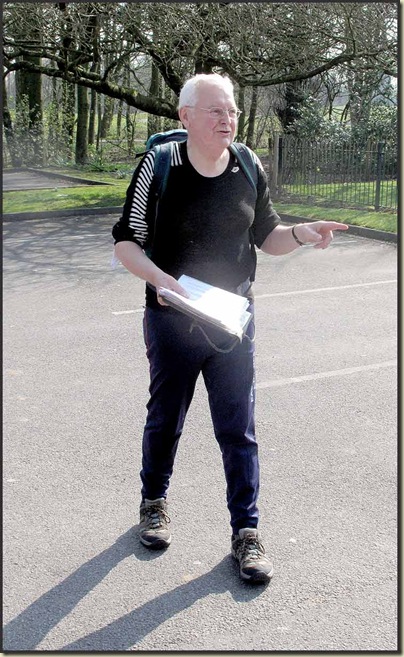
Reg 'The Butcher' explains what surgery might befall those who fail to listen
A group photo was taken. Several late-comers contrived to avoid this ritual. I’ve borrowed the official photo.
LDWA group outside Worsley Hall at the start of the Salford Trail (Part 3)
Eventually we set off. Then we stopped almost immediately to remove all except base layers and to arrange a rendezvous with some latecomers. We were on a golf course. “Watch Out” screamed Norman (54, but thanks to SpecSavers still alert as a wary Meer cat) when a golf ball whistled past his ears. “Sorry” the wayward golfer apologised to the rest of us, “I’ll get him next time…!”
Our tour of the golf course continued, along bone dry paths, in beautiful 16C weather – what a contrast with that day in February when we did ‘Part 2’.
The tall spire of the Ellesmere Memorial towered above us, but somehow we contrived to walk in a loop around this Memorial, without actually managing to visit it!
The main A572 Leigh Road was negotiated with difficulty, but we were soon progressing nicely through fields full of bull rushes beyond a Garden Centre to the relative tranquility of the Bridgewater Canal’s towpath.
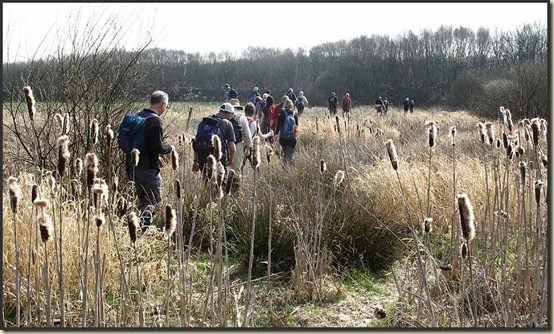
Bull rushes in Worsley
This path led gently to Worsley Green and a plethora of display boards detailing the history of the 250 year old canal and its associated mining and transport heritage.
The Bridgewater Canal at Worsley Green
Lunch time
We passed the half-timbered Packet House where passenger services on the canal to Manchester started in 1769.
By now we’d been going for nearly an hour, so a lengthy elevenses break was in order. Well, ‘twelvses’, perhaps – we hadn’t set off until after eleven. 
We feasted on the steps of Worsley's only monument to Francis, 3rd Duke of Bridgewater, "The Canal Duke" – 1736 to 1803. This was constructed from the base of the Works Yard chimney. Apparently it was originally a fountain, though sadly now dry. The base carries a Latin inscription:
A lofty column breathing smoke and fire,
Did I the builder's glory once aspire,
Whose founder was that Duke who far and wide
Bridged water through Bridgewater's countryside.

Stranger! This spot, where once did never cease
Great Vulcan's year, would sleep in silent peace,
But beneath my very stones does mount
That water's source, his honour's spring and fount.

Alas! That I who gazed o'er field and town
Should to these base proportions dwindle down.
But all's not over, still enough remains
To testify past glories, duties, pain.
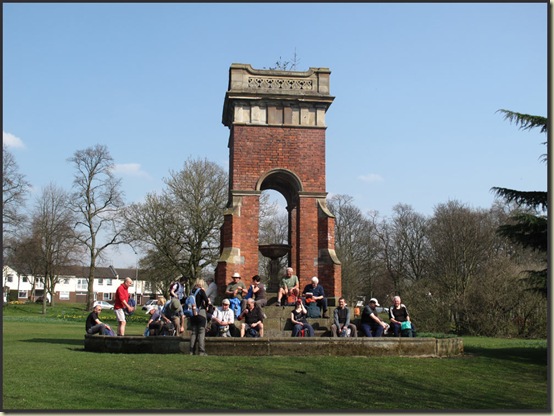
'Twelvses' on Worsley Green
We then wandered across to the Delph where Reg explained that the previously orange waters derived from seepage of iron ore into a sandstone quarry from where around 52 miles of underground channels served the Duke of Bridgewater’s coal mines as far as Walkden and Farnworth.
Reg offered another short speech: “The building of the Bridgewater Canal, linking coal mines in Worsley to Manchester, was responsible for halving the price of coal overnight thus fuelling the Industrial Revolution. A million tons of coal were mined each year until 1887.”
It’s much cleaner these days, with Kingfishers occasionally being seen hereabouts.
Our route continued into Worsley Woods and alongside the Old Warke Dam, at the end of which a black and white Tudor style cottage marked the point at which we descended some steps on to the old Tyldesley Loop Line footpath. The railway served the towns of Tyldesley and Leigh until its premature closure in 1965 thanks to Dr Beeching’s brutal axe.
Walkers on the Tyldesley Loop line
The previously muddy course of the railway has now been nicely surfaced – an excellent amenity that from here provides a straight walk of about one mile to its end at Monton. On the way, the site of Worsley railway station is passed. Young mothers with prams were enjoying the sunny day on the long platforms.

From the end of the Loop Line in Monton, we turned right at the conservation area that is Monton Green and crossed the bridge over the canal, gaining the towpath by ‘The Waterside’ pub, directly opposite the Monton Lighthouse.
Norman, and the Monton Lighthouse
Monton Lighthouse is a recent structure, the forty-foot red and white building having been built with loving care by "Barnacle" Phil Austin over a four-year period.  The local media has provided good coverage, with various videos accessible from here.
I fancied a pint – there were lots of folk lazing in the Waterside’s beer garden. Norman, a confirmed alcoholic, would have joined me but was scared of the repercussions from Reg. “You know he was a ‘butcher’ – he’ll have my guts for garters” whispered Norman, turning pale at the mere thought of crossing our leader.

The canal towpath was fairly narrow. A cyclist encountered some difficulty with our procession. I was at the back, expecting to hear a big splash, but the lad emerged unscathed.
Traffic jam beside the Bridgewater Canal
A railway passed overhead. Apparently this is the Liverpool to Manchester railway, opened in 1830, and the bridge is the world’s first example of a railway bridge over a canal.

Patricroft railway station is nearby, together with the Queens Arms pub, the worlds first railway pub. Originally named the Patricroft Tavern, this was opened in 1828 in anticipation of the business associated with the opening of the new railway. The name was changed following a visit to Salford by Queen Victoria in the 1850s. She arrived at Patricroft Station and then transferred to the Royal Barge on the nearby canal for transfer to Worsley where she stayed as a guest of the Duke of Bridgewater. A replica of the barge (another ‘Phil Austin project’) is stored beside the canal, covered by a tarpaulin that makes it less than photogenic. So no photo, I’m afraid.

We left the canal here, in favour of a path beside the railway line as far as Worsley Brook. Following the brook to a path under the motorway, we then jinked about and finished up at the side of a cemetery. Soon we emerged onto the moss land (Barton Moss) at the outer edge of the busy Barton Aerodrome.
It was 1.30. Time for lunch. For those who hadn’t eaten their lunch at our twelvses stop! I found a few more goodies in my bum bag – mini red cherry peppers stuffed with feta and mizythra cheeses – courtesy of Mr Sainsbury. Sorry I didn’t have enough for everyone (Norman refused to speak to me for at least ten minutes).
Apart from a little jink to cross the motorway, the path through the moss runs dead straight for nearly three miles.
Stalwarts of the LDWA (East Lancs Section)
Twelve Yards Road seems a most inappropriate name! It was pleasant enough though, in good chatty company under a burning sun, and before we knew it we’d reached the end of Twelve Yards Road and had turned left at Astley Road. This road was busier, with an assortment of vehicles from juggernauts to 4WD buggies out for a joy-ride to contend with. We survived, though, but I don’t know whether anyone noticed the unusual names of two of the farms along the way. Ebeneezer Farm and Hephzibah Farm.  Good old Salford names, in good old Salford countryside…?!

Soon after re-crossing the motorway, we eschewed the footpath sign that provided a clue to the continuation of the Salford Trail (that will be ‘Part 4’) and continued down Astley Road to the A57, where a right turn led us back to some cars at Irlam rail station. I think everyone managed to get a lift back to Worsley Old Hall. I know that we managed to acquire a new recruit for the Timperley Tipplers – Moira was on her first LDWA walk and it turns out that she lives very close to our little quartet (JJ, Rick, V and me). So she won a lift home. Well, as far as a pot of tea at Chez Rick, anyway.
It was also good to see Alan and Sheila (Alan’s entertaining take on the day is here), and John from Stockport, who we also saw later at a most enjoyable show of a cine film taken on an overland journey from London to Kathmandu in 1968.
What a lovely day!
Reg‘s official LDWA report on the walk is here, and Roy Bullock’s Salford Trail website is here. I’ve borrowed an image from the LDWA and a few words from Roy’s site – I hope nobody minds. Thank you, anyway!
I’ve uploaded a few more photos to an album here if anyone is interested.
Today’s route is shown below – 18 km, with all of 50 metres ascent, in a little less than 5 hours.
The Salford Trail (Part 3) - 18km, 50 metres ascent, 4-5 hours

Tuesday, 22 March 2011

Wednesday 9 March 2011 - Parkgate

The Harp Inn at Little Neston

Some time ago now, I enjoyed an 8 km stroll along the changing shore of Parkgate and Neston.  This area has undergone massive changes since the days nearly 300 years ago when it was a major seaport.

More of that later, after we’ve returned to repeat the walk on the evening of 31 March.  All are welcome.

We’ll be calling in at the Harp for a tipple, of course.

[Sorry about the delay – I’ve been wrestling with a lack of disc space/too many photos/etc – I really will try to catch up.  But we are out ‘Walkies’ again tomorrow…]

Postscript: Six of us did enjoy the evening walk, the report on which is here.  What we didn’t see on that walk were the egrets and the distinctive trill of the whirling curlew on the brisk wind that accompanied me on 9 March.

Friday, 18 March 2011

Sunday 6 March 2011 – The Angel of the North, and a Visit to Durham

The Angel of the North

Wolfie’s visit (we took him to Durham for a weekend Aikido event) enabled us to visit the Far North, where we caught up with a few folk and enjoyed Julie’s excellent hospitality.

On the way home we couldn’t resist stopping to admire The Angel, who from most angles seems to be leaning backwards.

Sue and the Angel's foot

She has a ‘club foot’.  (The Angel, that is, not Sue!)

We strolled around Durham and admired the Cathedral.

Durham Cathedral

Cloisters at Durham Cathedral

This is the land of the Pie Men, where some say the glaciers have been slow to recede this year.

But these spring flowers looked cheerful enough.

Spring in the land of the Pie Men

There are a few more (rather ordinary) photos from this trip here.

I’ll try to catch up with entries soon, but in the meantime:

1.  Hello Dot, I hope you’ll soon be able to get to your computer to read these entries after your ‘Half a Hip Replacement’.  We were impressed that you managed to escape from hospital after only a week.  Please take care not to break the other femur!

2.  Next Wednesday’s evening walk has been re-scheduled to 31 March – here are the details:
”Parkgate and Neston - meet at 7.30 pm at The Boathouse in Parkgate for a 8 km stroll featuring a disused railway line, Neston quay and Parkgate promenade. Go to Jnc 4 on the M53 > 2nd exit (from the south) > A5137 > go under the railway > join A551 then immediately turn left at a roundabout > after a short distance turn right down the B5135 to reach Parkgate.”
All are welcome.

3.  We enjoyed an excellent day out last Saturday at the TGO Challenge ‘Snake Reunion’.  I’ll report  with photos next week.

4.  Mick and Gayle gave an entertaining and informative ‘Dover to Cape Wrath’ slide show to the Stockport Walking Group last night.  It was good to see them both, and we wish them well for their next trip, which starts on Saturday.  (Mainly) Gayle’s daily reports aren’t to be missed.

I’ll also report on this coming weekend – to be spent in Eskdale – preparation for which is partly responsible for the backlog in postings, as we are catering for nearly 40 people for the weekend and we don’t want them to go hungry!

Tuesday, 15 March 2011

Pyrenean Perambulations

Sunset from a wild camp at the Col d'Ispeguy on 30 July 2004

Andy Howell has been busy over at ‘Must Be This Way’ with inspirational postings about the Pyrenees, such as this FAQ posting.

Well done, Andy, the information you provide will be of great help to those planning on visiting this wonderful range of mountains.

I shall be trying (again) to encourage Gayle and Mick to hatch a Pyrenean traverse project when I see them tomorrow.

For my own part, I can add a little to Andy’s wealth of information by mentioning that Sue and I completed a HRP (Haute RandonnĂ©e PyrĂ©nĂ©enne) crossing from west to east in 2004, in celebration of my release after many years from the shackles of full time work.

We set up a web page prior to the trip and sent a text message each day to our ‘webmaster’ (my daughter) who updated a spreadsheet with our progress to date.  A sort of rudimentary ‘blog’, though I wasn’t familiar with that term in 2004.  Was anybody?

After the trip we added a bit more information and copied a couple of days of our detailed diary to another web page, and showed the slides to a few people.

Later, I transcribed the postcards that we sent home every day (snail mail blogging?!) and have provided that document to a few people who have made contact during their preparations for a Pyrenean traverse.

Andy’s current efforts have triggered me into putting the postcard transcript onto a separate web page.  I hope to add some photos and perhaps reproduce a few more detailed diary entries, but for the present our main Pyrenean web page, with links to route details and a kit list (now a bit dated), is here, and the postcard transcript is here.

The photo at the head of this posting is the view from our wild camp at Col d’Ispeguy as the sun went down on 30 July 2004, on the fifth day of our crossing.

I hope someone may find all this of some interest (if only the link to Andy’s site).  The Pyrenees is a wonderful area to visit.

My other Pyrenean postings can be found here.

HI-TEC V-Lite Thunder HPi ‘Adventure Sports’ Shoes – A Review

HI-TEC V-Lite Altitude Ultra WPi boots HI-TEC V-Lite Altitude Ultra WPi boots

The above images were taken on 8 March 2010.  These trail shoes were kindly provided by HI-TEC, following the premature failure of some HI-TEC V-Lite Altitude Ultra WPi boots that had kindly been provided by HI-TEC for review.  That review is here, and my ‘New Shoes’ posting about the trail shoes is here.

The trail shoes have been worn a lot over the past year, but sadly didn’t quite make it to their first birthday.

They are currently still in production, with HI-TEC’s website proudly proclaiming the following:

Features

  • ion-mask hydrophobic technology
  • Breathable mesh and Synthetic Upper
  • TPU welding for midfoot support
  • Toe and heel abrasion for added protection
  • V-Lite strobel construction
  • V-Lite design and build technology
  • Comfort-Tec contoured sockliner
  • V-Lite compression-moulded EVA midsole for cushioning
  • External ESS Shank for added support
  • V-Lite MDT carbon rubber outsole

The RRP is about £80, but they are currently available for £50 or less.

Here’s what my shoes looked like on 25 February 2011, after about 600km (375 miles) of use, a third of which comprised three weeks in the Alps.

HI-TEC V-Lite Altitude Ultra WPi bootsHI-TEC V-Lite Altitude Ultra WPi boots

As you can see, the sole of one shoe had parted company with the upper and was flapping in a terminal manner.  Luckily the final straw occurred on a walk to the shops, so gaffer tape repairs weren’t needed.

It’s not all bad news though.  Here are my detailed observations.

Fit and Finish:
  • the EU size 43 were perfect for my average sort of feet.  As with the earlier V-lite boots, no breaking in was necessary and the shoes were a delight to wear for their entire life
  • the construction – they were made in China – was good, with none of the problems I encountered with their Innov8 Roclite predecessors.  BUT after nearly 12 months and only 600 km of use (plus about the same distance mountain biking), one of the soles parted with its upper.  Had this not happened I’d still be using the shoes, albeit with rather worn soles
  • visually, I like the finish – these were respectably tidy casual shoes.  I shall miss them
Features:
  • HI-TEC’s stated features are listed above
  • the shoes may be vaguely waterproof, but not noticeably more so than my fairly ordinary Nike trainers.  I’m not convinced by the ‘ion-mask hydrophobic technology’
  • forgetting all the technical jargon, the shoes were extremely comfortable for anything from walking to the shops to mid grade Via Ferrata in the Dolomites
Weight:
  • at 800gm, they are not the lightest in their class, but they certainly don’t feel heavy, so for me they are about right
Practical Use:
  • I’ve worn these shoes in preference to most other footwear over the past year.  They sat in the porch and were my first choice for anything from an evening out in casual wear, to a serious mountain day walk in dry conditions
  • the soles were satisfactorily grippy in the dry, even on steep ground
  • whilst I didn’t wear the shoes much in wet weather, I did notice seepage when walking on boggy ground, so those wanting to retain dry feet in wet conditions should consider using Sealskinz socks or similar
  • with limited ankle support, many users may be reluctant to use the shoes on certain steep ground such as some of the scree slope crossings in the Dolomites, where the additional ankle support provided by lightweight boots may enhance both comfort and safety
Alternatives:
  • there are lots of alternatives to these mid-range trail shoes.  I was lucky in that the shoes posted to me fitted perfectly, but I would always commend users to try on shoes before buying them – different products suit different feet
Conclusion:
  • these shoes provided me with comfortable day to day use for nearly a year.  They were good all round performers, from pub to mountain top.  In wet weather I would choose to wear waterproof socks with the shoes, or (preferably) waterproof boots instead, but with relatively grippy soles they were perfect for three hot dry weeks in the Alps last summer.  They were also excellent for a 400 kilometre TransAlp mountain bike ride, and for mountain biking generally
  • my only real criticism of these shoes is their durability.  I would normally expect to get more wear out of such a product.  Maybe I was unlucky, but the soles of my shoes normally wear out rather than fall off!  The laces, however, are excellent – they will live on as spares

So, it’s out with the old… I wonder what will be next? (‘G’ knows that secret!)

Monday, 14 March 2011

Friday 4 March 2011 – The Roaches and Lud’s Church

Lud's Church

With a chance to reciprocate Wolfgang’s hospitality to me last year in Austria, we enjoyed his company for this classic circuit over the Roaches to Lud’s Church, returning by the Dane Valley and The Hanging Stone.

Shortly after starting the walk, the climbing hut that is a memorial to Don Whillans is passed.  It’s surrounded by large boulders on which children can often be seen clambering before they tackle one of the many climbs up the rocky cliffs of the Roaches.

Bouldering rocks by the Don Whillans Memorial Hut

Our walk passed uneventfully over the Roaches on a cool, cloudy day, after which the shelter of the dark woodland of Back Forest was in stark contrast to the open moor.

The deep cleft of Lud’s Church (above) wasn’t as muddy as expected.  It’s a wonderful place; we were the only visitors.

A pleasant stroll beside the River Dane led to Danebridge.  On the way we spotted this huge (by Peak District standards) rock fall that had caused the river to back up a bit.  I wonder whether any attempt will be made to clear the debris. 

Landslip in the Dane valleySome 'very special' rare breed sheep 

A rare breeds farm along the route sports a variety of unusual sheep.

JJ and I lagged behind the other four, in the hope that they would accidentally turn off to the Ship Inn, which we’d decided to leave out of today’s itinerary, having already scoffed several rucksack loads of provisions.

JJ at Danebridge

The Snowdrops around here don’t see much sun, and are very late in flowering.

Late Snowdrops

Our ruse didn’t work – the others ignored the pub and skipped merrily on through pleasant woodland and up a long field towards the conspicuous prominence of The Hanging Stone.

Ascending to The Hanging Stone

There’s a plaque on the front of the stone in memory of a local landowner, Lt Col Henry Courtney Brocklehurst, who served in both World Wars and was killed in Burma in 1942, at the age of 54.

On The Hanging Stone

On the other side of the stone there’s an older (1874) memorial to Burke, a dog.

We stood near the top for a group photo in view of Shutlingsloe, but Viv and Sue decided to block out the summit…

Martin, Viv, Sue, JJ, Rick and Wolfie

The walk concluded with a stroll along a delightful ‘permissive path’ that led back to Roach End and a short stretch of tarmac back to the cars.

Our route - 17km, 690 metres ascent, 5 hours

We’d done 17 km, with 690 metres ascent, in a leisurely 5 hours, in excellent company.  There’s a slide show (30 images) here.  Thanks to Wolfie for a couple of the photos.

We’ve been here before – for other reports (which will include future ones) on Roaches walks, click here, and for Lud’s Church – mostly the same walks as those in the Roaches – click here.

Footnote – 14 March 2011
The Lud’s Church image seems to have gone down well, so here’s a reminder from 10 October 2007 of what it’s like when the sun shines…

This is one of the few photos I could ever have sold – it was used for the invitation to a naming ceremony for two children.

Lud's Church on 10 October 2007

Friday, 11 March 2011

Gear Review: Icebreaker Bodyfit 200 Men’s Oasis Crewe – time to turn down the central heating

Ascending Base Brown on 2 March 2011 - the Icebreaker Bodyfit200 Men's Oasis Crewe kept me warm 
   
[Note that on 5 September 2012, Webtogs Limited went into liquidation, but its business has legitimately been continued in the name of Dorset Mountain Sports Limited, t/a Webtogs, with whom I have had no contact whatsoever, nor did the liquidator of Webtogs Ltd respond to my enquiry as to whether any members of the public had lost money as a result of the liquidation.]

I was delighted, on return from Canada a month ago, to receive this superbly made garment from Webtogs for review.  Whilst it’s a shame I didn’t have it in Canada, where it would have been worn in anger on most days, I’ve now had a chance to wear the garment for long periods in various conditions.

Here are my first impressions:

Icebreaker Bodyfit 200 Men’s Oasis Crewe

The manufacturer’s product description is provided at the foot of this posting.

Icebreaker Bodyfit 200 - out of the box

First impressions:
Out of the box – it feels a little heavy compared with my regular long-sleeved t-shirt. Because it is – 200gm vs 155gm (TNF Polartec®).
This long sleeve Merino base layer garment appears to be a product of NZ, but was actually made in China – that’s a surprise – but it’s very well made and has a ‘BAACODE’ that traces the wool back to four ‘stations’ (farms) on NZ’s South Island.
It sells for £49.95 RRP, currently £40 from Webtogs (March 2011).
First day out – v comfy under NF fleece. Arms just a little on the long side.

Fit and Finish:
  • the medium size fits my 38” chest – it’s snug but comfy
  • the length is just right – long enough to tuck into trousers, but equally wearable outside them without it looking too long
  • I have heard that when Icebreaker first started to use Chinese manufacturers they encountered quality problems; there is no sign of any such problem with the well finished garment in my possession
  • the garment exudes ‘quality’, with the flatlock stitching and  seamless underarm reducing friction from internal seams, making it extremely comfy (I should know by now – I’ve lived in it for the last month)
Icebreaker Bodyfit200 Icebreaker Bodyfit200
Features:
  • in addition to the features mentioned above, the integrated raglan sleeve design also features a highish neck that helps trap in the heat when you need it most
  • the sleeves are generously long; I believe that this is a feature of Icebreaker clothing
Weight:
  • at 200gm, this garment is about 45 gm heavier than the equivalent Polartec® garment that I am used to wearing, but it’s definitely warmer.  Ideal for winter use, but probably too hot for most people as a summer base layer, when the 150gm version may be a better choice
Practical Use:
  • I’ve enjoyed wearing this base layer, indoors and outdoors, for the past month.  It has certainly resulted in a reduction in our household heating bill, and has meant that in the outdoors, an extra windproof layer over the Polartec® fleece that I use as a second layer has rarely needed to be deployed
  • in warm weather most people will find this garment too warm
  • I’ve worn this Merino wool top for days on end, including some ‘vigorous activity’, without it becoming noticeably smelly.  This is a big advantage over Polartec® polyester clothing.  On the other hand, if you do need to wash the Merino wool garment, it takes longer to dry than polyester
    [Apparently someone has worn one of these garments non-stop for 196 days in extreme conditions – so there’s no need to try to repeat that particular test!]
  • it’s a smart top that can be worn underneath a shirt or v-necked sweater as casual wear, as well as it’s obvious usefulness in The Great Outdoors
Alternatives:
  • numerous manufacturers make similar products, with leading producers charging similar or slightly lower prices, Icebreaker being an acknowledged market leader in this field
  • there are cheaper alternatives; I suspect that they are ‘cheaper’ in more ways than one
  • for really cold weather, Icebreaker offers heavier duty Merino wool base layers such as this one, that may be the choice of readers with poor circulation or a tendency to venture out in extreme conditions 
Conclusion:
  • this base layer is ideal for winter use for walking and backpacking.  Some backpackers may wish to deploy it all year round for use around camp and on cooler evenings 
  • if you work from home in the winter months, you’ll find that wearing a Merino wool base layer such as this one may have a dramatic effect on your heating bills
  • I’ll be using it for winter walks, and for general casual wear, all winter, and I may even take it on the two week ‘TGO Challenge’ backpack in May if the forecast is for cool weather
That’s it for now.  I’ll add to this review when I have been using this base layer for a longer term.
Icebreaker’s own product description is reiterated below

Icebreaker Men's Oasis Crewe 


Icebreaker Bodyfit200  

Product Description:

Designed to fit close to the body, this raglan long sleeve top has a higher neck to trap in the heat when you need it most. Flatlock stitching and a seamless underarm reduce friction from internal seams, which will make this top one of the most comfortable pieces of clothing in your wardrobe.
  • Crewe neck
  • Raglan sleeves
  • Gussets for ease of movement
  • Forward side seam
  • Fits close to the body
  • Flatlock stitching
  • Icebreaker tonal embroidered logo
For Icebreaker’s Size and Easy Care guides, click here
__________________________________________________________

Note: Whilst the gear was provided by Webtogs, this review, over which I have total editorial control, is totally independent of that on-line retailer.

Wednesday, 9 March 2011

Spring Flowers (3)

Flower at Dunham Massey on 3/3/11

Last Thursday Sue went down to the Winter Garden at Dunham Massey with a work colleague and snapped a few images.

Flower at Dunham Massey on 3/3/11

The ubiquitous purple and white flowers have now been joined by an array of daffodils that will become increasingly colourful over the course of the next few weeks.

Daffodils at Dunham Massey on 3/3/11