Sue and Martin in Mallorca 2019

Sue and Martin in Mallorca 2019
On the Archduke's Path in Mallorca

Tuesday, 5 March 2013

Saturday 23 February 2013 – Dunham Winter Garden (4)

Nallo Lady here again! Today, I was accompanied by my mother and the ‘Dunham Massey Winter Garden Plant List. Despite the dull, chilly weather, we had a lovely time trying to identify the numbered trees, shrubs, bulbs and herbaceous plants, with some success!

Helleborus

Despite the small size of this winter honeysuckle blossom, it had a lovely scent.

Lonicera x purpusii 'Winter Beauty'

The variety of hellebores is superb:

Helleborus

Helleborus

Helleborus

Helleborus

There are carpets of snowdrops still:

Snowdrop

These tiny hyacinths escape the eye if you’re not observant:

Scilla mischtschenkoana

I must remember to take my small tripod next time I visit – getting down this low (despite a small mat for my knees) is hard work!!

Friday 1 March 2013 – A Stroll from Bollington

0105-White-Nancy-2

A bit of grit and part of a Cheshire Ring, were today’s diet.

Andrew and I started in Bollington, on the western edge of the Peak District, where under a grey sky and with a cold following wind, we hauled ourselves up steep slopes to White Nancy, the folly that’s prominent at the northern end of Kerridge Hill, overlooking the town.  It was built in 1817 to commemorate victory at Waterloo, but it currently celebrates the Queen’s diamond jubilee (see above), and the London Olympics on the reverse.

0103viewfrom-White-Nancy

We were heading along the Gritstone Trail on this ‘easy to navigate’ stroll, but we missed the signs and found ourselves unexpectedly at the 313 metre pinnacle of Kerridge Hill.  From here there's a good view down to Rainow, with Shining Tor in the distance.  This photo cleverly utilises a trig point to block out the hovels of Rainow*, and places Shining Tor directly above said protuberance.

0107-Kerridge-Hill

After regaining the Gritstone Trail, we again failed to observe the signposts and found an alternative route  past Hordern Farm.  Then, as we rose to nearly 400 metres we encountered lingering snow, which certainly wasn't in a mood to melt in today's icy northerly breeze.  It must have fallen some time ago, but despite the lovely weather we’ve had for the last couple of weeks, low temperatures have encouraged the white stuff to hold tight in shady spots.

Our path led us down to Tegg’s Nose visitor centre, where we sat inside and enjoyed a cuppa and the last of my cake supplies before heading over the quarried (millstone grit) remains of Tegg's Nose and down to the fleshpots of Langley.

Shutlingsloe was unmistakable through the gloom, beyond Ridgegate Reservoir.

0115-Shutlingsloe-2

A couple of Goosanders were busy in Teggsnose Reservoir.

0116-Goosander

Saint Dunstans Inn, in Langley, is one of those rare establishments that welcomes you in to eat your own butties.

0117pub

Sadly, on a Friday in March, you have to arrive after 5pm to do this!

The last hill, en route from Langley to the Macclesfield Canal, was on a pleasant path that was new to us both.  Dropping down to the Macclesfield Canal, where we were to join the Cheshire Ring for the walk back to Bollington, we were unable to access the waterway from our chosen route, eventually reaching it after a little road walking.

A convenient bench, opposite the marina in Macclesfield, offered a good luncheon spot, in the company of a lone and mildly hungry Mallard.

This section of canal has some pleasingly designed bridges.

0123MaccCanal3

There are boatyards, marinas, mills, etc, as well as stretches of farmland adjacent to the towpath on the easy walk from Macclesfield to Bollington.

Before we knew it we had reached our destination - before 3 o'clock.

This was a short but pleasant amble of some 18 km (11 miles) with 500 metres ascent, taking around 5 hours.  The route is shown below, and there’s a short slideshow here.

0199route

* Just joking!

Sunday, 3 March 2013

Wednesday 20 February 2013 – Dunham Winter Garden (3)

Iris reticulata 'Katherine Hodgkin'

Nallo Lady here.  It was half term for my medium-sized friends, Andrew and Kate, so a trip to Dunham was arranged. They introduced me to the ‘log pile’, which proved a good place for some ‘hide and seek’ and chasing one another.  Foxy and nearby rabbit were watching, looking bemused:

Foxy

After a tumble for Andrew, which resulted in a bloodied knee (he was very bravely wearing shorts, as he has all winter!), we headed for the Winter Garden, past the pond, where this robin was enjoying seeds intended for the ducks:

Robin

The characteristics of the wooden sculptures were discussed….

Sculpture by Manchester School of Architecture

…before Kate hunted for the answers to the quiz, whilst I focussed on the flowers. Sadly, since this visit, hungry rabbits have eaten all the flowers and buds of this iris, and, yes, it is slightly out of focus!

Iris reticulata 'Purple gem'

Luckily, the rabbits don’t seem interested in the ‘Katherine Hodgkin’ variety:

Iris reticulata 'Katherine Hodgkin'

During the winter, the coloured bark of the shrubs and trees features prominently – this is Prunus rufa:

Distinctive bark of Prunus rufa

The hellebores are opening rapidly now, but need their heads turning over to see what pattern each has inside:

Helleborus

This primula has come into flower since my last visit…

Primula vulgaris subsp. sibthorpii

As usual, the garden brightens a dull day, and I will visit again very soon…!

Wednesday, 27 February 2013

Tuesday 26 February 2013 – An Evening Walk around Rivington

2603ViewfromRivPike2

Back down to earth!  I hope this posting doesn’t leave the likes of Alan and Louise with another dose of vertigo, as Sue looks down from Rivington Pike to the Reebok Stadium, where Bolton Wanderers were in the process of thrashing Peterborough 1-0.

Nobody else turned up for this delightful evening stroll in lovely weather, but we did surprise a group of scouts at Rivington Pike.  Their minders arrived later to be puzzled by the fact that their charges seemed to have grown rather rapidly; they weren’t expecting to see any other adults up here!  We strode round the 6.5 km route in about an hour and a half before adjourning to The Spinners’ quiz night, from where Lyn had sent an SOS – not that we really did very much to help once we got there!

A more thorough report, and route details (tonight we returned via the barn rather than by way of the castle – there are many different options hereabouts), can be found from an earlier visit, here, but this is always a good venue for an evening walk as it enjoys fine views over Greater Manchester and Lancashire.

2601Pigeon-Tower

Tuesday, 26 February 2013

What would he make of Crib Goch in the rain?

I think I’ve referred to my scary day on Half Dome before.  Sue reported on it here.

Thumbing through the current Trail magazine today, I discovered the picture below.  This guy, Alex Honnold, seems to have found a much flatter path than the one I was on, so presumably (assuming the path continues amiably round the corner) he got to the summit without suffering the dizziness that got to me.

2501HalfDome

The photo is credited to Jimmy Chin/National Geographic.  The title to the post is credited to Trail Magazine’s caption.

Our Scottish Tour – 9 to 17 February 2013

1018morronedescent1

For the few people who may be interested, here are some links to the individual postings for our recent trip around Scotland – press the Back button to return to this index if you want to work your way through the postings, and there’s a slideshow (150 – of dubious quality) here.

Saturday 9 February – Travel to Braemar

Sunday 10 February – Morrone

Monday 11 February – Leagag

Tuesday 12 February – Glen Banchor

Wednesday 13 February – Glenstockdale

Thursday 14 February – Allt Buidhe

Friday 15 February – Beinn nan Imirean (M) and Meall Glas (S)

Saturday 16 February – Creagan na Beinne with the XXL Club

Sunday 17 February – Travel to Timperley

Enjoy…as we did in the music room on Saturday night – picture courtesy of TGO Challenger, Simon Sawers.

Perth-and-Kinross-20130216-00204-(2)

Sunday, 24 February 2013

Saturday 2 February 2013 - Dunham Winter Garden (2)

A perfect morning for me (Nallo Lady) to be amongst the flowers in the garden. These bell-like snowdrops have pretty orange stamens inside and are just one of several varieties creating carpets of white.

Snowdrop

The early morning light is also perfect for lighting the clean, white bark of the silver birch grove:

Silver birch grove

The lawn at the back is a spread of yellow aconites and white snowdrops….

Aconite

…And even the buds of the irises are elegant.

Iris reticulata 'Purple gem'

Only one was flowering:

Iris reticulata 'Purple gem'

The hellebores, newly opened, enjoy the sun.

Helleborus orietalis 'Red Spotted'

Hellebore

Hellebore

Hellebore

This Daphne smells sweet…

Daphne mezerium f. alba

…with the Viburnam scent only just detectable.

Viburnum bodnantense 'Charles Lamont'

The witch hazels are still looking stunning:

Hamamelis intermedia

The snowdrops are worth a close look, with their inner parts varying from orange to green, and simple to complex.

Snowdrop

Snowdrop

Snowdrop

There are more photos from visits to Dunham’s Winter Garden mid-January 2013 and from early March 2011 and late March 2011.

Friday, 22 February 2013

20 February 2013 – A Plod around The Wells of Silverdale

Allan inspects Silverdale's former water supply at Wood Well

After some gloriously sunny days, East Lancs LDWA’s Plodders (and friends) chose a rather overcast day for this entertaining stroll, featuring the wells of Silverdale.

A new technique of leadership was deployed for this walk. With everyone having been handed the route sheet shown below, I was able to select victims leaders at random to try to navigate our way from point to point, so I’ve retained the waypoint numbers in this write up.

Approximate (planned) route - 19 km, 400 metres ascent

1. Leighton Moss RSPB Visitor Centre.  After some of us had suitably refreshed ourselves in the cafĂ©, we set off more or less on time at 10.30, the obligatory photo shoot causing some amusement to passers by in the busy car park.
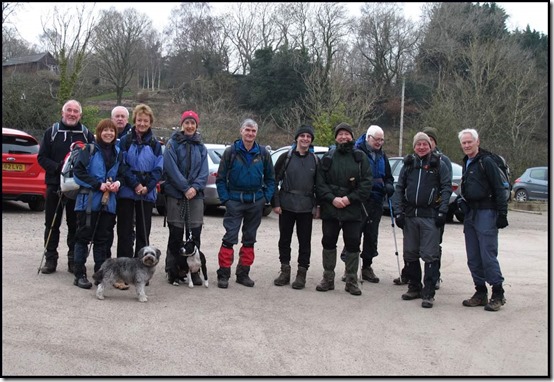
Plodders turn out at Leighton Moss on a cool morning

2. Burton Well supplied water to the people of Silverdale Green for many years, before the roofs of the houses were fitted with gutters and downpipes to collect rainwater, which was stored in tanks. These were in cellars, with hand pumps being used to deliver the water to the kitchen. By then the wells were only used in times of drought, when water carts were used for house to house deliveries.

Our efforts to find Burton Well were hampered by my indecision in choosing a volunteer to lead this section, and having no idea of the route to it myself we finished up in a bit of a pathetic huddle after a while.  When the well did eventually appear (by accident, I fear) it revealed itself as quite a substantial basin surrounded by a slippery brick wall, from which I nearly made a spectacular dive!

(Photos are in the slideshow – there’s a link later.)

3. Bank's Well.

Returning across Lambert's Meadow and over a wooden bridge, we reached an area situated between wooded outcrops of limestone. The northern part of the meadow is dominated by rushes, but the southern area has richer flora and is richly populated by insects in the summer. Once back at the road, on the left hand side is a damp hollow now largely overgrown with trees. The water flowing from Bank's Well has formed a small pond here, in a saucer shaped depression probably lined with impermeable loess.

Roger was now, by popular demand, elected leader for the journey to point 4.  “Where’s the path?” he ejaculated.  In this case the route designer had cunningly made the navigation harder by smothering the path with an ocean of ‘Anquet blue’.

4. Dogslack Well.

However, Roger soon discovered that opposite the pond, a track runs behind houses for 200 yards to reach a pile of stones on the left. If visiting on a night ramble, you may witness a bouncy campervan in this vicinity! At the pile of stones, a hole of about 8 feet has been dug to reach a perched water table. This forms Silverdale's only true well. It supplied water to nearby cottages until 1938, when it was succeeded by a pipe from the aqueduct from Haweswater to Manchester.  Otis and Maude had to be persuaded to show interest…

Otis and Maude at Dogslack Well

5. Eaves Wood. The other side of a minor road, a path leads into Eaves Wood and across the railway, where Bernard led us confidently up what I thought was the wrong road.  It turned out to be the right road.

6. Hagg Wood. After re-crossing the railway and dodging trains for the second time, we came upon the giant Middlebarrow Wood quarry, where a splinter group in need of a comfort break was almost followed by the entire party.  A dampish path then led towards Arnside, passing to the right of Hagg Wood despite Bernard’s inclination to turn left towards Arnside Tower.  “Later Bernard, later!”

7. Arnside Knott. The suburban streets of Arnside, past Conrad’s house but we decided to spare him the stress of an unplanned visit by eleven strangers, (this was the first time Conrad, a fellow blogger, had met any of us) gave way to a steep haul that some Plodders may have found rather demanding if we hadn’t almost fully circled the hill on gently rising slopes before popping out near the top.

Lunch was taken. (I must apologise for the lack of an elevenses stop. “Sack the leader” would have been chorused if anyone had known who the leader was at the time.)  Cake was provided.

Lunch on Arnside Knott (159 metres)

A little further on, Conrad completed his leadership duties by duly delivering us to the 159 metre summit of Arnside Knott.   We had paused along the way to admire the knotted tree that used to be much bigger, and to enjoy the unfolding views of Morecambe Bay, the Lake District and the Yorkshire Dales.  Insofar as they could be seen through the thick cloud that made this lower summit a place of preference today.

The Trig Point just had to be climbed

Rogues Gallery - Roger, Jim, Vi, Otis, Don, Nancy, Bernard, Graham, Hilary, Allan, Maude, Alan and Conrad

We enjoyed our time on the summit, but on leaving it I looked backed to this ghostly sight of a schizophrenic plumber who thinks he’s a barber.  Time to leave!

A ghost of Plodders past

8. Arnside Tower.

Arnside Tower

Walking aids mere deployed by those recuperating from surgery etc* for the steep descent to another minor road, and gently on to Arnside Tower which due to its bulk meant that Roger could again be placed in charge without fear of a myopic error. This prominent ruin is the largest of the pele towers in the district. It was built in C15 as a defence against the Marauding Scots (not you, Hilary). A corner fell off in 1884, since when I’d been told that H&S fears had led to an embargo on entry, but Don assured me that he had climbed it more recently than in 1884, when he was only a nipper.

9. The Pepper Pot.

I’d never before visited this small obelisk on the flat area above Silverdale Jungle. It overlooks Silverdale and was built around 1887 to commemorate Queen Victoria's Golden Jubilee.

The Pepper Pot

It took a bit of finding, but after passing through the extensive grounds of Holgates camp site we took a left beside a wall boundary and eventually came out at the obelisk, half expecting to see Norman sitting on top of it.

10. Elmslack Well.

After descending uncertainly (due to too many path choices) to the track that runs around the lower perimeter of Eaves Wood, a right turn took us to Elmslack Well, situated, to Allan’s surprise, behind a litter bin!

Elmslack Well

11. Cove Well.

Beyond Elmslack Well/Litter Bin, Cove Road leads to...the Cove!

Cove Well is shown on the map, but if you can find it you've achieved the impossible.  This group of Plodders, led by someone good at reading signposts who said “I’ll do 10 to 11”, strode past it with hardly a glance at the thirsty alpacas, who I blame for drying up the well.

However, around the base of the cliff to the left, a small depression in the salt marsh marks the spot of another spring which rises after heavy rain, producing a jet of water of up to 3 feet. This spring arises from the main water table, as opposed to perched water tables from which the other springs arise.

It hasn’t rained recently.  There was no jet of water.

There's a cave at the cove, formed by groundwater circulation. Nancy and I explored it.  It didn’t take long.  Nearby, Red Rake is a prominent vein of red rock running through the limestone cliff to the south. Iron ore was mined here, but the roof of the workings has long since collapsed.

12. Bard's Well. The shoreline route leads to Bard's Well, on the edge of the car park. This was also known as Battling Stone Well, as clothes were washed here and beaten clean against the stones. It stops flowing in dry weather, so its location remains a puzzle to me.  There’s an alternative field route here, as the beach can be tricky when the tide’s in - the first field has never been fertilised and supports a rich variety of flora.  Worth a look in the summer.

13. The Silverdale Hotel is a place of refreshment, but as we passed by at 3pm, and we still had dregs in our flasks, its services were not called upon today.

14. Wood Well.

The old animal basin at Wood Well

A selection of routes (this is Silverdale, there's always a choice) leads to Wood Well, where the water drips from the roof of a small recess in the base of the cliff (see header picture) and is collected in a small trough from which it flows into the large basin pictured above, used originally for watering cattle.  Conrad told us that hawfinches and firecrests can sometimes be seen near here.

15. The Wolf House Gallery. This is a good place to stop, but we weren’t expecting it to be open today, so the fact that it was open took us by surprise.  We headed instead towards the attractions of nearby Gibraltar Farm.

Is that a T20 I see?

From here, a pleasant lane and some coastal paths lead to Cow's Mouth and Jack Scout, where a ruined lime kiln has been restored. Giant's Seat, a large slab of limestone may, if we’d found it, have proved irresistible, so I made no attempt today to locate it.  Instead, we all stumbled along at our own pace before reconvening at the prominent chimney that is all that is left of the copper smelting mill at Jenny Brown's Point, just beyond Brown's Cottages. Birds foraged in the quicksand as we continued on our way beside the estuary.

The beach at Jenny Brown's Point

The chimney remains of the copper smelting plant at Jenny Brown's Point

By now, a low sun kept peeking from below the clouds, and despite a keen breeze it was a delightful walk back to Leighton Moss beside the salt marsh on which I once saw a flock of spoonbills.

Lovely afternoon light by the salt marsh

The walk turned out to be about 19 km (12 miles) with 400 metres ascent, taking less than 6 hours at a very leisurely pace.

Alan R has reported here, and has promised to compile a more considered version from his deck chair in Spain, based on a play on the word ‘Well’.  We’ll see about that…

Conrad has reported here during a brief perambulatory pause.  I’m glad you liked the brownies, Conrad – I should have brought more!

I took quite a few pictures, some of which are available for viewing here.

What a lovely day out.  Thanks for your company, everyone.  My fourth and final plod of this little series of walks is on 6 March, starting in Culcheth, after which Reg resumes his rightful position at the head of the crocodile in Bury on 20 March.

I’m also walking around Bollington (1 March), Alderley (22 March) and I’m repeating the Roaches walk we did in October 2012, on Monday 25 March, by special request from Don, so please do feel free to join us on that walk in particular, which this time will start from the Roaches.  Details of all these walks are here.

* For ‘Plodders’ perhaps read ‘cripples’.  Don and Bernard have recently broken ankles, Conrad has a new knee, and countless others have serious back problems!