Sue and Martin in Mallorca 2019

Sue and Martin in Mallorca 2019
On the Archduke's Path in Mallorca

Monday, 18 May 2020

The 'Radioactive Ramble' - 2 to 5 May, 1986

 
Here's another entry from days past, coincidentally with the same participants as the recent 'Pilgrimage to Portree' in 1994. I've added a few comments in blue.
 
The Radioactive Ramble
 
Friday 2 May 1986 (Author MW)

Owing to Greater Manchester transport I was a paltry 10 minutes late at the Rising Sun. (Queen Street - rendezvous point for weekend trips)

Notwithstanding this,I was later blamed for causing John to wait almost a whole hour for us to pick him up at Carlisle. Spring has only really just broken in Manchester - the last couple of days have been fine. Today has been fair, but a little 'close' and indeed soon out of Manchester we hit rain and then drive into a thunderstorm which comprised one or two flashes of lightning.

Dave (SG) (I think SG probably means 'Senior Gaffer' - Dave was employed in a senior role at CWS) has started off on the wrong foot and is anxiously burbling that he has only 16 shots left and no more film. We stop at Forton to allow him to discharge his frenzy by hunting around the shop for a film but it is to no avail. Will his anxiety increase as the trip progresses, or will it be assuaged, we shall see?

As we left Manchester the news was that the radioactive cloud from Chernobyl was just about reaching the South of England, so at least we are going in the right direction, but it may well catch up with us in the next two days, hence the name of this trip.

We arrived at Carlisle station at 8:30 to find John nonchalantly leaning against the wall. As we drew near, he walked off in the opposite direction, but soon realised his mistake. All aboard, then it was a short trip to the Little Chef feeding ground renowned for its pancakes.

After a marathon effort by MB we arrived at Ardlui campsite 12:05 am. Thankfully not raining as we deploy tents in the dark with only one torch between us. (Supplied by SG.)

MW is very annoyed as he put his ice axe through his flysheet - causing a sickening ripping sound. Fortunately not in a critical place, and easily mended.

Rather a noisy team on the site tonight. A young lass wandering around with a bottle of wine greeted us thinking we were more of her party. I don't know why people need to shout at each other to have a conversation at this time of night - it's most antisocial. I hope they don't go on for too long.

As we sleep the menacing radioactive cloud draws.....

During the night there is an eerie plaintiff moan that pierces the now peaceful site ... filllmmm....

A spirit in torment.

Postscript (DS) I must record that before he went to sleep MW made horlicks on his primus while the rest of us just crashed out.

Saturday 3 May - Two Days to Doomsday (DS)

We all woke up early in the morning to hear the army next door still talking. Perhaps they talked all night. Martin was about to brew up when it was realised that it was only 6 am.
Back to sleep for another hour. Up fairly quickly. Hurried breakfast. Martin (I was only 10 minutes late) found he had lost his porridge, this leading to a plaintive eerie tormented radioactive moan from his stomach.
After John had gone to find man to pay (he woke him up and got a receipt for April), we set off and soon stopped at Tyndrum. Dave got some film and Martin got some porridge. Martin B was stopped from brewing up and contented himself with sniffing tea bags.
 
 
Travelled on to Victoria Bridge along a most unlikely looking 'A' road (A8005) - single track, no passing places, but a nice surface.

John was packed within 10 seconds of parking the car, but Martin (who had no beard two days ago) did a 'Laurie/Nick Gray' (absent team members who are renowned for their faffing) and spent a long time packing a large looking rucksack. He blames it on his winter sleeping bag.

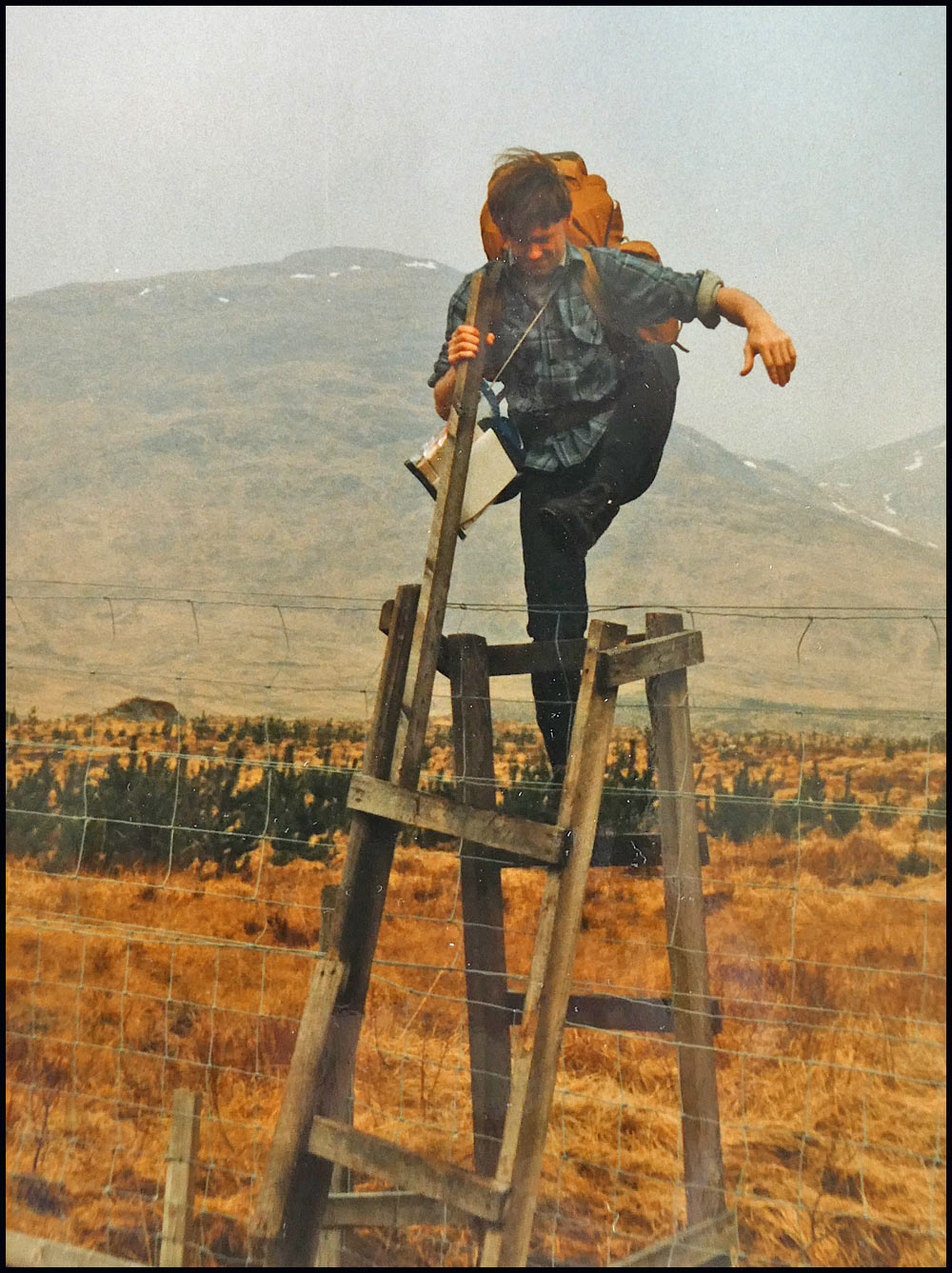
Set off from forest Lodge, west along Linne nam Beathach and the slow gentle ascent towards Loch Dochard. This walk in was marked by frequent stops and interesting stiles and bridges. Dave (me) made a much photographed mess of going over a very dodgy high stile. John described my crossing as a Right Pig's 'Ear of a Sow'.

Martin W displayed city attitudes in his testing the strength of a suspension bridge (which, unless it has been replaced with an identical bridge, has stood the test of time!)


We stopped near Point 289 (on our old map, but not on my current maps - NN 201 411) on the path having left Loch Dochard behind. Martin W was only a paltry 10 minutes behind. His excuse this time being that he had met two day walkers and stopped for a chat. "It's a fine day Laddie, etc, etc..."

The weather has been getting warmer and is muggy, with a gentle east wind at times. Visibility up high is not very good. Brew of tea and much eating.  Two walkers pass. Conversations about news on TV and in newspapers.

Carried on to an amazing suspension bridge which worried most who crossed it yet seemed perfectly ok. Again many photographs.


Turned NE up the glen that goes past and to the north of Beinn nan Aighenan (957 metres). That, John says, should be pronounced 'Ainan' (silent gh as in dh). He further stated (authoritatively) that the i before the gh is only there because of the e after the gh. He is now saying that the spelling doesn't conform to the rules.


More frequent stops as we contour, gaining height. Eventually John and MW power on and Dave and MB arrive at the col a good though paltry ten minutes after the others (no excuses). There was a sharp climb at the end.

Here we had a quick brew, parked our rucksacks, and walked up Beinn nan Aighenan - the mountain with the badly spelt name. Quickly into the mist, and it began to get slightly damp and windy. Up at the top we had three self-timed group photos, with John not bothering. He was very cold.
 
 
This is the first Munro of the trip. The journey down was excellent. Very quick. We half run down the soft snow most of the way. At the bottom, MB's foresight in wearing gaiters for this peak paid off.

Continued down to find a campsite and found one very quickly. Tents quickly up. John went some way to get us some (safe) water. Very cold on the hands. Slight drizzle began as we put the tents up. Leisurely cooking and eating of meals.
 
 
John had corned beef and smash - (again). MB had paella (again). and Dave had beef stew and chocolate mint Angel Delight (with real milk). MW was in his own tent (to escape the farting) so I don't know what he had.* Everyone in bed by 8:30 - knackered.

* Lentil stew with Bulghar Wheat, then dried fruit and custard - yum! (MW)
 
Note: This report conforms to the standard of truth, honesty, accuracy, independence and objectivity, as defined by BBC/ITV news.
 
PS Fashion Note: MB looks very chic in his green duvet vest - very 1983. (Green Ultimate Equipment gilet - still going strong in 2020.) russian note
 
PPS Status Note: John's a gaffer but Martin B is a senior gaffer - he also has difficulty leaving work habits where they belong.

Sunday 4 May (JM)
 
A good night's sleep. We are in the cloud at 8 am. By 9:15 the cloud is lifting (we are still in our tents).
We set off for the bealach between Glas and Bheinn Mhor and Ben Starav at 10:05, and arrive there at 10:40. On to Ben Starav at 11:40 via a knife-edge. Pause for photos.


Off via a snow slope, and back at the bealach and our rucksacks at 12:10. For the last 2 hours the cloud has been well above the mountains, and there is some sunshine and a brisk westerly breeze. Pause for lunch.

On Glas Bheinn Mhor at 13:25. Off again at 13:40. Pause for lunch. There seems to be more cloud than sunshine now. Next peak we are aiming for is Stob Coir' an Albannaich, which, from this (windy) bealach, looks like a hard slog. Set out at 14:20. On top 15:05. Weather is still holding. At the bottom, en route for Meall nan Eun, it certainly isn't.

Stob Coir' an Albannaich vanishes from sight. On top of Meall nan Eun for 16:40, and it is not raining. Meall nan Eun is quite breezy (SE breeze it seems); and Stob Coir' an Albannaich is visible once more.
 
 
Off the hill by 17:30 to look for a campsite. Pegs in by 18:00. The weather is still quite good, but the breeze is quite brisk.
 
Clarification: (MB)

1. Dried fruit and custard is not eaten as such. "You soak it and it goes soggy" - MW.

2. He who had a beard two days ago was MB. MW had a beard two days ago - and any day you care to mention over the past 10 years, except yesterday and today. (And there was no hurry.)

3. "Lunch" is a frequent occurrence throughout the day. It means "ate food".
 
(MB) Variable weather for rest of the evening.
Smelly tent.
Tussocks.
MW comes for a tea bag party, and makes the tea.
Pleasant gurgle of the river a few feet away should lull us to an early kip with no difficulty.
 
 
Variable light as early as 8 o'clock. MB's camera bust.
 
Monday 5 May (MB)
 
After a bumpy night John brewed up at 7 am and we arose. There is a view today and scraping sounds from next door. John confesses to having had nightmares. Dave combs his hair to demonstrate his application of work attitudes to the trip. A bit of rain and wind in the night.

Off by 8:30. I donned waterproofs to contend with the drizzle but the others didn't don theirs until we reached the end of the initial slog up Meall Odhar (876m).

A tramp along the ridge to Stob a' Bhruaich Leith (940m), and a steady radioactive shower was falling. Not very warm.

Considering the weather, visibility very good, with views towards Glencoe, and cloud level above 3000 feet, although by the top of Stob Ghabhar (1087m) we had entered the cloud.
 
 
Interesting ridge off this hill, but we didn't risk going over the cornice to maintain height towards Stob a' Choire Odhair, an outlying Munro (really a separate mountain). Instead we came off the nose, which was in itself precipitous, although a gully to the right made it into an easy scramble.

We then contoured round very satisfactorily to a stalkers path for the descent to Victoria Bridge, by 2 pm, after various 'relief' stops.
 
 
Saw two people on the hills all day, and only about ten the whole weekend. A reasonable tally of six Munros, and an easy journey to get John to Carlisle, but a traffic jam between Forton and the M61 prevented further speedy progress

Pleasant meal at the Asia for me and Dave.
 
 
Here's our route - 45 km with about 3000 metres ascent. Click on image for a better version.
 

Sunday, 17 May 2020

New Zealand Revisited (9)

 
With 1257 images now in a properly indexed and labelled state sufficient for Sue to compose a Photobook, here are images from our last five days in New Zealand.
 
Hasn't it gone quickly!
 
On 8 March 2008, some forest paths with occasional views kept us entertained. The tree pictured above was somewhat of a curiosity.
 
Globetrekkers Lodge in Omapere proved an excellent spot from where to view the sunset on 9 March.
 
 
We saw some massive Kauri trees on 10 March. Some exceed 50 metres in height, with a girth of over 13 metres, They are over 1200 years old.
 
 
We made our way to stay with Sue's mother's cousin Barbara in Auckland, and on our last day in New Zealand, 11 March, we enjoyed a walk on nearby Piha Beach.
 
 
On 12 March we dumped the Silver Bullet and flew home via a five hour break in Singapore.
 
 
I hope readers enjoyed that little NZ interlude. I did, anyway. Back to 1986 next...

Saturday, 16 May 2020

New Zealand Revisited (8)

 
I've taken a break from NZ today, with only five days being 'processed'. I'll finish the job tomorrow.
 
From Rotorua we travelled to the Coromandel Peninsula on 3 March, stopping for a long break at Karangahake Gorge, where we explored paths and tunnels associated with gold mining between 1875 and 1920.
 
4 March was a wet day. We found some shelter in Cathedral Cove.
 
 
Blue skies greeted us on 5 March, when we headed to Black Jack Lodge near Knoatunu, which had been recommended by folk at Moana Lodge in Wellington. Here, Carl and Carol offer 'sit-on' kayaks on which you can paddle from their lawn up a river or into the sea. We did both; most enjoyable.
 
 
A 438 km drive on 6 March took us to the Bay of Islands. We stopped en route for a comfort break at some quirky toilets built by Frederick Hundertwasser.
 
 
We stayed at Mayfair Lodge in Paihia for three nights. On 7 March Sue went scuba diving and I enjoyed a bike ride that passed Haruru Falls.
 

Friday, 15 May 2020

New Zealand Revisited (7)

 
The Waitomo Caves, visited on 25 February 2008, proved to be quite an adventure, with some flooded passages and some tight squeezes. The wetsuits proved invaluable.
 
On 26 February, we embarked on the Tongariro Northern Circuit, hiking in to the Mangatepopo Hut, from where we enjoyed a glorious sunset.
 
 
27 February - after an early start to climb Mount Ngauruhoe, we moved on to Mount Tongariro, from where this picture back to Mount Ngauruhoe (of Lord of the Rings fame) was taken.
 
 
Our third day on the circuit, 28 February, started from Waihohonu Hut.
 
 
Sky diving in Taupo gave Sue a thrill on 29 February.
 
 
A rainy day on 1 March saw us cheering on the participants of an Ironman Triathlon.
 
 
We moved on to Rotorua, where on 2 March we admired the Devil's Bath from a safe distance.
 

More progress across the North Island will be made tomorrow...

Thursday, 14 May 2020

New Zealand Revisited (6)

 
It has been another productive day for photo processing, and I'm enjoying selecting one picture from each day for these rather rushed postings.
 
On 16 February 2008 we found ourselves in Renwick, wine producing country, so we lunched - with copious amounts of wine - at Framingham, a Marlborough winery (above).
 
By 17 February we were in Nelson, admiring the stained glass windows from within the rather odd looking cathedral.
 
 
Our next adventure, starting on 18 February, was a three day kayaking trip on the Abel Tasman coast.
 
 
It was an organised trip, with good guidance and good food. Here we are on 19 February, awaiting our evening meal.
 

The trip continued into 20 February, when we took a short break on the beach at Pitt Head.
 
 
Kayaking over, we moved on to Picton, from where on 21 February we walked a short but scenic section of the Queen Charlotte Track, which yielded some fine views.
 
 
22 February marked our crossing to the North Island, with this 'sun dog' impressing us at one point.
 
 
The botanic garden in Wellington kept us occupied for a few hours on 23 February - the flower below is an 'August Koch' water lily.
 
 
On 24 February we left our Wellington base - Plimmerton - pictured below at the start of a rainy day, and headed to Rap, Raft 'n' Rock bunkhouse, near Waitomo Caves
 

Wednesday, 13 May 2020

New Zealand Revisited (5)

 
It has been another productive day of 'processing' images from New Zealand.
 
Starting above, on 7 February 2008 Sue and I enjoyed a kayaking trip in Doubtful Sound, curtailed by poor weather, but I'm not sure how well we'd have fared with the sandflies had we gone ahead with the planned camp!
 
On 8 February we moved on from Te Anau to Wanaka, via Kingston, where this picture of the Silver Bullet Grey Slug, our hire car with 134,000 km on the clock, was taken.
 
 
On 9 February we were to be found in the Matukitubi Valley, where we were befriended by this Kea bird.
 
 
The next day, 10 February, was spent on several excursions from Wanaka, including one to a toy and motor museum. The toys included a Lego village from the 1980s identical to one that resides in our loft, and the cars included what I think is an Austin A40 Devon Estate car.
 
 
My first trip to Scotland, in September 1968, was in one of these. We managed about 40 miles a day, picking up spares and carrying out repairs from time to time. NAM 648 is pictured below outside our rented two-up/two-down house in Levenshulme (where the only taps were in the kitchen sink and the lavatory was at the end of the back yard) on the day that Howard (RIP) decided he could no longer afford to keep it and so - minutes after this photo was taken - took it to our local scrapyard.
 
 
On 11 February we moved from Wanaka to Franz Joseph, going via a walk to Monro Beach on an over-sanitised path through rain forest.
 
 
Franz Joseph Glacier, which since 1970 had been advancing, proved elusive, but the mist on 12 February did clear briefly, late in the day.
 
 
The road from Franz Joseph to St Arnaud, a 500 km journey in the Silver Bullet (now with a chipped windscreen) took us past the Pancake Rocks at Punakaiki on 13 February.
 
 
The next two days were taken up with the Angelus Hut Loop, where we saw some interesting flowers, this one on 14 February.
 
 
It rained, and on 15 February we had a few torrents to cross before making our way slowly back to the Travers-Sabine Lodge in St Arnaud.
 
 
That's it for today, when in other news, and thanks to a slight relaxing of lockdown rules, we enjoyed an unexpected encounter with JJ, who kindly donated two boxes of tomato plants in return for some tea and cake. Thanks JJ.

Just in case you were thinking of going somewhere interesting...

 
I very much doubt that any readers of this blog would contemplate going anywhere 'interesting' at this time, but you never know. The text below has certainly killed off any thoughts I might have had about going for a walk or ride in the Peak District. Thanks to Conrad, who lives a bit nearer to the Lakes, for publicising this:
 
This is a copy of a Facebook page for Coniston Mountain Rescue.
It is worth reading in full and disseminating widely in the outdoor community.  
Hello All,
Hopefully, you’re all managing to stay safe and healthy through the Covid-19 pandemic.
We know that many of you will be desperate to get back on the fells and trails, and to get your Lake District “fix”. The relaxation of the Coronavirus lockdown may have been music to your ears when the Prime Minister stated that it is now Ok to drive any distance to take your exercise. This came as a total surprise to us as a Mountain Rescue Team (MRT), Cumbria Police, Cumbria Tourist Board, The Lake District National Park and also The National Trust. Simply, the Lake District is NOT ready for a large influx of visitors. The hospitality sector remains closed, some car parks may be re-opening, along with some toilet facilities, but this is an enforced opening due to this announcement to cater for those that do decide to come, rather than an invitation.
Why are we, Coniston Mountain Rescue Team, so concerned about the relaxation of the travel to exercise rules? Maybe if we talk you through what happens it may explain why we’re worried.
Firstly, we are all volunteers – most of us have day jobs from which we take time off to deal with incidents during work hours, or time out of the rest of our lives “out of hours”, and secondly most of us have families who we need to protect.
How a rescue might play out during the Covid-19 pandemic:-
1. Paul and Sarah came up from Preston, and have summited the Old Man of Coniston, had their lunch and set off down towards Goats Water.
2. Paul slips and hears a crack from his left ankle, Sarah tries to help, but Paul can’t put weight on his ankle which is at a funny angle anyway. Paul is 15 stone and 6ft 2 tall. Sarah is fit but no way could she help Paul back down.
3. Sarah dials 999, remembers to ask for Police and then Mountain Rescue, the operator takes the details and asks a lot of questions to assess the Covid-19 risk posed by both Paul & Sarah to the MRT, and subsequently to Ambulance and medical staff that will need to treat Paul.
4. In the meantime, four groups of people come by, they all say they’d love to help but haven’t got any Personal Protective Equipment (PPE) and must socially distance themselves by at least 2 metres.
5. The Police alert Coniston MRT to the incident via SARCALL, and the Duty Team Leader (TL) calls Sarah, having sent her a link by text for her to click on to confirm their exact position, and asks more questions, to work out the resources needed.
6. The TL then calls other members of the Leader Group to discuss the requirements and decides a 10 member group is required on the hill and alerts the Team to that requirement.
7. The Team numbers are depleted anyway, we have a number of people who contribute massively to the Team generally but are over 70 years old, i.e. higher risk group, we have people who may be shielding a family member, or at risk themselves due to underlying medical conditions that normally wouldn’t be an issue. So a team of 10 assemble at the MRT base, plus someone to run the base – this person is important as it helps with coordination of other services letting the hill party get on with the job.
8. All members are briefed regarding the incident, and check all are happy with the unknown invisible risk posed by the incident; the risk of walking up the fell is taken as read and a baseline anyway. All PPE is checked.
9. Team members climb aboard two of the Team’s three vehicles. Why only two when social distancing could be better in 3 vehicles? The need to decontaminate the vehicles on return probably outweighs the advantage of social distancing, and it leaves another vehicle able to respond to any other incidents.
10. Normally the Team would mobilise within 10-15 minutes of this type of call, due to all the pre-checks, personnel checks etc., the time elapsed thus far is 45 minutes.
11. The vehicles arrive at the road head, one last check on PPE and kit for the incident, including radios, and the Team sets off for the casualty site. Walking time to site is around 45-60 minutes.
12. The Team can’t call on the Air Ambulance for support as they’re off-line for this type of incident due to staff being redeployed elsewhere in the NHS or due to other priorities and risk factors so cannot support. Similar with Coastguard Helicopters…
13. On site, one casualty carer and one assistant will approach the casualty with as much PPE on as possible, and may well apply PPE to the patient before carrying out a full primary survey, in this case that’s simple, Paul’s ankle is (probably) broken, and there are no other underlying medical factors like a head injury, multiple other injuries or catastrophic bleeding.
14. The casualty carer and helper would normally give Paul some Entonox (pain killing gas) while they straighten his ankle to ensure a pulse at the foot and also maybe a pain killing injection. The injection takes 15 mins or so to work, but Entonox is not given because of the potential risk of contamination. However, the foot needs straightening ASAP to restore the pulse in Paul’s foot. Paul screams as the casualty carer re-aligns the foot (it’s called reducing the injury) to restore circulation and allow for splinting.
15. Paul’s ankle is splinted and although he’s still in pain, it’s less than it was and the painkilling injection is starting to take effect. Time elapsed since Paul fell is now 2 hours 15 mins.
16. The Team moves in and helps Paul on to the stretcher, the stretcher is made of stainless steel and heavy, it is about 2.5 metres long and maybe 0.6 metres wide, usually it takes 8 people to carry a loaded stretcher, they cannot socially distance.
17. The Team carries Paul down to the Walna Scar road, where they’ve asked a North West Ambulance Service land ambulance to meet them to reduce potential contamination at base. The carry down has taken 2 hours, so now it’s 4 hrs 15 since Paul fell. Paul is transferred to the Ambulance and taken to Furness General Hospital. Sarah can’t drive, but can’t go in the Ambulance either. How can the Team get Sarah re-united with Paul and then how do they both get home to Preston when Paul is fixed? What happens to their car? In normal circumstances we can fix these issues, not so easy in the Covid-19 pandemic.
18. The Team returns to base and starts to decontaminate the stretcher, the vehicles, the non-disposable medical equipment, the splint and themselves. Jackets and other clothing are all bagged ready to go in their washing machines when they get home, which takes a further 1 hour 15 minutes. Total time elapsed 5hrs 30 minutes. Total man-hours 10 folk on the hill plus 1 running base = 60.5 man-hours.
19. Paul is admitted to Furness General Hospital after a wait of 1 hour at A&E. He is taken to cubicles and X Rayed to understand his ankle injury better. He is also routinely tested for Covid-19. Paul’s ankle needs an operation to pin it as the break is a bad one.
20. Paul’s Covid-19 test comes back positive. Oh dear! Paul is asymptomatic, he has the virus but is either naturally immune or has not yet developed symptoms. The message is passed back to Coniston MRT, who then have to check the records of those on the incident. Every one of them, the ten people on the incident and the base controller, must now self isolate and so must their families, so now we have maybe 35 people all having to self-isolate. Plus possibly the Ambulance crew and their families.
21. Three days later Eric from Essex decides he wants to come to Coniston to do the 7 Wainwrights in the Coniston Fells. He sets off, and completes Dow Crag, the Old Man, Brim Fell along to Swirl How and Great Carrs and across to Grey Friar, then on up to Wetherlam. Eric puts his foot down on a rock, the rock moves and Eric is in a heap on the floor, his foot is at a funny angle…he gets his phone out and dials for Mountain Rescue… but there are only three people available from the Coniston Team now, so the decision needs to be taken by the Coniston MRT duty leader which Team to call to support, Neighbouring Teams are Langdale-Ambleside and Duddon & Furness MRT’s. The issue is, they’re in the same situation as Coniston with people self-isolating due to potential contamination, or their members are keyworkers in the NHS and can’t deploy on MRT incidents.
So – we’re asking you to think twice, even three times before you embark upon travelling to the Lake District for your exercise. The risk, however small, is real, and I write this as an MRT member for over 30 years with probably around 1000 incidents under my belt, I know, accidents happen.